
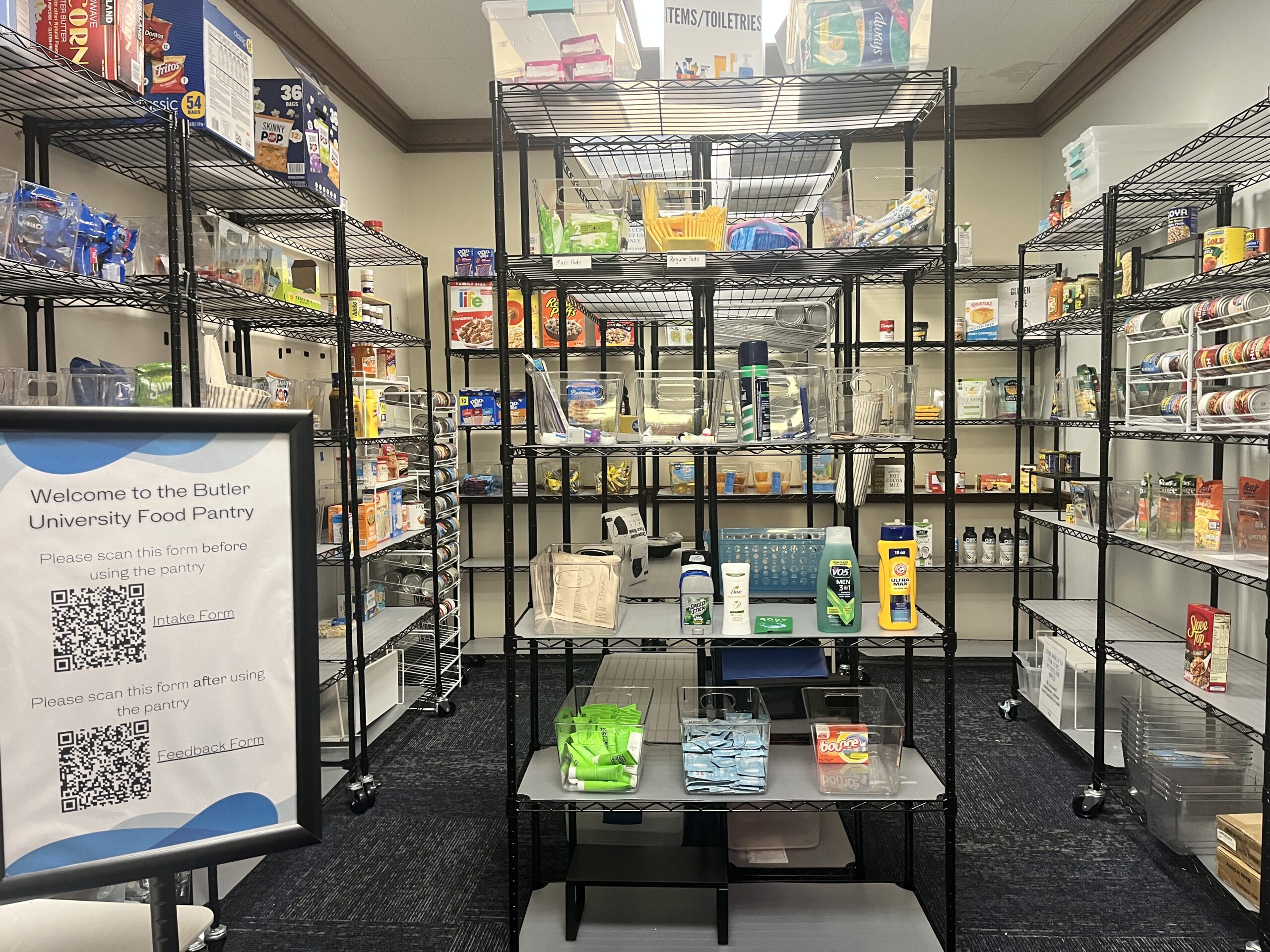
Halt of SNAP funding will put more than 40 million Americans without food stamps. Photo by Elliot Muehlhausen.
ELLIOT MUEHLHAUSEN | STAFF REPORTER | emuehlhausen@butler.edu
Starting on Nov. 1, Supplemental Nutrition Assistance Program (SNAP) benefits on Electronic Benefits Transfer (EBT) cards were no longer funded due to the government shutdown. Over 40 million Americans are signed up for SNAP, putting more than a tenth of the country without extra financial support.
A federal court case, brought forward by North Carolina Democrats, challenged the Trump administration’s failure to access the emergency budget. The court decided that President Trump was required to use the spending. Despite the court’s order, Trump has announced that he will not use this spending until the shutdown is resolved.
Indianapolis Mayor Joe Hogsett has stated that Indianapolis will help provide food and money, but there is still a need for donations and community involvement.
In Indiana, over 600,000 people are on SNAP benefits. SNAP is divided among individuals on a state level, with each state designating how to distribute and who qualifies for it.
In order to be eligible for SNAP benefits in Indiana, as a single-person household, there is a net income monthly limit of $1,305. Households of all sizes have a $5,000 asset limit, including vehicles, bank accounts, real estate, personal property and cash. If a single-family household makes less than the net income limit, then you can be eligible for up to $298 of SNAP benefits a month.
Keaton Smith, a junior history and political science double major, is the technology coordinator of the Volunteer Opportunity Council (VOC), the organization in charge of Butler student civic engagement. One of the main institutions of the VOC is the Butler Food Pantry in Atherton Union, room 301.
The Butler Food Pantry is a place for students and community members to find “shelf-stable” food. The VOC also runs a second pantry located in Founder’s College on South Campus. Smith explains that there are many ways that students can help support the community, including donating to Butler’s food pantries.
“The best donation option would be anything that’s individually packaged and non-perishable,” Smith said. “At the moment, I would say shampoo, conditioner, deodorant and snacks.”
Smith discussed his concerns about the politics of the shortage, having worked with the food pantries on campus.
“[The VOC] can’t make a partisan statement, but for my own personal statements, it’s extremely concerning that the Republican Party thinks it’s morally acceptable to starve American citizens in exchange for political goals,” Smith said.
Many of Butler’s neighbors will be heavily affected by these issues. The MLK Center, located on 40 W 40th St., looks to help support four different neighborhoods throughout Indianapolis by hosting community spaces and clubs and providing assistance to those in need.
Advocacy and engagement director Mary Dicken and family and community director Terrance Sanford of the MLK Center are both conscious of the importance of SNAP and how its halting will affect the greater Butler community.
They both agree that there are many misconceptions about SNAP.
“[An] application process for SNAP [is] not easy. It’s a complicated process. It’s not easy to get. And even to qualify, you have to be extremely poor,” Dicken said. “Statistically, of the SNAP recipients, the majority of them will be working adults.”
SNAP benefits are limited to what individuals can buy. Using their EBT cards can only purchase foods such as meat, fruits and snacks. Items that are not available are things like alcohol, vitamins, medicines and toiletries.
“[There’s concern] these people are using it to buy junk food,” Smith said. “Well, rich people still buy junk food: we don’t critique it when they buy it, but as soon as someone wants to enjoy the same luxuries that a higher class wants to enjoy, then suddenly it’s a problem.”
The largest racial group on SNAP is Caucasian, making up 35.4% of recipients. Another heavily affected group is current military officials and veterans. There are over 1.2 million military veterans and thousands of military families on SNAP, including officials whose pay has also been suspended due to the government shutdown.
“The average person [on SNAP] is 65 and older — [it’s], a lot of seniors, [and lots of] families with children,” Sanford said. “Stereotypes will tell you only African Americans or people of color [are on SNAP], but that’s far from the truth.”
The MLK Center serves hot meals and snacks to students after school, but does not function as a food pantry. Neighbors looking for more support are referred to Mid North Food Pantry, Boulevard Place Food Pantry, local churches and the [Indianapolis] Urban League.
Donations and financial support allow for short-term food shortage solutions, while long-term solutions require more action, according to Dicken.
“Calling up your elected representatives and saying, ‘I care about [SNAP], this is not okay,’” Dicken said. “Making your voice heard, I think, matters a whole lot.”