
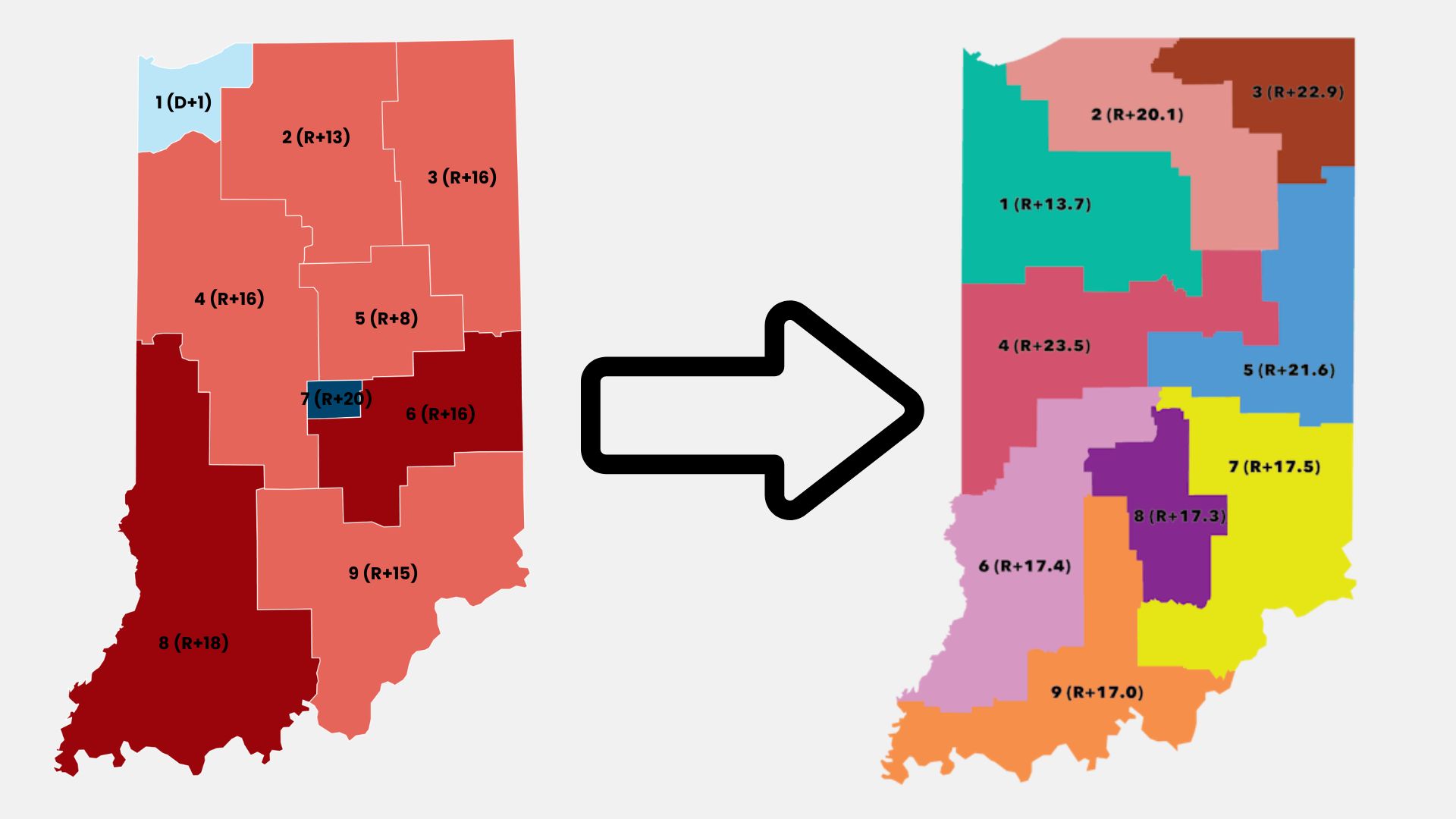
Proposed redistricting would split Marion County from two to three different districts. Photos courtesy of CNN and Cardinal Media. Graphic by Lily O’Connor.
ELLIOT MUEHLHAUSEN | STAFF REPORTER | emuehlhausen@butler.edu
CHASE MENDYGRAL | STAFF REPORTER | cmendygral@butler.edu
Vice President JD Vance visited Indiana lawmakers on Oct. 10, attempting to persuade them to consider redrawing Indiana’s congressional map. In order for the redrawing to occur, a special session must be called by Governor Mike Braun, where the change would be voted on.
This is the outcome of a nationwide movement from the Trump administration to redraw districts in an attempt to win seats for the 2026 midterm elections.
Redistricting is outlined in Article One of the Constitution, Section Two. It is framed to be done every ten years, when the census is collected. The last nationwide census was completed in 2020, with Indiana’s maps being redrawn in 2021.
Assistant professor of political science Rhea Myerscough helped clarify and explain the redistricting process.
“State governments are in charge of [redistricting], [where they] engage in a process — adjusting the lines — [with the] main purpose to account for population shifts over the past ten years,” Myerscough said.
It is uncommon for redrawing to happen in non-census years, but there is no ruling against this in the Constitution. Court cases constantly debate on the legitimacy of redistricting and the Voting Rights Act.
The Voting Rights Act of 1965 was signed by President Lyndon B. Johnson, which prohibits racial discrimination in the voting process. It has allowed for more representation of people of color throughout the country.
The part of the Voting Rights Act under attack is Section Two, which allows redistricting based on race, with the intent to represent Black, Latino, and other minority populations. White voters in Louisiana claim this is racist towards white people, and it is currently under trial as Louisiana v. Callais.
If Section Two is struck down, protection of voting rights, especially for Black Americans, will be at risk. This would have an impact on legislative, school boards and other elected official positions.
Alia Grimm, a sophomore political science major and president of Butler’s Turning Point USA chapter, supports the republicans redrawing, but also understands the difficulties of being a minority party within a specific state.
“I’m from Illinois, where gerrymandering is a huge issue,” Grimm said. “As a republican, it’s hard to see other people’s voices, in a way, be stripped away.”
Grimm expects the redistricting to turn Indiana “into a republican powerhouse”. If the proposed map is accepted, it would eliminate the two seats primarily held by democrats, leading republicans to hold all nine.
Dylan Noble, senior political science major and president of the Butler University College Democrats, is against all forms of gerrymandering.
“As a Democrat, I do not want [Indiana to redistrict in a] purely partisan way, but in a fair way,” Noble said. “Ideally, our government should be a republic and a democracy; having a one-party state that is totally controlled by one group, with no input from the minority, is not really a democracy.”
Mysercough, Noble and Grimm can all agree that Butler students should care about congressional redistricting, especially natives of Indiana.
“I think for a lot of students, it’s really hard to see this as anything but toxic, illegitimate and unfair,” Myerscough said.
If the proposed map comes to fruition, Democrats in Indiana would have no congressional representation.
“[Indiana Republicans are] on a bit of a time crunch,” Noble said. “[Redistricting] would have to happen more or less by the end of the year … We basically have like a month and a half to see if this [happens].”
It is expected that a decision by Governor Braun will be made in November.
The Butler Collegian will continue to report on this story.