
Content warning: contains mentions of sexual violence and abuse.
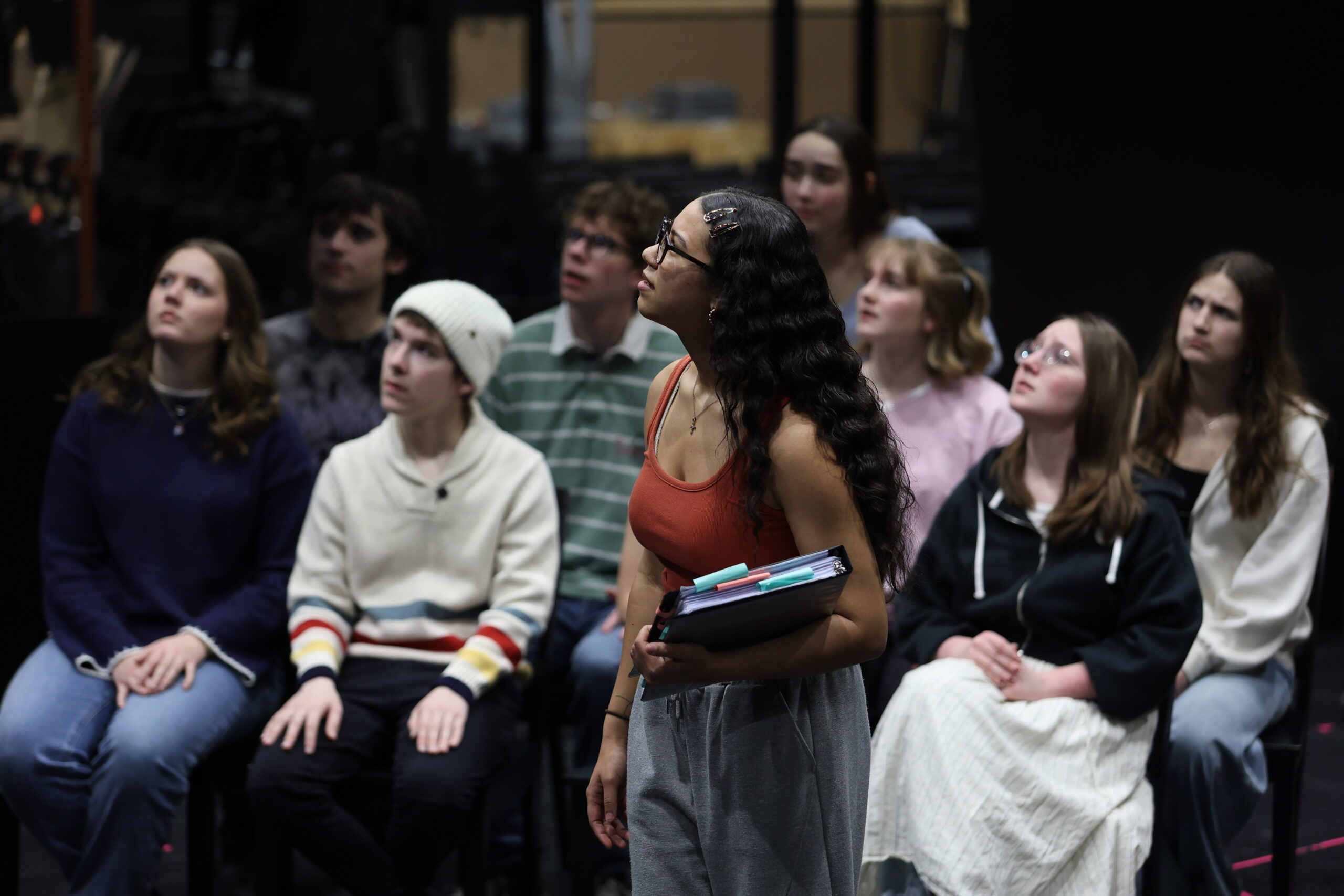
Delicate, witty and powerful, “Lorena: A Tabloid Epic” is a show that will challenge how one thinks about sexual violence, media coverage and authentic storytelling. The show will run from Wednesday, Feb. 25 to Sunday, March 1 with performances at 7:30 p.m. nightly and one matinee performance on Sunday at 2 p.m.
The production tells the tale of Lorena Bobbitt, an infamous case of a woman from the early ‘90s who cut off her husband’s penis after enduring years of rape and physical abuse. In an unusual yet dynamic way, the show details the trial, the following media frenzy and the lasting effects of a society that blames victims of abuse.
While Bobbitt and the cultural craze are all real, the play is a fresh take on Bobbitt’s tabloid story. In fact, “Lorena” has only been presented once before, as a senior thesis project at Boston University. Butler Theatre is the second program to ever showcase a full production of the show, and even had the unique opportunity to discuss the story with the playwright herself, Eliana Pipes.
Andrés López, who is both an assistant professor of theatre at Butler and the director of “Lorena”, described the experience of meeting with a playwright like Pipes.
“It was very reaffirming and invigorating,” López said. “When the playwright is still with us, there’s a little extra care [and] extra attention that [you take]. You want to make sure you are bringing their vision to life as well as your own and doing their play justice.”
For actors, the experience of putting on a production that is in its infancy has been a welcome challenge. While actors normally might have the chance to study other renditions of their roles, in the case of this show, this was impossible. Instead, actors had to search for elements of their characters through personal research of the real-life personas they played.
Izel Valdiosera, a junior acting major who plays the part of Lorena Bobbitt, emphasized the extensive amount of work that went into preparing for her role.
“I’ve never done a character study before, so I [watched] the documentary [to] see how she talks,” Valdiosera said.
Not only did Valdiosera have to research the mannerisms of the real life Lorena Bobbitt, she also had another challenge — the play is told with intermittent fourth wall breaking by a character known as “The Playwright.” As Lorena’s story is told, “The Playwright” interrupts scenes, crumpling up pieces of paper and re-writing the story as it progresses. Through this method, a back and forth dialogue appears between Lorena and “The Playwright”, providing a creative demonstration of what it means to truly capture someone’s story.
Valdiosera described the mental gymnastics she had to do in order to perfect her character, who is simultaneously a representation of Lorena Bobbitt and “The Playwright’s” interpretation of who Bobbitt as a figure in the media is.
“Once I got the script in front of me, I [realized that] this [was] different, because [play Lorena] doesn’t really know what happened to her, and she is what ‘The Playwright’ thinks Lorena is,” Valdiosera said.
While the play-within-a-play structure provides an interesting composition to the work, one of the best features of the show is its ability to delicately balance humor with a story as painful as Bobbitt’s.
Kaya Howell, a senior theatre major who plays the role of “The Playwright”, explained how “Lorena: A Tabloid Epic” weaves elements of comedic relief into the play.
“The balance is about keeping the integrity of [Lorena’s story] and what happened [while] not overshadowing that with the comedy or the laughs,” Howell said.
Howell illustrated that meeting with Pipes was one of the most helpful points of guidance in creating a poignant yet humorous piece.
“She talked a lot about how she likes to use comedy to bring people in, because a lot of what people receive well [are the] funny moments; [the] things that they can laugh at,” Howell said. “It makes them feel comfortable, but [still has] the serious story and [doesn’t] lose the depth of it with the funny moments.”
When a woman’s story is taken and made into a scandal, she becomes commodified, a part of media culture. Lorena Bobbitt’s story is just one of those moments in history — and is a prime example of what happens when a person is placed in the spotlight of a culture that lacks concern for the well-being of its victims.
“Lorena: A Tabloid Epic” will premiere on Feb. 25 in the Lilly Hall Studio Theatre. Tickets can be purchased online.