
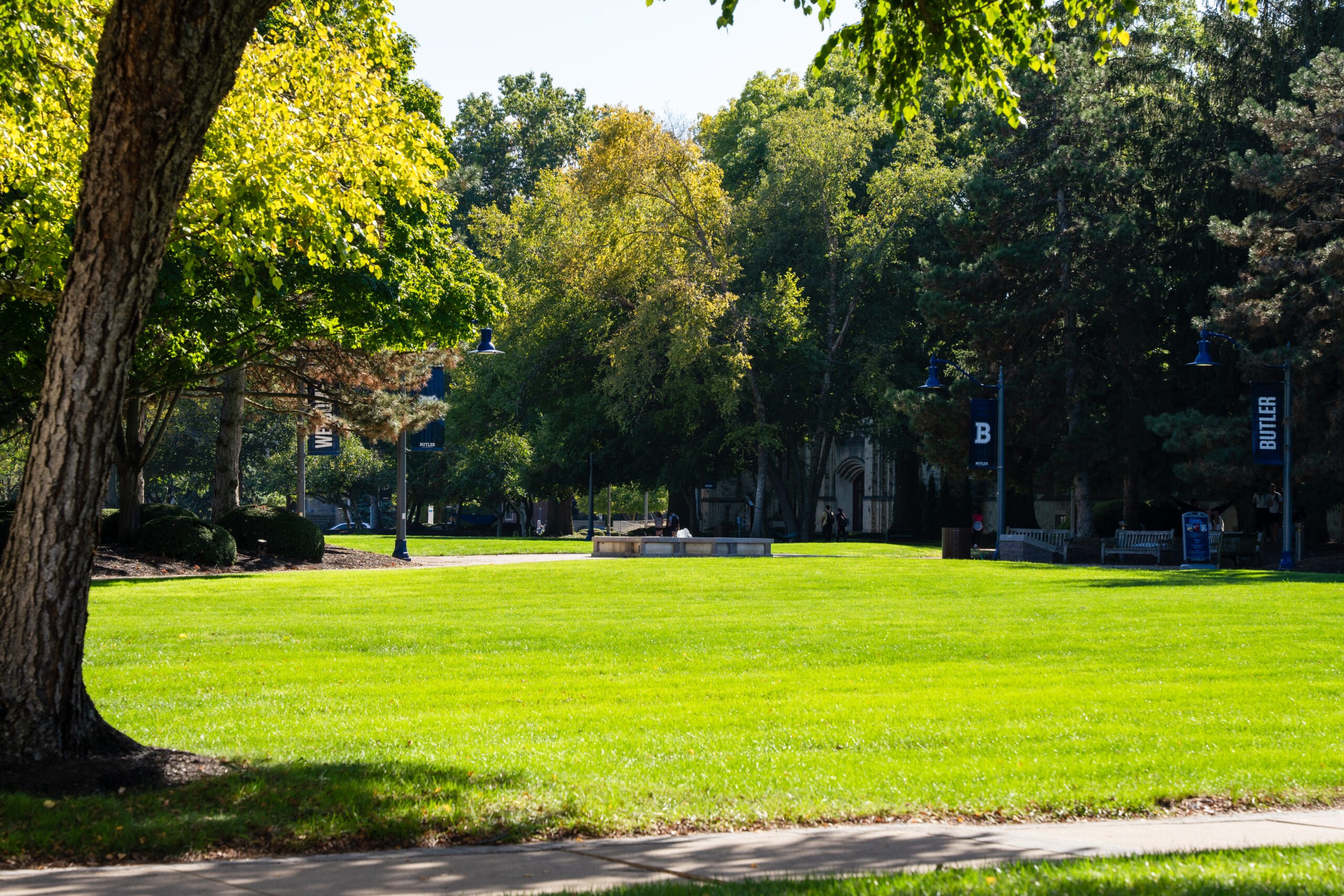
With five years until 2030, there are campus-wide initiatives to inspire sustainability. Collegian file photo.
LAUREN FISCHER | STAFF REPORTER | lrfischer@butler.edu
Butler University’s Office of Sustainability continues to spread initiatives that minimize the amount of waste produced on campus. In 2012, President Danko signed a pledge to reduce the university’s greenhouse gas emissions. He also committed to making the university zero waste by 2030.
Butler’s Office of Sustainability has been working with student organizations and various departments to find ways to increase sustainability. Over the past year, they went through every building on campus, taking note of each trash and recycling can. One of the office’s next steps is to ensure that trash cans are located in the most convenient areas and signage is updated to educate everyone on how to properly dispose of waste.
Julie Lindeman, the Assistant Director of Operational Sustainability, pushes students to understand and consciously practice the four “R”s: refuse, reduce, reuse and recycle. Refuse has been added in recent decades to inspire people to refuse using and buying things they do not need.
“The number one thing that students can do other than refusing and reducing is understanding what kind of material they are throwing away,” Lindeman said. “There’s a lot of basic knowledge that [the Butler] community can learn from.”
The Office of Sustainability is also working closely with the campus dining service, Bon Appétit, to figure out how to compost all food waste on campus. Container material has been a focus to ensure that containers can be composted or reused. By 2030, it aims to have all food sold in either recyclable or compostable materials.
To further reduce food-related waste, the Sip Sustainability: Reusable Cup Campaign began on Sept. 15, 2025, and runs until Oct. 17, 2025. Students can pick up a punch card at either the Starbucks on campus or Butler Brew, and they will receive a punch each time they bring a reusable cup of their own. They can receive a free small drink after collecting eight punches.
Butler’s focus also expands far beyond waste disposal.
“What we’re trying to achieve is to reduce waste by conserving our resources, reducing our consumption [and] finding ways to reuse more things and to recover more recyclable materials [so] that we’re not sending any waste to landfill or incinerators,” Lindeman said.
Over the summer, the Jordan Hall hallways and the Efroymson Diversity Center lights were updated to LED lights, replacing the fluorescent lights to increase energy efficiency. The Office of Sustainability also identified every light fixture on campus, looking to update all campus lights to LED.
Additionally, student organizations such as Student Government Association’s (SGA) Board of Sustainability and EcoReps have worked alongside the Office of Sustainability and on their own to inspire sustainable actions from the Butler community.
Eloise Ayotte, SGA President and a senior environmental studies student, served as SGA’s Director of Sustainability last year and worked to create the SGA Board of Sustainability.
“I realized in that year, working in that position, that sustainability, especially from a student initiative perspective, was not getting the attention that it needed,” Ayotte said.
The primary goal of the board was to introduce sustainability as a long-term priority. SGA’s Green Grant and FEAST Fund are both grants that students and student organizations can apply for to cover expenses for sustainable initiatives. The Green Grants apply to environmental projects or educational events, while the FEAST Fund may be used for food-related sustainability initiatives.
“I want to encourage the student body to take advantage of [the grants],” Ayotte said. “That money exists, and it exists for the sole purpose of giving students that opportunity to have those funds and access those resources to make sustainable changes on campus.”
In recent years, those grants have been utilized to increase sustainability. The BlueGoContainers — reusable boxes offered at on-campus dining locations — were made possible through the FEAST Fund.
EcoReps, an environmental sustainability club, received a Green Grant last year for the little library near Starbucks, and an additional grant for an aluminum can drive, where cans were collected and sent to a facility to be repurposed.
Natalie Zagorski, an environmental studies, Spanish and organizational communications triple major, is the current president of EcoReps. She explained that many of their project ideas come from what current EcoReps members value, or events that they would like to see. Their most popular event is a biannual clothing swap, where students can bring clothing to donate, and for each article given, they can take a new piece.
“The initiative is to reduce clothing waste and promote a second life cycle for clothes instead of buying new, because that reduces the environmental impact,” Zagorski said. “Then [the] extras go to the Julian Center.”
EcoReps, along with other organizations around campus, are rooted in educating the community and leaving campus a better place.
“[We are focused on] creating a community of individuals [who] want to promote sustainability on campus,” Zagorski said, “That extends into the community as well in different ways.”
With five years left until 2030, many of Butler’s students and faculty are dedicated to reaching the zero-waste goal.
“It’s definitely not easy, and it’s going to be a lot of work, but it’s going to be very rewarding to know that our campus is clean, that we’ve reduced our carbon emissions and [that] people can leave campus, gaining some skills on how to leave a place better than they found it,” Lindeman said.