
The Bulldogs have won seven or more games in each of the past three seasons. Photo by Sawyer Goldwein.
SAWYER GOLDWEIN | SPORTS EDITOR | sgoldwein@butler.edu
In the shadow of Apartment Village, where Butler University students lie fast asleep, the Bud and Jackie Sellick Bowl fosters a lively atmosphere for a 6 a.m. fall football practice.
Enthusiastic screams carom around the stadium, as players fire themselves up for another day of work.
“Might as well work your ass off, man,” one player remarked. “Where else would you rather be?”
There are few programs in the country where that sentiment rings as true as it does at Butler.
The Bulldogs compete in the Pioneer Football League (PFL), one of just two Division I football conferences that do not allocate any scholarships to its players — the other being the Ivy League.
The PFL was founded in 1991 in response to the NCAA passing a rule change that required Division I schools to compete at the highest level for all sports. Founding members — including Butler — agreed to form the conference on the grounds that athletic scholarships would not be permitted, due to the schools’ inability to afford enough scholarships to field a full roster of football players.
Today, the PFL consists of 11 teams located everywhere from California to Florida to New York. Ten of its schools are private, with Morehead State being the only exception. Every PFL school has an enrollment of less than 10,000 students.
Watching the Dawgs practice, it is impossible to tell that these players are not on scholarship. In fact, the intensity and joy with which they take on each drill, play and walkthrough is infectious, energizing everyone in the vicinity.
Senior defensive back Will Mason credits the team’s lack of scholarships with creating a tight-knit environment within the team..
“The great thing about being a non-scholarship team is that there really isn’t a walk-on player,” Mason said. “There’s no money value being put to your head because we don’t have scholarships. Everybody is worth the same.”
Mason’s optimistic outlook is shared throughout the program. Nobody seems to mind being a non-scholarship team. In fact, they embrace it.
“I would much rather be unfavored in every single game than favored,” Mason said. “Then there’s no pressure, no expectations. Every single time you have the opportunity to exceed those expectations. That’s what we do.”
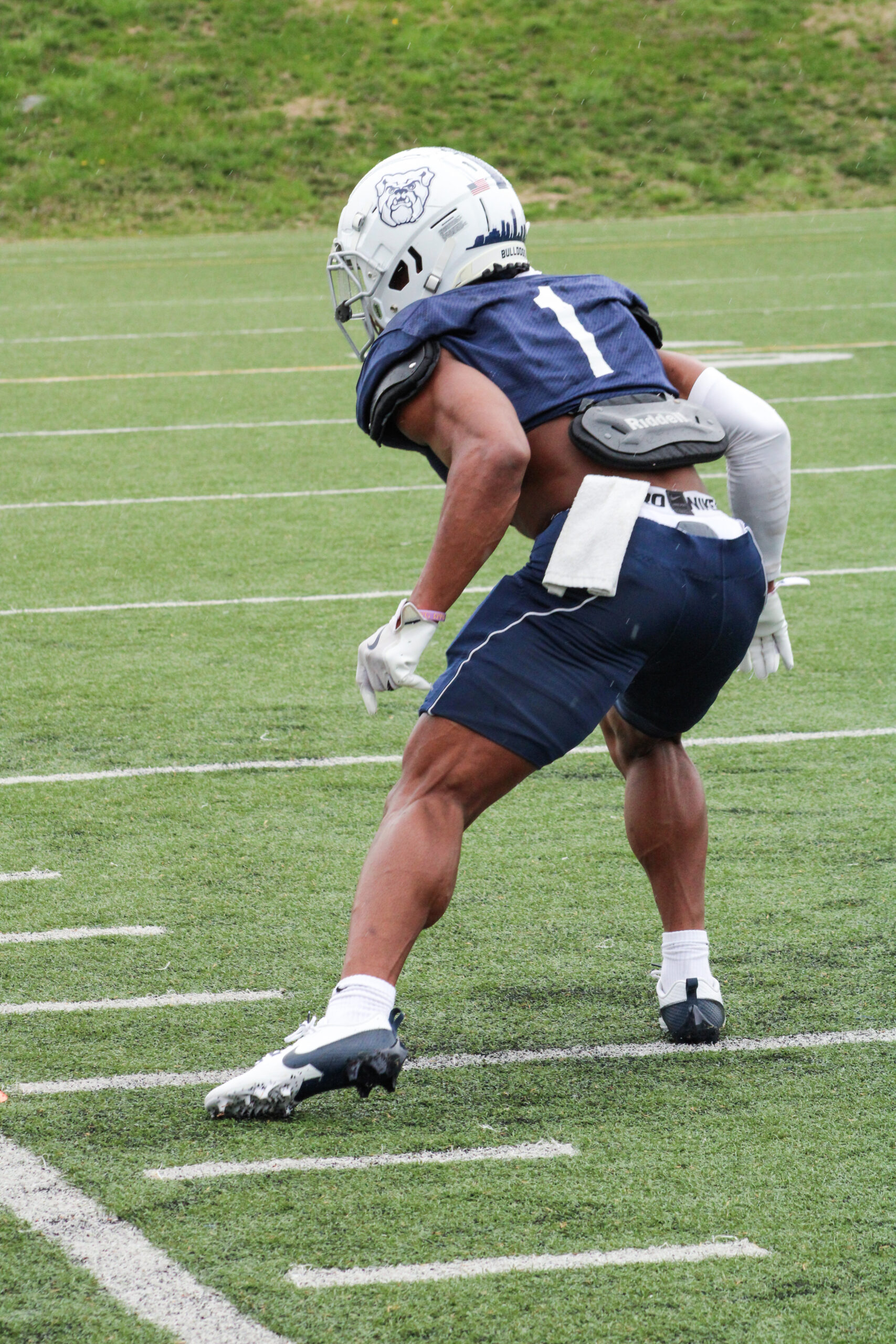
In his senior season, Will Mason is one of the vocal leaders in the Dawgs’ secondary. Photo by Lilly Frieling.
The Bulldogs consistently find themselves in positions to prove their mettle in games with nothing to lose. The Butler athletic department and coaching staff make a concerted effort to have at least one game against a scholarship school on the schedule each season.
Senior players like Mason and linebacker Jeremiah Jackson immediately got a taste of the tough competition as first-years, facing eventual Football Championship Subdivision (FCS) national champion South Dakota State in their third game of the 2022 season. The Jackrabbits used a balanced offensive attack — scoring three touchdowns on the ground and three through the air to hand Butler a 41-17 loss.
The Dawgs inched closer to success in 2023 when they traveled to Missoula, Montana, to take on the University of Montana. For the second straight season, it was a road matchup against a national finalist for Butler, as the Grizzlies finished as FCS runners-up that season. The Bulldogs fared better against Montana, taking a 35-20 loss. The game was close throughout, with the underdogs trailing by just one possession heading into the final quarter.
“We had a chance to beat them,” Jackson said. “We just didn’t execute the right way.”
Finally, in 2024, the Bulldogs broke through. The team had a date with Murray State scheduled after a blowout win over Division II Upper Iowa. In the week leading up to the game, the Butler locker room got some bulletin board material from Murray State head coach Jody Wright.
Wright guaranteed a victory for the Racers in multiple posts on X before the game.
“I Promise YOU!!” Wright said in one post two days prior to the game. “We are going to WIN Racer Nation”
“Yes We Are Going to Turn it Around!!” Wright posted the next day. “Yes We are going to WIN. This Saturday is Going to be Special!!”
The message was for Murray State fans, but they were not the only ones who saw it. Butler players took notice, and Wright’s promises reaffirmed the Dawgs’ attitude towards opponents.
“For us, the mentality has always been, ‘If you’re not gonna take us in high regard, if you’re always gonna consider us an underdog, we’re fine,’” Mason said. “That’s just gonna keep our mindset the same.”
The Bulldogs marched into Murray and grinded out a 19-17 win on the back of an efficient passing day by then-redshirt sophomore Reagan Andrew and two rushing touchdowns by graduate quarterback Nick Howard.
The Dawgs — spurred on by Wright’s comments — held Murray State to the lowest time of possession of any opponent all season.
“It was pretty embarrassing for them,” Jackson said. “We played against [Division III] teams and other schools that just weren’t that good [last season], but that was the least amount of plays we played on defense the entire year. That’s fun doing that to scholarship schools.”
The Bulldogs’ schedule gets even tougher this season in head coach Kevin Lynch’s first year at the helm. Butler was handed a 38-14 loss on the road at Northern Iowa in week one and will face Weber State in week four, both of which are scholarship schools. In addition, the Dawgs face Division II Truman State in week two, a school that also gives out scholarships and is 5-1 in its last six games against PFL teams.
Lynch understands the underdog mentality that comes with playing against solid competition.
“Anytime you’re playing what is supposedly ‘up’, you’re definitely going to have that chip on your shoulder,” Lynch said. “These guys on our football team are good players, confident players. Anytime you’re gonna play in a place where people are going to assume they’re better than you, you’re definitely gonna have a giant chip on your shoulder.”
Butler plays hard and sticks together regardless of the opponent, but forcing an opponent to eat their words is an opportunity the Bulldogs never want to pass up.
“How you do anything is how you do everything.”
The phrase that echoes across campus among football players. From the meeting rooms in the basement of historic Hinkle Fieldhouse, to the Sellick Bowl for practices and games, to academic buildings and study spaces in Irwin Library.
It is a consequence of being a non-scholarship school: the football team — as well as every team of Bulldogs in the athletic department — has to embrace both aspects of being a student athlete. As such, work ethic on and off the field is a focus for Butler in the recruitment process, shares director of football operations Ty Morgan.
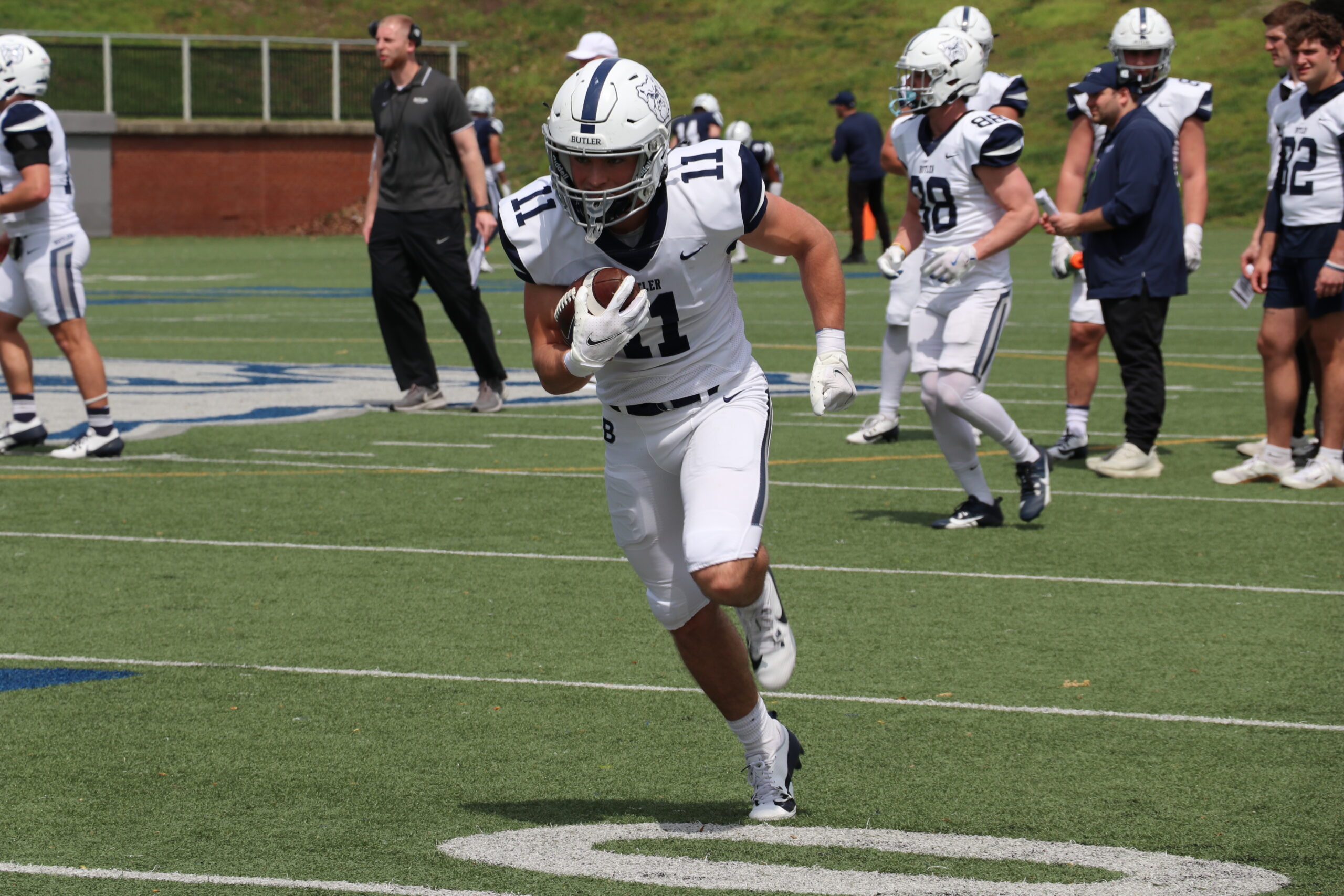
Butler was picked to finish fourth in the 2025 PFL preseason poll. Photo by Sawyer Goldwein.
“For us being a non-scholarship program, we have to invest and recruit in players that have a high academic standard,” Morgan said. “They typically come from families that value education and value the return on investment within Butler. So they’re not necessarily getting a scholarship to play football like at other places, but to them the return on investment is you’re getting to come here for four years, get a great education, play good football, work internships [or] part-time jobs and create those relationships for beyond when they’re done.”
Unlike most schools, Butler does not just try to sell transfers or high school prospects on its football program. Familiarizing recruits with the team is part of the process, as prospective Bulldogs are introduced to their coaches and schemes and given an idea of what their schedule will look like.
However, recruits and their families are also shown around campus, familiarized with the academic buildings, shown the living arrangements and caught up to speed on what their potential class schedule would look like.
It is an all-around recruiting effort that ensures members of the team will be well-equipped for more than just football.
“I knew off the bat that Butler would set me up for something great,” Jackson said.
The well-rounded pitch plays well with recruits’ parents, who Butler tries to get bought into the program as much as the players are.
“We do a great job of getting families involved here,” Morgan said. “For one guy going across the country, it can be difficult adjusting to the college life and being so far from their families. But we find a lot of times that we do have high character guys that care about their families and their families care about Butler.”
Further demonstrating Morgan’s point, Butler consistently recruits transfer players from Ivy League schools to suit up at the Sellick Bowl. From former wide receiver Tyler Adams, who previously played at Harvard, to Howard, who played most of his collegiate career at Dartmouth, the Bulldogs have familiarity with their fellow Division I non-scholarship conference.
“I think Ivy League guys [have] a great transition coming here because they value the academics,” Morgan said. “They know that they’re going to work hard on the field, they’re going to work hard in the weight room, but they’re also going to work hard in the classroom. We don’t have to worry about adjusting to the academic rigor that Butler has.”
Graduate defensive back Onye Onuoha is familiar with the enticing academics offered by Butler. He transferred to the Bulldogs with two years of eligibility remaining, in part because he knew a starting spot was waiting for him, but also due to Butler offering a two-year MBA program that fit his academic needs.
Onuoha is also well-equipped to compare Ivy League football to the PFL after arriving in Indianapolis from Dartmouth.
“On the field, there’s not much of a difference,” Onuoha said. “Size-wise [and] speed-wise it’s all very similar. The competition is the same regardless of where you go.”
While the on-field products of the two conferences resemble each other closely, other aspects start to vary in other ways. Onuoha credits Butler for the culture and energy surrounding the football program.
“I enjoyed my time at Dartmouth, but I think there’s a lot more pride, people are a lot more involved in football games [at Butler],” Onuoha said. “This is a different vibe and a great atmosphere.”
It does not take long to see that Butler differs from top Division I programs.
The football team’s 6 a.m. practices are partially a byproduct of having to share one of the two fields on campus that have football markings with other teams, like men’s and women’s soccer.
At practice, instead of using pristine new tackling dummies for drills like many schools, coaches use large trash cans to help them put players through the motions.
When the sun eventually rises over those early morning workouts, it does not reveal any fancy facilities or decked-out weight rooms.
On game days, tickets must be purchased. Unless, that is, a fan simply walks around Apartment Village, where junior students are housed. If a fan takes that route, no security will be waiting to stop them from entering the stadium for free.
Much like with Butler as a school, familiarity is paramount to the football team’s culture. Jackson is willing to pit his teammates against any other team when it comes to chemistry.
“I don’t feel like there’s a locker room in America that’s tighter than ours,” Jackson said.
The Dawgs pride themselves on running their program the right way. No matter the coach in charge, the players on the field or the staff on the sidelines, The Butler Way remains constant, driving the team forward year after year.
“To me, The Butler Way means finding a way,” Mason said. “They’re gonna talk about the excuses for if you lose, the reasons you’re not a favorite. All of those excuses that somebody might make, ignoring them and finding a way to win. It’s all about saying, ‘We don’t really care about all the background stuff, the coulda, shoulda, woulda’. It’s about finding a way to succeed. That’s what we do, that’s how we embody things on a day-to-day basis. To me, that’s what The Butler Way is, and the football team has really embodied that by our success.”