
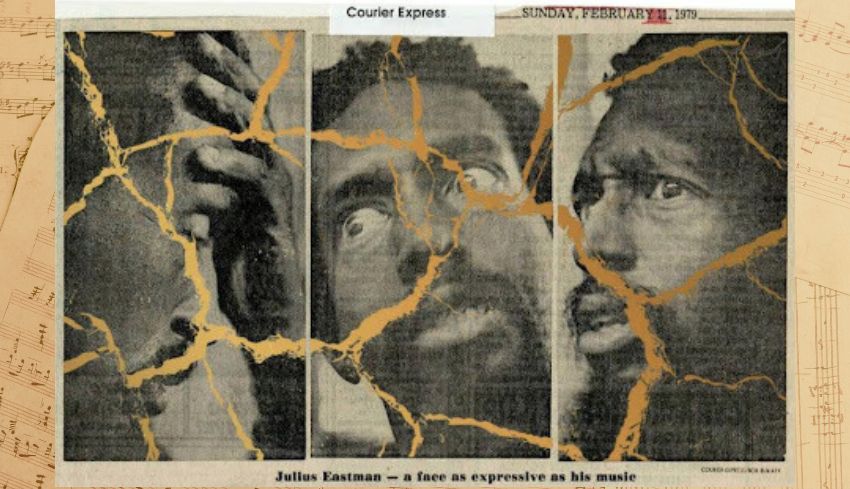
In 1990, Julius Eastman died alone in a Buffalo, New York hospital. It took eight months for the unconventional composer’s obituary to be published. In his wake, he left sheet music that no one could read and a legacy of beautiful brokenness.
Ellie Hisama, a musicology professor at the University of Toronto, became enraptured with Eastman’s work when a CD with his full discography was mailed to her. After dedicating countless hours of ongoing research into Eastman’s life, including speaking with his family, friends and colleagues, Hisama presented her lecture on the beauty of Eastman’s life and what the world can learn from him.
“Listening, Making Art, and Teaching in the Age of AI: Hearing Julius Eastman’s Music through Kintsugi” was presented on Friday, Feb. 20 at the Eidson-Duckwall Recital Hall as part of the Wayne C. Wentzel Lecture Series. During the hour, Hisama expounded on how Eastman’s life as a gay African American man without a home affected his mind, career and art.
The Butler Collegian spoke with Hisama about her research on Eastman, kintsugi and the synthesis of audiovisual art that comes to be when they are studied together.
THE BUTLER COLLEGIAN: What inspired you to study Julius Eastman’s work?
ELLIE HISAMA: Hearing his music. When I played the CD [with his discography], “Unjust Malaise”, I just had never heard a voice like that before. His music can’t be ignored, and some of the pieces are really long, like many minutes long. Sometimes with minimalism or post-minimalism, I get bored and feel it’s going on too long, but with Eastman, his music changes at just the right moment. I found his music speaks to me in a way that other music has not.
TBC: What drew you to the connection between Eastman and the idea of kintsugi?
EH: I can’t remember where I learned about kintsugi, but I was reading a lot about Eastman and thinking about this idea of his life not working out in some ways and the idea of being broken. I think it was contemporaneous with thinking about him and his music, which was also piecemeal. Some of his music is quite vague and it looks unfinished in some ways. Some of it is [even] lost. [I was] just thinking about dispersal and pieces and fragments and then kintsugi, which is the process of bringing together pieces.
I saw myself as doing kintsugi, but as a scholar, not as an artist or practitioner … so it was more of a metaphor. Later it became something actually tactile. I do kintsugi myself to understand it better. Now I’ve done three workshops, and I still feel there’s so much to know. It will take years to understand and develop, but to me, it helps quite a lot to have a practice [that] is more than listening to music and writing words down, which is the way music scholarship [usually works].
TBC: Are there any other artists you would like to study who represent this idea of metaphorical kintsugi?
EH: Someone I have [researched] a lot is Ruth Crawford Seeger. She was the stepmother of Pete Seeger, who was much more famous than she [was], but she was a modernist, avant-garde composer [who lived from] 1901 to 1953. I was thinking of her because she has this idea of imperfection. She writes music in a very exacting way. It’s serial, so every note is generated, but she didn’t want to just follow the machine [that was] spitting out notes. She said in her string quartet, ‘I’m not going to write this note [correctly] because I’m going to put an imperfection into the piece [and] break the system.’ She also said [something along the lines of], ‘Only God is perfect. Humans are not perfect.’ She [did] not want to strive for perfection.
Eastman also talked about this idea of imperfection, and in a recorded statement about [his work], he says it’s not perfect. He didn’t want it to be perfect, and she didn’t want [hers] to be perfect. In music scholarship, we like cleanliness [and] tidiness. So having a model [that says], ‘It’s not perfect, there is some mess,’ is a different sort of model. I like thinking about music differently because I feel music scholarship is often about STEM worship or envy of STEM practices, and it all has to be neat and tidy, and I’m trying to get away from neatness and tidiness.