
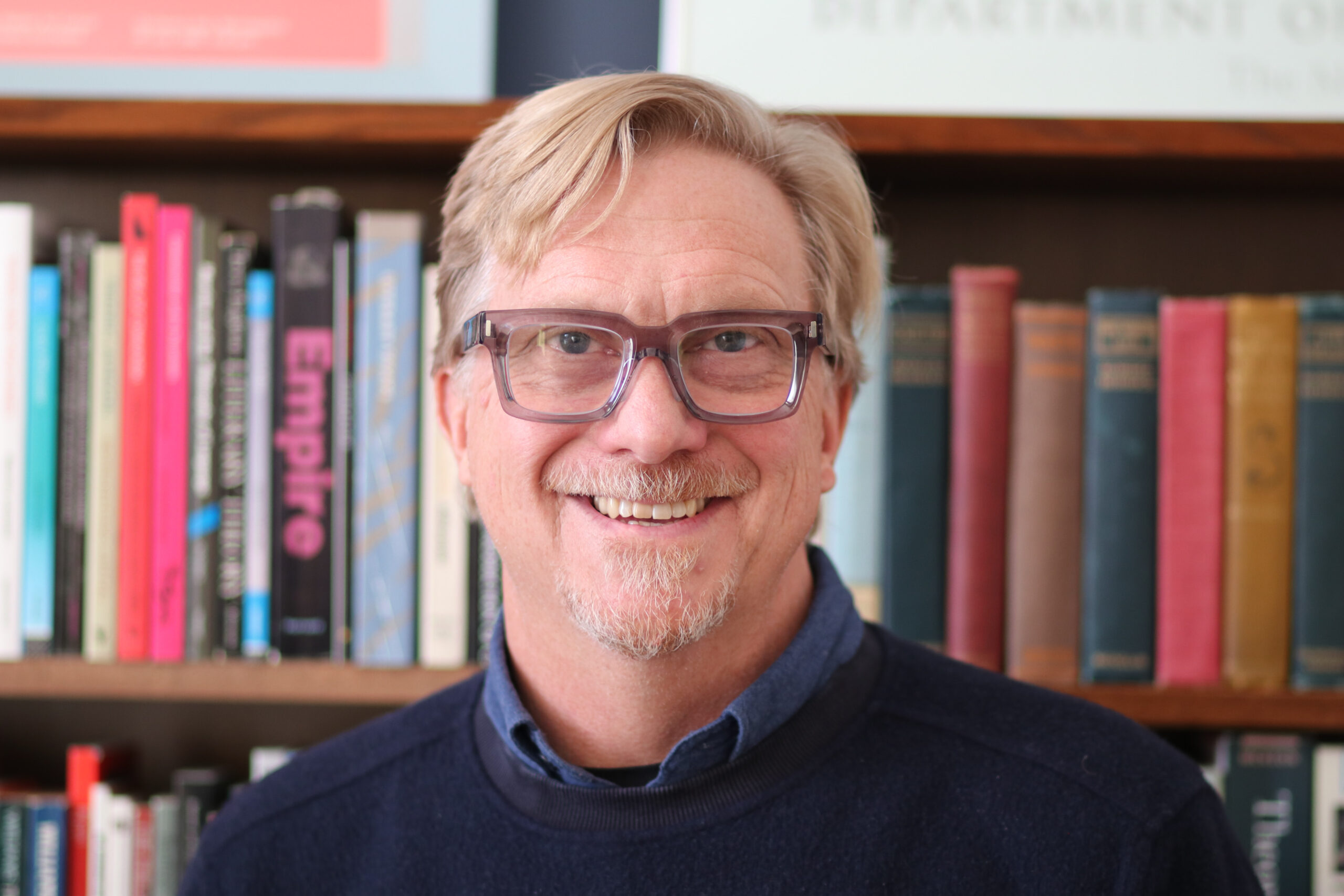
Dr. Swenson poses in his office, surrounded by a massive collection of books. Photo by Jonathan Wang.
ANA DOLLARD | ASSISTANT CULTURE EDITOR | adollard@butler.edu
Members of the Butler community are achieving extraordinary things, both on and off campus. From first-years to alumni to administrators and back, each Bulldog has a story to tell. Read on to discover the next of our Bulldogs of Butler through a Q&A style interview.
Dr. Brynnar Swenson has achieved an illustrious status in the English department. He is so prominent that an illustrated version of himself attached to a paint stick was created by former students and aptly named “Swenson on a Stick”. His “sticksona” is often used by other professors to explain concepts relating to capitalism — Swenson’s specialty.
Swenson received his PhD in comparative studies in discourse and society from the University of Minnesota in 2008. He started teaching at Butler shortly after as an adjunct professor before beginning his tenure track in 2009. Currently, as an associate professor at Butler, he teaches courses in American literature, literary theory and cultural studies.
The Butler Collegian sat down with Dr. Swenson to chat about his passions and professorship.
THE BUTLER COLLEGIAN: How did you become interested in English?
BRYNNAR SWENSON: Well, I am dyslexic. I was an athlete [in] high school and did not learn to read in a competent way until I was late into my teens, when I met a guy who owned a pizza parlor in my hometown. He was an incredible intellectual and reader, and he gave me some books and started talking about reading. I also had a history teacher who gave me some books, and I had an English teacher my senior year who helped me through my first reading of a novel, which was “Billy Budd” by Herman Melville. After I stopped swimming in my sophomore year of college, I started reading, and once I learned how to read, I became obsessed.
TBC: How does your background in race, gender and sexuality studies (RGSS) inform your teaching?
BS: When I went to college — on accident — I got involved right at this moment in academia in the late 1980s, where intellectuals were pushing strongly to include new voices in the canon, and in other ways. In particular, Paula Rabinowitz was one of my main mentors at the University of Minnesota, and she was a very serious feminist scholar from the 1980s and ‘90s. Her work was very influential, and she was one of the main people who took me in and taught me how to be an academic. The work that I did was always — first and foremost — centered in this political space of literature. Gender and queer theory, class issues and the history of race — and for me, in particular, how the history of slavery informs American culture and literature — are completely central to everything I’ve done.
TBC: Is there anything you haven’t gotten to teach yet or would like to teach if you had more time?
BS: Yes. One of the absolute best things about this job that I am always super happy [with] is how much freedom we have to produce our classes and to teach the classes we want — obviously within the parameters of what the department needs. When it comes to the actual course, [designing intellectual journeys through text] … is still the most creative and dynamic part of this job, and it’s the thing that I find most satisfying and rewarding.
I would like to have some space to teach advanced courses in pre-1700s American history and literature and textual production, [such as] early colonial first contact [and] the history of Native Americans — in particular histories that are only recently being [taught]. The data has been around forever, but the amount of information available in accessible history and literature texts about Native Americans in the United States has exploded in the last 10 years. I’ve never taught a 400-level class on the Puritans. I’ve never quite had the guts to try and run that class.
TBC: Could you talk about what it’s like being an English professor with dyslexia?
BS: I call it a ‘dyslexic tax’, which is the amount of extra time and energy it takes to do something academically … for me, it’s very physical, and it’s time and space oriented. Once I’ve done that, I think my reading has its own kind of abilities. It’s not a disability when it comes to actually engaging with the text though, as I get older, some of this is going away. Historically, in my reading, I’ve had a very high level of retention and detail.
When we got into more complicated philosophical or literary theoretical texts — it was difficult for me to move forward unless I actually understood all the words … Dyslexia made reading philosophy better [and] easier in a way. [It has] forced me to do a little more work, but [I now can] stop and define [unfamiliar words] on my own before I could move forward … I credit my dyslexia very much with my ability to read [complicated theoretical texts], and also other big, complicated books, which are my favorite things.
Today [in] the world, [it is hard] to read with our phones [and AI] … The strategies I had to use as a dyslexic are productive for everybody today. I grew up at a time where reading was just supposed to be something you did. It was not separate from your life. Today, I think to read, even us English [academics] who want to read books, can struggle [to find] the time and space to read an old text. I like to say Henry James books were not written with the idea that there was anything else to do in the world at the time … This has been a big push for me to openly discuss my dyslexia … A lot of students who have ADHD and dyslexia can be very similar in the way that [reading can be difficult] … [and] these strategies can really help. In the end, dyslexia is why I’m an English professor, and sometimes I still question it. I still have to work to be in a space to read, but yeah, I learned to read.