
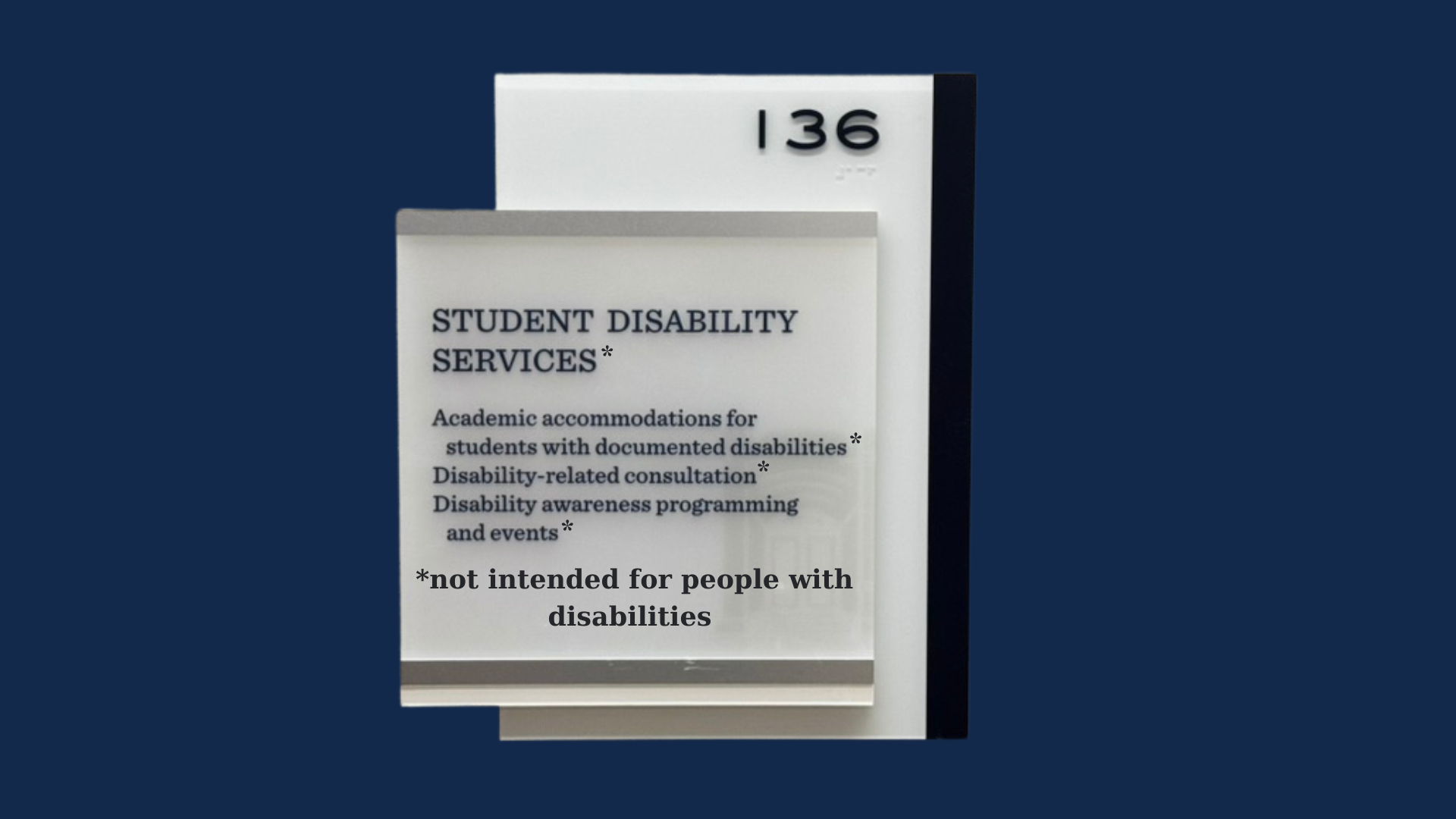
SDS is unavailable and ineffective. Graphic by Anna Gritzenbach and Tessa Specchio. Photo by Anna Gritzenbach.
TESSA SPECCHIO | OPINION COLUMNIST | tspecchio@butler.edu
At what point is inaccessibility unacceptable?
In the United States, all universities are required to follow accessibility standards laid out by federal legislation. Title II of the Americans with Disabilities Act (ADA) and Section 504 of the Rehabilitation Act state that an individual who would be otherwise qualified is entitled to equal access to a college education as would a non-disabled individual at all public institutions. Title III of the ADA requires the same of all private institutions. These laws are in place to protect against the discrimination of students with disabilities.
The ADA took decades to pass; the first discussions of a form of civil protection for disabled Americans began in Congress in 1973 after decades of activism. One of the most famous being the “Capital Crawl” in 1990, where, following yet another stall of the act in Congress, 60 wheelchair users crawled up the steps of the Capitol, physically demonstrating how inaccessibility impacts the American people. The ADA was officially passed later that year.
The disability activists fought so hard for the ADA to gain the right to accommodations, which are put in place to allow for equitable access. This means that things like wheelchair-accessible entrances, preferential seating and flexible attendance are protected by federal law. However, the law is only able to protect the availability of those accommodations, not whether they are obtainable or convenient for those who need them.
The inaccessibility of Butler’s campus is present regardless of the exact location. Jordan Hall’s ramps are too steep for a wheelchair user to use, Apartment Village has no resident building elevators and most classrooms have no accessible seating. Is this the holistic approach to disability that Butler promises?
Despite federal accessibility regulations and its claims to be an institution interested in supporting equity and inclusion, an accessible campus is not Butler’s top priority — or even a priority at all — which creates an environment that is exclusionary and unsustainable for disabled students.
Butler University has issues with accessibility and inclusivity on every front. From physical barriers to fundamental misunderstanding, all of which prevent disabled students from thriving.
Butler has a dedicated activist club aimed at fighting ableism on campus — Bulldogs for Universal Design (BUD). This group is arguably the most prominent voice in fighting for equal access, often stepping up to argue with the administration about issues of inclusivity.
Sophomore journalism major Maéline Bringuier is a member of BUD’s executive board who often comes in contact with Butler’s indifference toward supporting disabled students.
“I think that definitely the university hears us,” Bringuier said. “We are very loud about what we want … it’s not a secret, everyone knows. And all we want is to be recognized.”
BUD is consistently setting up informational discussions and campus-wide demonstrations — most notably, chalking inaccessible buildings around campus — of the lack of inclusivity, actively seeking out ways they can promote disabled voices. They also tend to pick up the pieces of disability services’ attempts to promote accessibility.
Student Disability Services (SDS) is a part of Butler’s weak attempt at promoting diversity, equity and inclusion. Their website states that they are dedicated to providing equitable access to the Butler community for students with disabilities, claiming that they are most interested in supporting students in learning to advocate for themselves.
SDS — despite their alleged commitment to supporting students with disabilities — are extremely difficult to get in contact with. The office declined to be interviewed for this article, citing scheduling issues.
Their disinterest in being interviewed illustrates SDS’ campus culture, which maintains that the department is not committed to helping disabled students, forcing organizations like BUD to form in an attempt to aid fellow students where faculty refuse.
A lack of accessibility on campus, combined with SDS being seemingly unwilling to help, leads to an unfriendly environment for the disabled population on campus.
The majority of Butler students are able to ignore injustices around accessibility, but disabled people are forced to worry about whether the automatic door operator will be functional on their way to class in Jordan Hall. Access is an extra concern because Butler has made it an afterthought, which is incredibly disheartening, especially from a campus that claims to be focused on diversity, equity and inclusion.
The current level of access that Butler’s campus is offering is not good enough.
However, Butler could absolutely refine their campus to suit their disabled population, as they have done several times; the issue is who it is consulting.
Dr. Barbra Campbell, senior lecturer in the English department and professor of several disability related classes, understands the solution to conferring with disabled students.
“It’s an ongoing project to identify places and attitudes that need attention,” Campbell said. “It’s important to hear from disabled students what the priorities are.”
Butler needs to make changes to their outdated policies and even older buildings. They have organizations like BUD that are explicitly stating the problems, but currently, no change is happening. Butler has the privilege and resources to create an equitable and welcoming environment for all students, but they are actively choosing inaccessibility.