
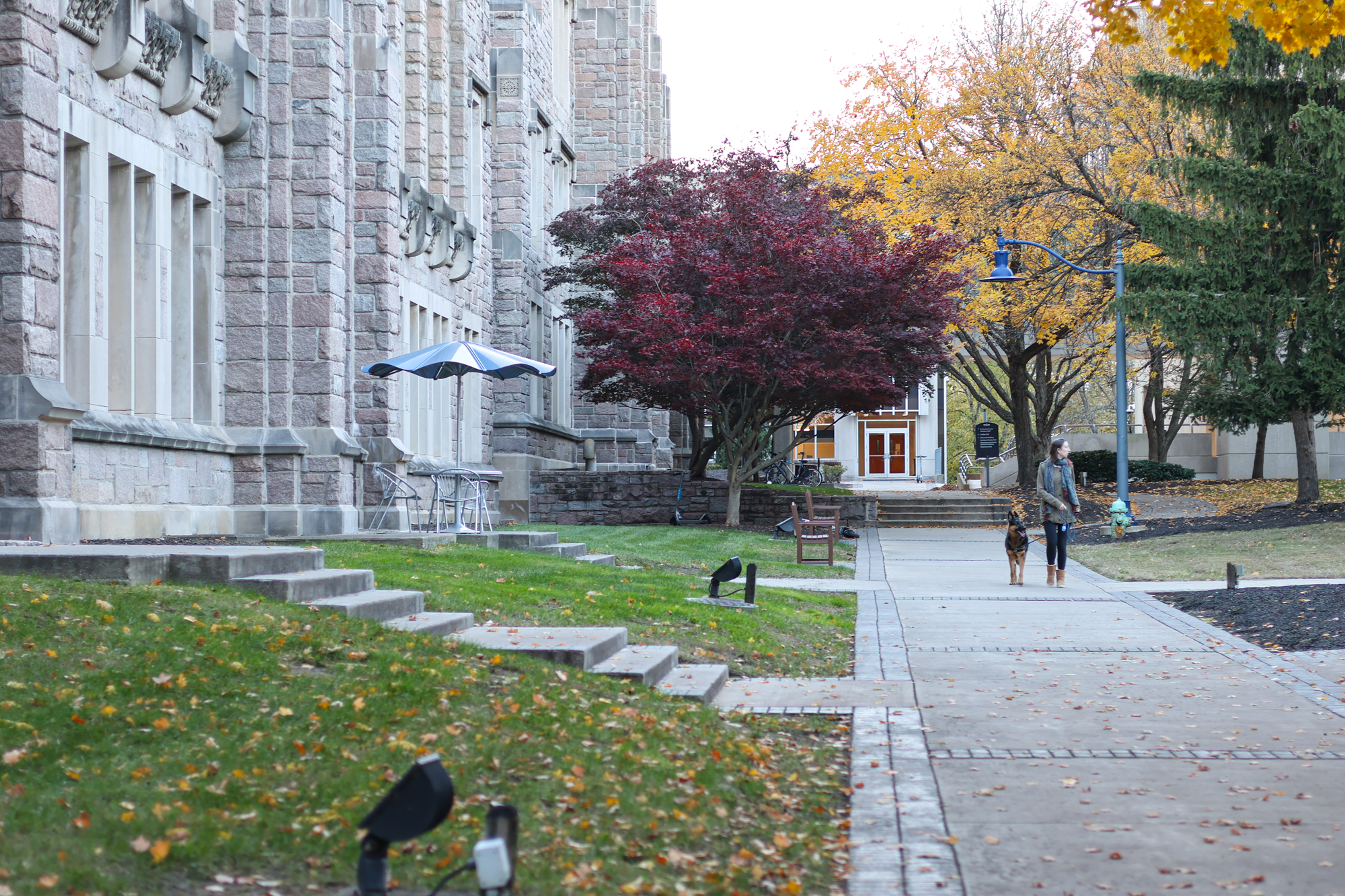
The sidewalk outside Jordan Hall contains recent accessible renovations. Photo by Jada Gangzaha.
ERIKA KOVACH | STAFF REPORTER | ekovach@butler.edu
University construction crews have worked to replace features on the north side of Jordan Hall to make the building more accessible to those around campus.
In an announcement through My Butler, the operations team stated that the project began over Fall Break on Oct. 23 and concluded on Oct. 28.
John Lacheta, the interim associate vice president of facilities & operations, explained that the crew removed and replaced the sidewalks, curbs and accessibility ramps on the north side of Jordan Hall.
“We planned for this work over the past few months in order to improve campus accessibility and safety,” Lacheta said.
While campus pathways and roadways are frequently assessed for issues, Laceta said his department frequently confers with Student Groups and Student Disability Services (SDS) to prioritize what work to complete.
In the past, Butler has struggled with issues of inaccessibility across academic buildings and dorm rooms. Bulldogs for Universal Design (BUD), an advocacy group for disability education, regularly works toward improvements.
Julia Veres, a junior strategic communications and sports media double major, is the vice president of BUD. She said that the group had previously filed barrier reports — grievances reported through SDS following discrimination — regarding sidewalks and cracks across campus.
“I think the fact that the university has repaired the sidewalks outside of Jordan was a long time coming,” Veres said. “We are quite happy with the repaired sidewalks.”
Cracks and small potholes in the sidewalks can make it difficult for those who use mobility aids, such as wheelchairs and canes, to get around. Small parts of these devices can easily get stuck and even lead to injury.
“As a part-time wheelchair user myself, the small front wheels of my chair — casters — often get stuck in the cracks, which then jolts me forward and makes it extremely difficult to navigate campus,” Veres said. “Non–disabled people can also be affected by bad sidewalks because [it’s still easy] to trip and fall.”
While updates outside of Jordan Hall align with BUD’s goal of making campus more accessible, Veres explained that this is not the only building with issues, and the university can always continue to make improvements.
Jeanna Jorgenson is the director of First Year Seminar (FYS) courses and teaches an FYS course on disability studies in fairytales. She explained that the Americans with Disabilities Act, passed in 1990, was supposed to open up society for all people with disabilities, making it illegal to discriminate against them in everyday activities — including getting an education and going to work.
“A lot of Americans who aren’t disabled and don’t have disabled friends or family don’t realize how inaccessible everyday life can be,” Jorgenson said. “For those with mobility impairments, the lack of curb cuts and elevators can add extra time and difficulty to a person’s day … which, here at college, can mean the difference between getting to your classes and jobs on time or not.”
Lacheta said the university will continue to assess campus walkways and address what areas need repair or placement in the future.