
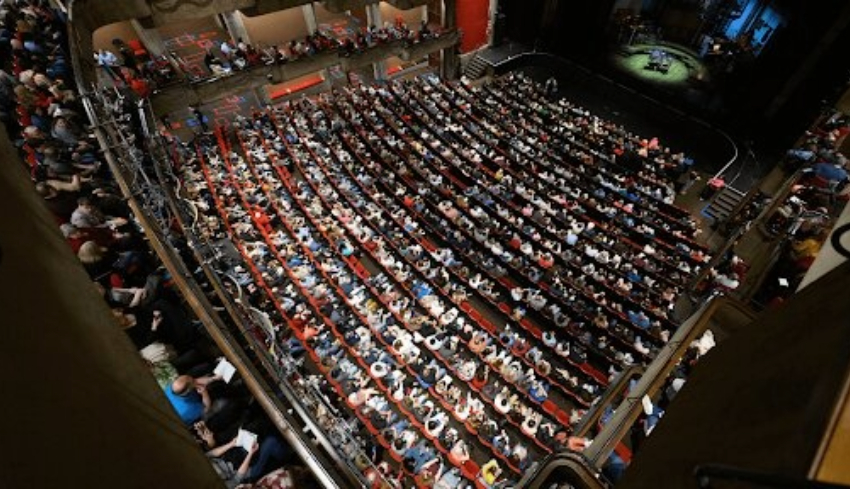
In an effort to support the new Midtown Arts District — a plan to transform Butler into an art hub connecting campus and Midtown Indianapolis — the university started an Arts Performance Fund in June 2025. In less than a year, $150,000 has already been raised. For every ticket sold at Clowes Memorial Hall and other venues, a dollar is donated to the fund.
The fund will begin distributing donations to local arts organizations in Indianapolis in the summer of 2027, with a focus on increasing accessibility and opportunity surrounding the arts. This will include providing spaces for arts organizations to show their works, whether that be in Clowes or other venues, including a new one that Butler is about to break ground on. The program’s long-term goal is to reach $10 million, with a short-term goal to raise $1 million by summer 2027.
As a part of the Butler Gateway Project, the university is being centered as a place for the arts to thrive. The Gateway Project represents Butler’s long-term goals of transforming the campus and surrounding areas into a community that will better support entertainment, arts, athletic and educational opportunities.
Aaron Hurt, vice president for arts, events and enterprise management, highlighted the university’s enthusiasm for providing a central space to celebrate the arts.
“We’re very excited about the Arts Performance Fund and the impact it will have both on advancing the City of Indianapolis’ performing arts scene and Butler’s leadership in the Arts,” Hurt stated. “Clowes Memorial Hall was built in 1963 to be the arts center for Indianapolis, and over the last 60 years has been the home for many of central Indiana’s performing arts organizations. As we look to what a modern arts center needs to be for 2026 and beyond, we want to be a leader for the arts sector nationally, and the Arts Performance Fund is our next major step to fulfilling that vision as a part of the Boldly Butler strategy.”
Funds supporting the arts are crucial to many students and community members, as they enable them to follow their dreams. Many careers in the arts receive less recognition than other paths, making them discouraging to pursue.
Marissa Huggett, a sophomore acting and arts administration double major, spoke about how many arts students face potentially damaging stigmas.
“There’s the caricature of the struggling artist, because there’s so much shine about [being] a performer, but it’s still not valued, despite it taking just as much time or effort [as other careers],” Huggett said. “I feel like [performance arts are as specialized as] other fields, but it’s not regarded as that.”
Funds like these help the arts gain more attention and be taken more seriously, while providing a place for students to share their work.
Huggett also emphasized the importance of arts education and how this specific fund can benefit children getting involved in the arts.
“[Art is] very pivotal to development,” Huggett said. “The arts in general are so important everywhere in the world. It is a defining factor of culture, and with kids, it [develops] fine motor skills, creativity and imagination. Giving funding to the smaller places that are open for everybody allows it to be that much more accessible.”
Performance arts also serve as a source of community for many individuals, who can connect over a shared passion for and understanding of the arts.
Lily Avery, a senior dance pedagogy and psychology double major, explained why the arts are invaluable and why they have been so important in her life.
“I feel like there is nothing that can replace [the arts],” Avery said. “It’s something that gives you a chance to think deeply, [but] there’s nothing to influence you to think a certain way other than strictly what you’re seeing. There’s so much meaning behind [art], and I love, especially with contemporary dance, there are so many ways you can interpret it and have it connect to your life.”