
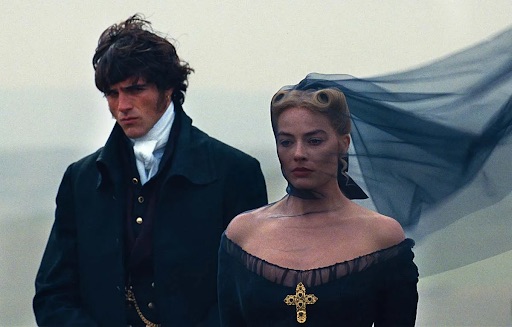
“Film Fanatics” explores Hollywood’s recent releases, cherished classics and everything in between. These thought-provoking reviews invite fresh perspectives and weigh whether a film deserves attention — or if its best left in the past. Read on to find out what our writers think of this week’s film.
Literary classics are always getting adapted to film in new and strange ways. From simple era shifts like “Romeo + Juliet” to full-on parodies like “Pride and Prejudice and Zombies”, no tale is safe from an unfaithful adaptation, intentional or not. “Wuthering Heights” is the latest victim, albeit in a significantly more racy — and possibly racist — way.
The upcoming movie has made waves well before its release for its overly sexual tone. Though Emily Brontë’s novel told a story of volatile obsession, there were no explicit scenes. The movie, however, is seemingly selling itself on its own sexual content. The trailers feature suggestive motifs and actions, partial nudity and a lot of heavy breathing, making for a film very different from the book.
Alejandra Sierazy, a sophomore psychology and sociology combined major, believes that the film’s content is incongruent with the book’s themes.
“[The main characters] don’t even kiss in the book,” Sierazy said. “The hypersexual take on [film] is definitely trendy right now. We’ve seen [it] in lots of recent movies, like ‘Babygirl’ and ‘Saltburn’, which were good films, but they weren’t based off of classic literature … It’s distasteful, and Emily Brontë is probably rolling in her grave right now.”
Not even the comment sections of the “Wuthering Heights” trailers are a safe space for the film’s new direction. Comments frequently mention a lack of understanding for the source material, discomfort with the suggestive nature and Brontë’s legacy being tarnished. Though no movie is free from preemptive criticism, “Wuthering Heights” is in a special amount of danger.
The film seems to acknowledge its own looseness as an adaptation, as the posters and trailers feature quotation marks around the title along with claims of only being based on the book. Artistic liberties in film adaptations are not new, but “Wuthering Heights” begs the question: should the change in content be this sexually charged?
Erotic themes of obsession seem to be a specialty for writer, director and producer Emerald Fennell, who also made “Saltburn” and wrote the second season of “Killing Eve”. Both projects — and presumably “Wuthering Heights” — follow tales of dangerous and calculated infatuation.
Fennell’s version of “Wuthering Heights” especially resembles her work on “Saltburn”. The films share a plot of a lower-class young man growing obsessed with his close friend during his stay at the estate of the friend’s wealthy family. Both movies even star Jacob Elordi, are named after the fictional English manors they take place in and have the protagonist seek revenge for his unrequited love and lower social status.
Senior lecturer of English Angela Hofstetter believes Fennell may be using heightened sexuality to explore themes of power and control.
“Gothic fiction in general plays with themes of sadism and masochism, and ‘Wuthering Heights’ is dark,” Hofstetter said. “It’s not explicit in terms of sexuality, but it is in terms of its sadistic expression and the ways in which people use power, take pleasure in the pain of hurting other people and destroying other people. It’s going to be very interesting [to see] what [Fennell] does with it, because that is a theme of ‘Saltburn’ in a lot of ways.”
Another big point of conversation is Elordi’s casting as the vengeful Heathcliff. In the novel, the character is described as ethnically ambiguous and significantly darker than the white Elordi. Further, it seems that Heathcliff’s skin tone was swapped with his rival, Edgar — portrayed by Shazad Latif. This supposedly colorblind casting does more damage than good, as it undermines the fact that Heathcliff’s mistreatment and struggles are a product of having dark skin in 1700s England.
Max Korte, a junior sociology and criminology combined major, expressed unsurprised disappointment with the whitewashed casting decision.
“I don’t think that it’s shocking,” Korte said. “There are a lot of characters and roles that were people of color and then [were] cast in white roles. There was a lot of uproar when they had a Black Ariel, and we don’t see that same thing when it comes to white actors being cast in roles that were explicitly described as being for a person of color.”
To cement the film’s provocative tone, Elordi and his co-star Margot Robbie had a photoshoot and interview with Vogue Australia in designer clothes and suggestive poses. The “Wuthering Heights” marketing campaign has leaned heavily into the actors’ fame as conventionally attractive heartthrobs, fans of whom seem to be the movie’s target audience.
It seems unlikely that “Wuthering Heights” will be viewed as the pinnacle of literary adaptation, but it undoubtedly has an audience. Much of the marketing has focused on the movie’s sex appeal, so it is unknown what other story elements will be changed or how significantly. No matter the case, its combined fame and notoriety will make it a standout.
“Wuthering Heights” will be released in theaters on Feb. 13, 2026.