
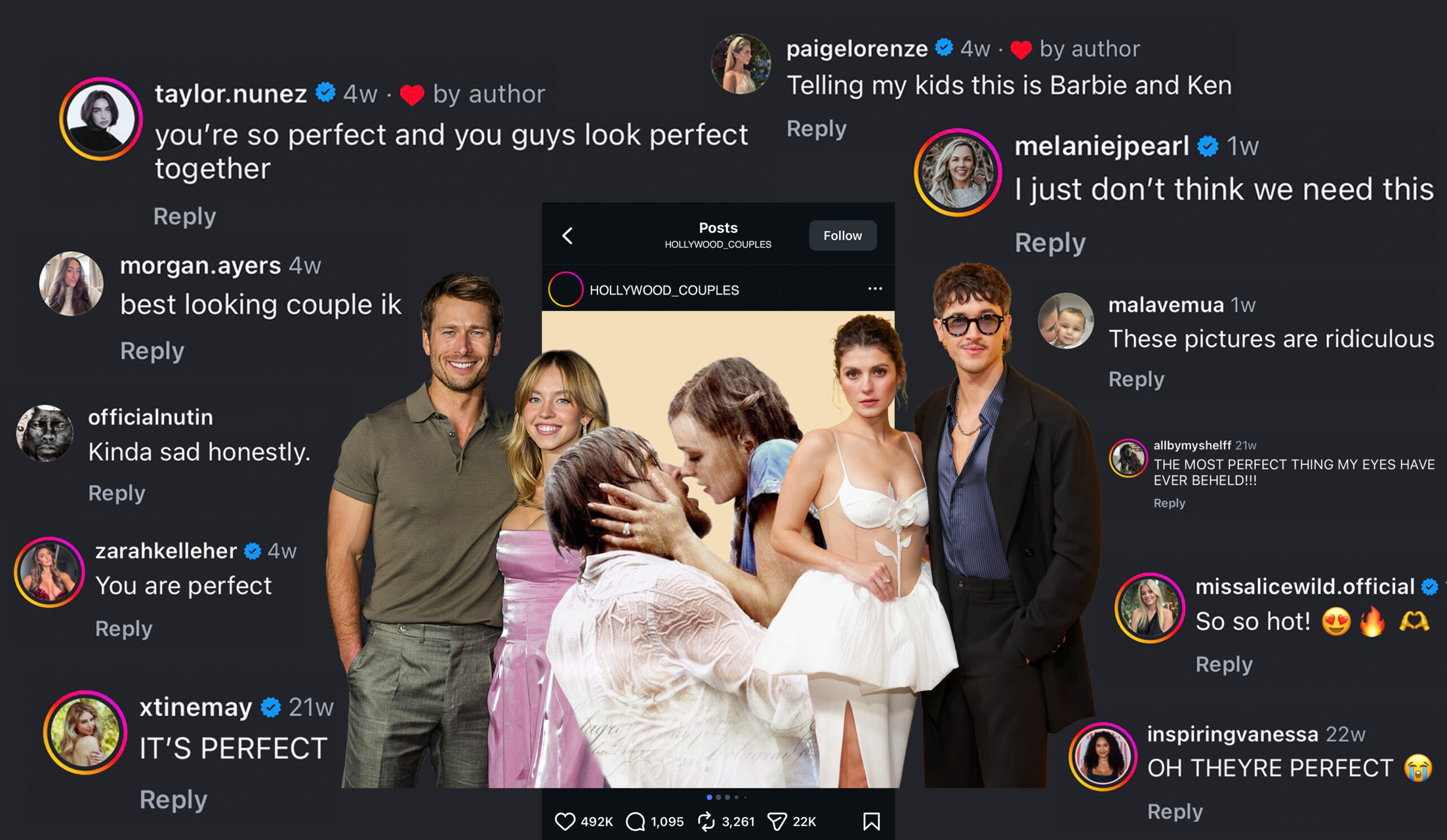
There is no doubt that the Hollywood film industry holds the power to influence everyday people. Based on true stories or not, Hollywood can shape the way we view different experiences in our lives. Through fictional stories that are inspired by the creators’ imaginations, or the documentary based on a true story, Hollywood does a great job at exposing us to a variety of ideas, morals, beliefs and expectations.
In today’s society, Hollywood’s influence has grown to become something that leads us astray from reality. Especially in the context of romantic film productions, we see unrealistic characters leading unrealistic lives, while in unrealistic relationships.
When I think of an unrealistic relationship, “The Notebook” comes to mind. This idea of casually cheating while in a committed relationship — like being engaged — is honestly distasteful. I believe Hollywood uses cheating as a plot twist to enhance its productions and add suspense; but I wonder if it realizes how negatively that influences an audience.
Gen Z, in particular, struggles with the idea of commitment. In fact, because of the way Gen Z has grown up with media promoting casual dating and hook-ups, we now resort to “situationships” and talking stages as a compromise to real commitment.
When thinking about the way Hollywood portrays romantic relationships, oftentimes we see a high demand and standard put on men to dazzle their lady with gifts. I’m not saying we shouldn’t have high standards when looking for a partner. However, we must ensure that we are not letting fictional stories cloud our judgment of what is and is not realistic.
Eva Hallman, a senior journalism and strategic communications double major, shared her own experience of the unrealistic expectations she found herself influenced by at the beginning of her relationship.
“The biggest [expectation] is flowers or gifts, where every holiday there’s boo baskets or Valentine’s baskets that people curate on social media,” Hallman said. “I had these expectations of gifts or events, or going to these fancy things, but honestly, if a date night now is going to grab food, I’m happy and that’s just the dream.”
The standards that we see in the media — whether it’s TikTok, YouTube or Netflix — are what the producers choose to show. What we see in cinematography isn’t all that there is. We need to remember this when consuming media.
Thinking back to the way Hollywood depicts romantic relationships, the reality seems to be that most of the time, producers fail to show all of the hard work that goes into a relationship. Reality is not a perfect marriage where they live happily ever after. Reality is putting in everything you are, every single day, no matter if you’re happy too or not — it is commitment. The idea that relationships are easy or that once you get that relationship, all your problems will be solved is incorrectly normalized.
Shyanna Itza, a first-year accounting and finance double major, gave her perspective on unrealistic relationships portrayed in Hollywood.
“When you watch romantic movies, you expect that [behavior] from your significant other,” Itza said. “But in some way it’s kind of delusional because it can change your perspective of what you want.”
I am giving Hollywood the benefit of the doubt and choosing to believe that it is not intentionally trying to make us “delusional,” or trying to raise our standards too high. However, it is definitely not trying to avoid this mindset either.
Genesis Washington, a first-year criminology and psychology combined major, explained her reasoning for whether or not Hollywood’s portrayal is harmful for perhaps more impressionable viewers.
“It can be harmful to an extent,” Washington said. “Sometimes I think it’s good to have certain high standards, but other things are not realistic. On the other hand, some of those [standards] are really good to have, because a lot of people don’t have any.”
Washington suggested that these unrealistic portrayals of a modern romantic relationship may have the possibility of exposing us to standards that, perhaps, we should aspire to set. While this is a good point to make, the harm that is more likely to be done outweighs the possibility of the good.
As college students, we are already impressionable and influenced by those around us. For Hollywood, being as influential and powerful as it is, to promote this kind of fantasy is only leading us to harm.
It is healthy to dream. It is refreshing to see something easy, glamorous and heartfelt. But at what cost? Setting up young adults to view relationships as something casual, something that is too risky or scary to commit to?
The most meaningful parts of a relationship are not exclusively the occasions where everything is perfect and easy. If Hollywood’s goal is to make us want to fall in love and be hopeless romantics, then it shouldn’t blast this image of perfection.
The truth is, there is no such thing as “happily ever after.” At least, not in the way Hollywood shows us. I believe that a couple can live a long, happy life together. But to be influenced into thinking that it requires anything less than total commitment, perpetual dedication, unconditional love and ceaseless forbearance, is unrealistic.
I don’t mean to burst anyone’s bubble, but I just don’t think it’s fair that, as young adults, we are being manipulated into thinking that love is easy. If more of us understood why the work that goes into love is so undoubtedly with it, then maybe we’d find ourselves falling into it more often.
Hollywood needs to show the real, raw parts of a relationship: the disagreements, the misunderstandings, the heartbreaks, the struggles and the inevitable disappointments. At the moment, these feel like parts of the movie you want to fast-forward through. However, if you can make it to the end of the scene that shows the argument or disagreement being resolved, that is where the commitment shows and that is where the “this is worth it” moment appears.