
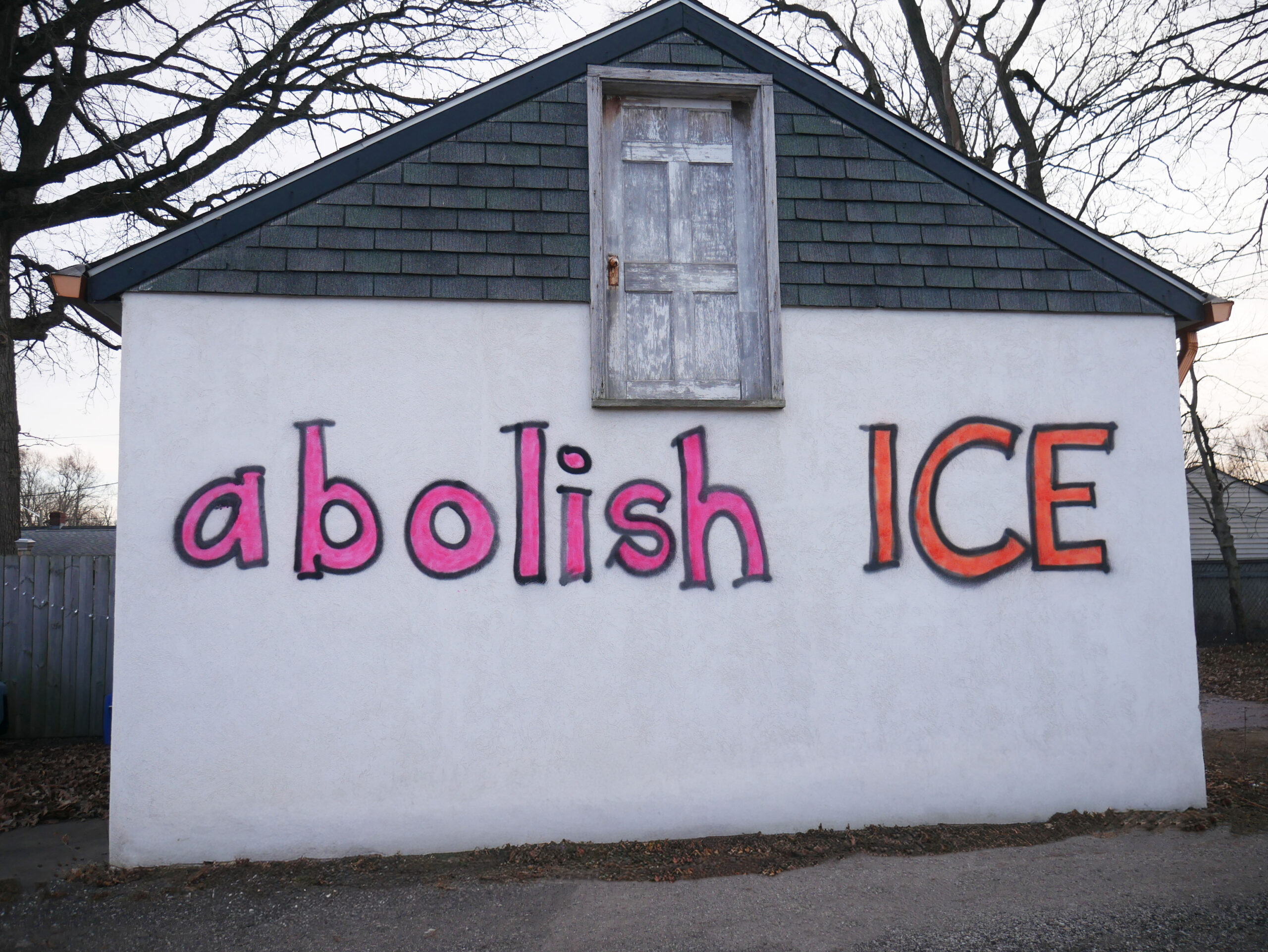
After the homicide of Renée Good by an Immigration and Customs Enforcement (ICE) officer in Minneapolis, protestors throughout the nation took to the streets. Now, cities across the country have to decide how to respond to both protests and the presence of ICE in their city.
In Indianapolis, ICE has already made its appearance. In October of 2025, the organization made 223 arrests in Northwest Indiana, and has recently pushed the Marion County Jail over capacity, according to a statement made by the Sheriff’s office three weeks ago. The jail will no longer hold ICE detainees for over 48 hours.
Protests have followed across the greater Indianapolis area. One of the largest protests we have seen in the city occurred Jan. 8, with hundreds of civilians gathered around Monument Circle. Another protest happened on Jan. 10, taking place on 86th Street, in unison with other efforts across the country.
Zion Zacarias, a sophomore political science and strategic communications double major, said that the presence of ICE has been on his mind, being from an immigrant family.
“The fear of deportation was something that ran throughout my family and throughout the way that we went about our everyday activities,” Zacarias said.
Although being a political science major, Zacarias said that none of his classes have mentioned or spent time discussing ICE. Zacarias has also not seen any statements or emails sent out by the school regarding ICE.
“At a politically charged time like this, there gets to a point where the university is responsible for addressing some student concerns,” Zacarias said. “While we are in this closed neighborhood — what people call the Butler Bubble — it’s still a fear that is going to be present.”
Mark Apple, the director of strategic communications of the Butler office of the president staff, gave a statement on behalf of the university.
“At this time, the university will not be participating in an interview on this topic,” Apple stated in an email to the Butler Collegian. “We do not believe it is appropriate to speculate on hypothetical scenarios or situations that have not occurred and are unlikely to occur. As a general practice, the university addresses legal questions and institutional responses based on actual circumstances rather than conjecture.”
The school’s inability to make statements regarding ICE leaves some students uncertain about where Butler stands.
“I think the first step in the university doing something is acknowledging [ICE] is happening, and the University has obviously not done that,” Zacarias said.
In addition to ongoing immigration tensions, the Temporary Protected Status (TPS) for Burmese refugees was scheduled to end Jan. 26, reverting all persons under TPS back to their citizenship status. This action has since been suspended as a result of a class action lawsuit.
As TPS is designed to be a temporary status for those under threat in their home country who may not qualify for the specific requirements of asylum, it is not a pathway to citizenship, meaning Burmese individuals under the status will now be considered undocumented immigrants.
Furthermore, ongoing violence in Burma as a result of the Burmese Civil War still presents a danger.
Indianapolis immigration lawyer Brandon Hicks has been practicing immigration law for five years.
“There is usually a grace period following [the end of TPS],” Hicks said. “However, if there is an ICE raid and you are swept up, I would not rely on that period.”
The revoking of TPS for Burma will likely hit Indianapolis harder than the rest of the state and country, the city hosting the largest Burmese population in the country, roughly 30,000 people.
“I would not expect an increase [in ICE raids],” Hicks said. “But I wouldn’t be surprised.”
Stuart Mora, a legal assistant at Muñoz Legal, has been organizing movements against ICE in Indianapolis.
“As somebody who works at an immigration law firm, we do not consider the immigration courts to be due process anymore,” Mora said. “They have both gotten rid of immigration judges that they deemed too favorable to immigrants [and have] now denied bond [for immigrants].”
One of the largest prisons in Indiana is located an hour north of Indianapolis, named the Miami Correctional Facility. After a partnership with Homeland Security, up to 1,000 beds are now available to hold ICE detainees. It has been given the nickname the “Speedway Slammer”.
Mora and Indivisible are working together to protest this facility being used for ICE detainees. This protest is happening Sunday, Feb. 22, at 4 p.m. at the Indiana Governor’s mansion, located at the intersection between 46th Street and Meridian Street.
Indianapolis specifically has already had internal battles related to ICE. Indiana Attorney General Todd Rokita sued Indianapolis Public Schools for failure to cooperate with ICE officials on Nov. 6. This came after IPS prohibited employees from sharing the immigration status of students, as well as accusing IPS of limiting ICE access to schools.
On Jan. 16, a proposal was shared by IPS as a result of the lawsuit, continuing to protect the immigrant status of students while trying to find ways to cooperate with Rokita’s requests.
However, ICE may be facing a funding challenge in the near future. Congress has yet to decide a budget for ICE spending in the 2026 appropriations bill, leaving a question about the future operations of ICE until Jan. 31.
If you would like to contact your representatives about the appropriations bill or other issues, you can call Congress at (202) 224-3121.