
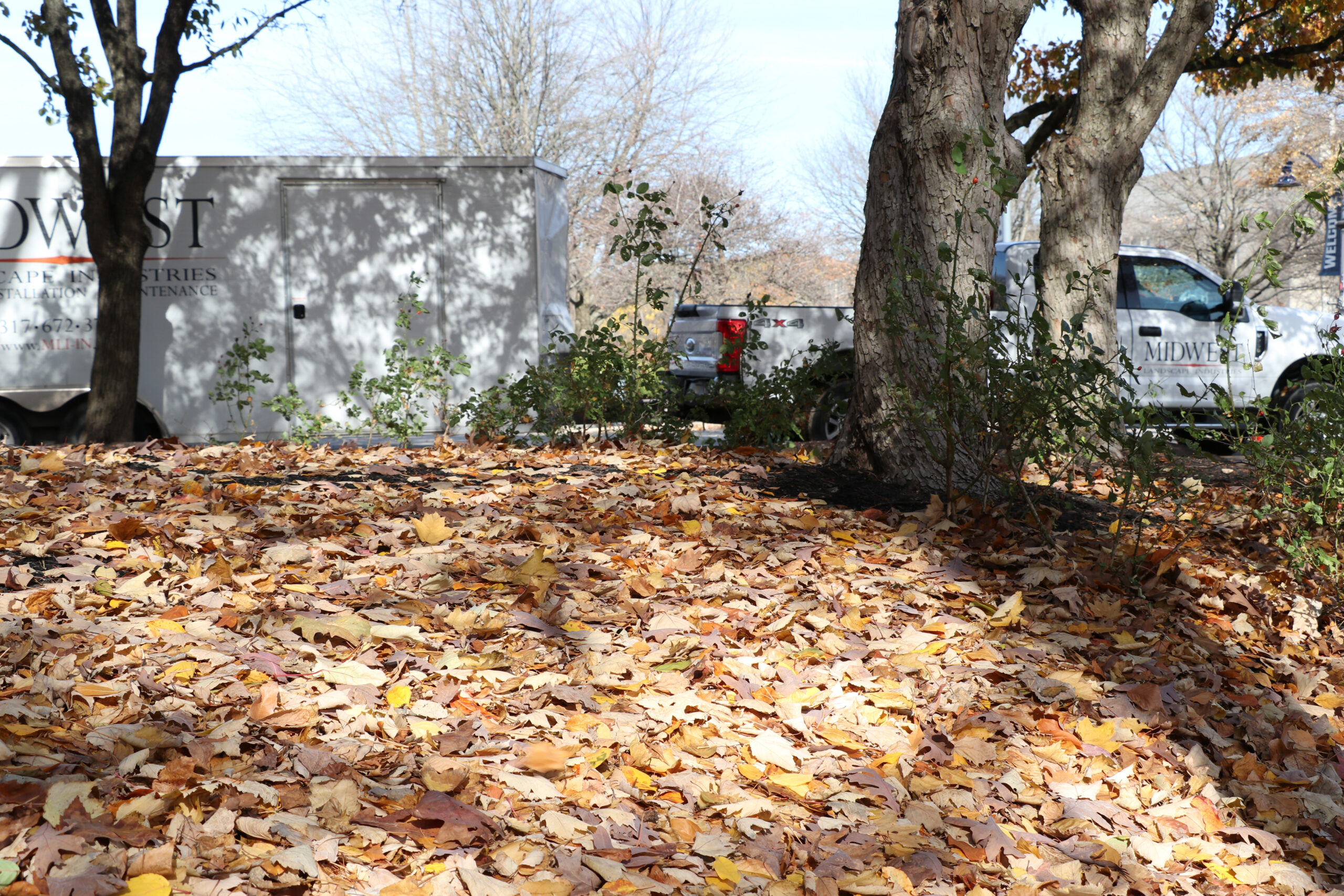
Does this pile of leaves really need to be removed? Photo by Jonathan Wang.
SILAS OWENS | OPINION COLUMNIST | szowens@butler.edu
There’s nothing that defines fall at Butler like beautiful foliage and the constant drone of leaf blowers. On any nice-enough weekday, the sound is inescapable. Sometimes it is a roar right next to you on the sidewalk, and at other times a distant hum from an unknown location, but the sound is sure to be there.
On a recent sunny Thursday after snow had melted, I was walking to Starbucks at 8:15 a.m. and had to navigate leaf blowers clearing the mall. That morning at 10:30 a.m., I was leaving class and saw the sidewalk blocked by a leaf collection truck. At around 1:30 p.m., I noticed, on the way to do an interview for this article, that the sound was particularly loud in the second-floor hallway of Jordan Hall. I looked out a window and saw a fleet of leaf blowers accompanied by what looked like a backhoe that should have been on a construction site.
The very next day, walking to my 9 a.m. class freshly out of bed, I was once again assaulted by the sound of leaf blowers. Later that afternoon, I could still hear the distant echo of machinery from somewhere across campus.
The issue goes from merely an annoyance and personal pet peeve of mine to a legitimate disruption when you enter Jordan Hall, a historic building surrounded by green space. The building’s ancient windows, which might as well just be decorative, do almost nothing to control temperatures and sounds.
Elijah Smith, a senior history-anthropology and English double major, described how the noise can be disruptive to him during class.
“When it’s not happening, I don’t think about it, but when it is happening, that’s all I can think about,” Smith said. “It can be very distracting, especially during a class discussion where you’re discussing things like social economic status or race and gender and then you just hear RRRRRR from outside.”
Associate professor of mathematical sciences, Dr. Shaha Patwary, emphasized the distraction to students while he gives quizzes and exams in Jordan Hall.
“The sound is pretty much next door, right outside of the building, and here in Jordan Hall, all the windows are not completely shut down,” Patwary said. “[When] the sound is coming and it is a heavy sound, students are often distracted while they are taking exams and quizzes … We have to make sure [campus] is clean, it is beautiful, but at the same time it is a concern, especially when students have their quizzes and exams.”
The difficulty here is actually solving the problem. As a student, leaf removal doesn’t seem like it should be such a priority as long as the sidewalks are fairly clear. Does the mall really need to be completely free of leaves at all times? Is it that big of a deal if leaves pile up in the grassy areas surrounding Jordan Hall?
Whichever administrators decide these things should think hard about how much leaf removal is actually necessary and what the best way to go about it is. It would be bad if someone slipped on leaves on the sidewalk and hit their head and left brains all over the floor. So we probably try to keep the leaves off the sidewalk.
But would visitors to campus have a worse first impression if there were more leaves in the grass, or if there were loud leaf blowers blasting for the entire visit? I would take the leaves in the grass every time. At the same time, it is reasonable to want the grass on the main mall not to get completely covered in decaying leaves. So where’s the line?
For Daphne Kirby, a junior philosophy and psychology major, the current use of loud gas-powered leaf blowers should be completely removed.
“I feel like we don’t really need leaf blowing,” Kirby said. “The only problem that I can anticipate with the leaves is that they would make the sidewalk slick, and getting them off the sidewalk could be done with a rake or a shovel or a broom or anything other than a gas-powered leaf blower. Even electric leaf blowers would be quieter.”
Kirby also raised concerns about the environmental impact of such frequent use of these leaf blowers, which pollute the air at much higher rates than cars and trucks.
“Butler tries to pride themselves on being sustainable,” Kirby said. We’ve started this new composting thing where it’s like, ‘save your food scraps so we can compost them.’ Fun fact, leaves are actually compostable, naturally, on their own, so to bring like 50 gas-powered leaf blowers to campus every day is actually a little bit counterproductive.”
So what can be done? Maybe the solution is to reduce the landscaping schedule. Maybe more isolated grassy patches like the ones around Jordan Hall can be left alone for longer. A change in equipment to electric blowers or even good old-fashioned rakes could be a good solution. Much of the Butler community would appreciate any indication that the impact of leaf blowers on campus life is being considered.