
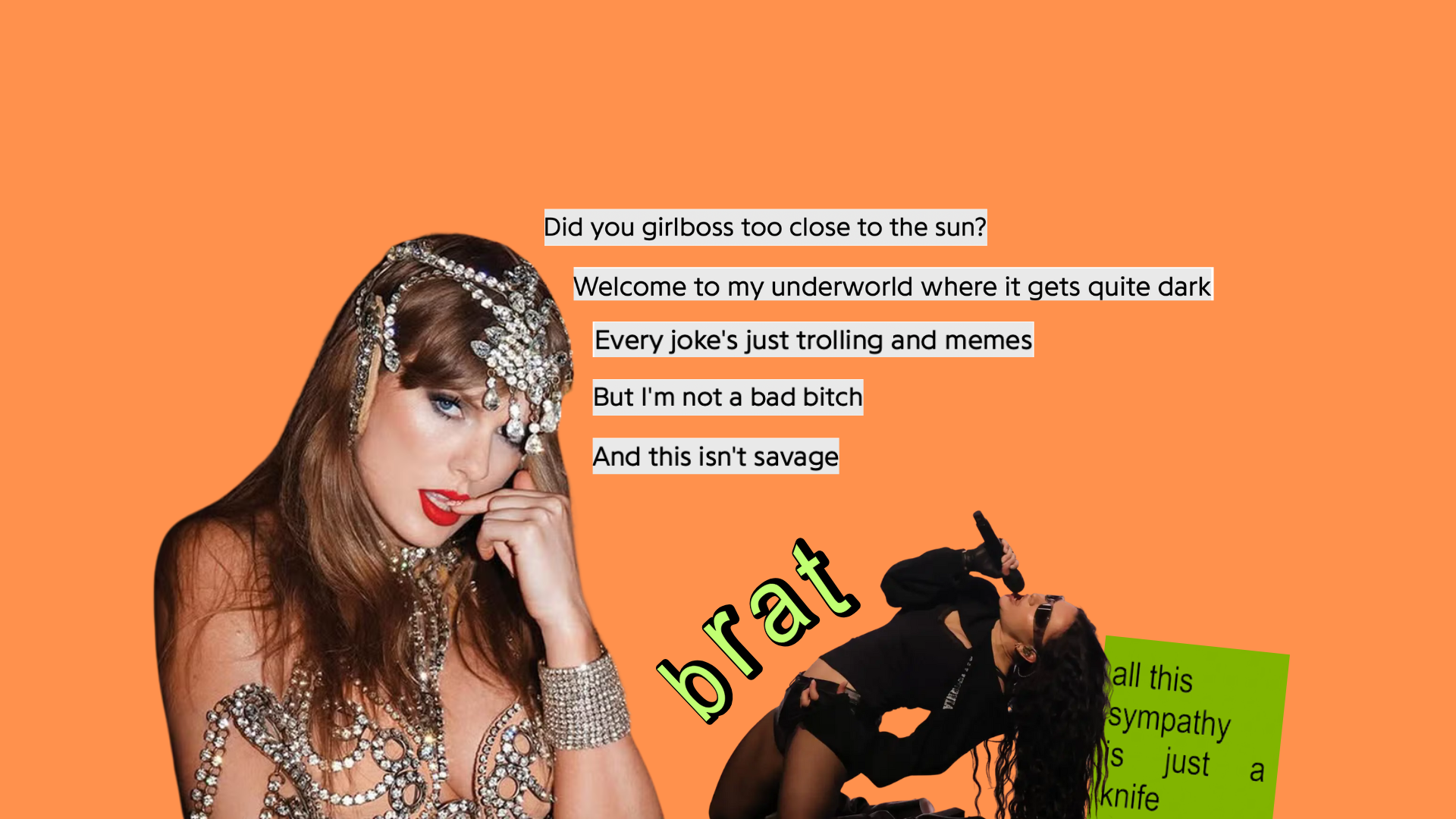
The old Taylor can’t come to the phone right now. Graphic by Emma McLean.
EMMA MCLEAN | MANAGING EDITOR | emclean@butler.edu
Over the past decade, billionaire pop icon Taylor Swift has come to symbolize the apex of modern musical success. But can such a level of cultural and economic dominance be attained without sacrificing individualism or succumbing to hyper-commercialization?
Her latest release, “The Life of a Showgirl”, offers me little reassurance in this ponderance.
When the album dropped on Oct. 3, the reception was notably more negative than her usual releases. Swift’s work has often been unfairly dissected under a gendered microscope, with double standards and personal attacks clouding fair engagement with her artistry. That being said, there is also, of course, completely valid criticism, particularly of “Life of a Showgirl”, like, for example, that it’s largely devoid of emotional nuance.
Senior psychology major Emily Farkas has been a lifelong fan of Swift; in the wake of her new album, Farkas is grappling with disappointment.
“The person who wrote ‘Teardrops on My Guitar’ and ‘White Horse’ can’t be the same person who wrote this album,” Farkas said. “I view [‘The Life of a Showgirl’] as almost egotistical. It seems like she doesn’t think she has to try anymore … I’m getting secondhand embarrassment.”
The album’s lyrics — once Swift’s most reliably praised strength — are being widely ridiculed online. With lines like, “Did you girlboss too close to the sun?” and “I’m not a bad bitch and this isn’t savage,” audiences get caught in a kind of tonal vertigo.
And then there’s the major contention: “Actually Romantic”, a thinly veiled diss track purportedly aimed at pop provocateur Charli xcx.
In June 2024, Charli xcx released “BRAT”, an album that swiftly transcended the boundaries of pop music to become a cultural touchstone, particularly resonant among young people. Among its standout tracks is “Sympathy is a knife”, a song that delicately navigates the terrain of personal insecurity and self-comparison, with alleged lyrical references to Taylor Swift: “I couldn’t even be her if I tried.” Far from a direct critique, the track unfolds as a nuanced internal monologue rather than a targeted rebuke. It is within this context of vulnerability and self-interrogation that “Actually Romantic” enters the conversation.
“[‘Actually Romantic’] is hard to get through,” Farkas said. “Taylor tries to be discreet — it’s always a puzzle. But some are easier than others. This one, for example, is quite easy.”
Through lyrics alluding to “The 1975” and Charli xcx’s rumored drug use, Swift implies that Charli’s motivations stem from mere obsession. This reductive characterization flattens the emotional and psychological complexity at the heart of Charli’s work, collapsing nuanced introspection into a narrative of pure antagonism.
Avery Terry, a junior history and German double major, defends “The Life of a Showgirl” as an entertaining pop album that doesn’t need to be Swift’s best. Yet, she agrees there is an overwhelming juxtaposition between songs.
“Context aside, [the songs] are not on the same level at all,” Terry said. “‘Sympathy is a knife’ is definitely trying to make a more deep, profound statement about female relationships and competition … but I don’t think [Taylor] was trying to make an equal statement.”
Intentional or not, the message failed to resonate. Rather than engaging with these topics directly, Swift’s response sort of sidesteps them altogether, offering instead a defensive posture. This ultimately reinforces a broader cultural pattern in which women’s emotional transparency is misread as hostility or madness-induced.
McKenna Curless, a junior media and creative entertainment and strategic communications double major, is a fan of Charli xcx and the inclusivity she stands for.
“In [‘Sympathy is a Knife’], Charli is harping on her insecurities about Taylor Swift,” Curless said. “I just think it’s so crazy that someone would make a song — a mediocre song at that — clapping back at this when it’s not even a diss track in the first place. It’s disrespectful in my opinion … ‘Actually Romantic’ missed the point entirely.”
Beyond the waves of lyrical and social criticism that have followed the album’s release, a number of more serious concerns have emerged, particularly surrounding questions of racial stereotyping and bigotry. Many listeners have critiqued “Opalite” for perpetuating racial stereotypes.
Ultimately, the question isn’t whether Taylor Swift has the right to release a “fun” album or one that includes subtle disses at others. Of course she does. The question is what happens when one of the most powerful musicians in the world starts using that power to churn out demeaning, algorithm-friendly work devoid of thoughtfulness.