
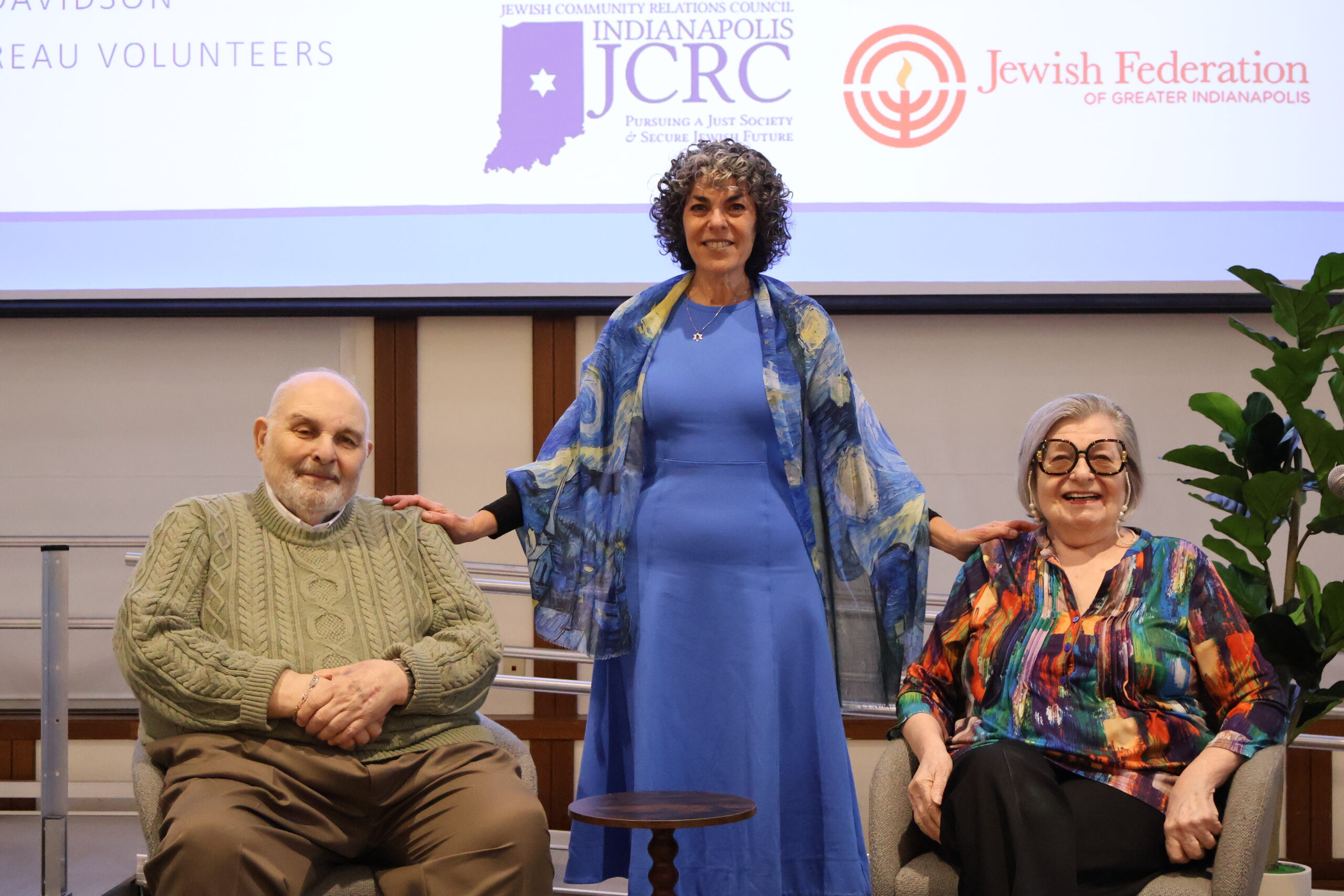
Ed Davidson, Sharie Fields and Esther Davidson share their family’s Holocaust story during an event in the Reilly Room on Oct. 22. Photo by Mason Buysse.
KINLEY SHOEMAKER | STAFF REPORTER | kbshoemaker@butler.edu
Holocaust educator Sharie Fields spoke alongside her parents at Butler University on Oct. 22, sharing her family’s history and experiences during World War II. Fields began with an introduction and explanation of her family’s background before asking her mother questions about her experiences as a child during the Holocaust. The discussion concluded with an open Q&A session, allowing audience members to ask both women about their family’s story and the importance of Holocaust education today.
The Butler Collegian spoke with Fields before the event about her family’s history, her approach to Holocaust education and the responsibility she feels to share her family’s story with new audiences.
THE BUTLER COLLEGIAN: For those who don’t know your family’s story, how would you describe their experience during the Holocaust?
SHARIE FIELDS: Sheer hell. Is that good enough? Interestingly though, [my] mother never spent a moment in a concentration camp, thank God; so she was a child of the Holocaust. My mother’s parents — her mother — spent quite a bit of time in a gulag in Siberia.
My mother and her mother were Holocaust survivors. They were from Poland, and very few people survived — [but] they did. My mother’s biological father was murdered during the war, so she never knew him. My grandfather, who raised my mother, also has his own story of losing a wife and a child [and] six of his seven brothers. He’s from Ukraine. He landed in the same gulag where my grandmother landed. That’s how they met — in a very unromantic way.
My father’s father immigrated to the U.S. in the 1920s from Latvia. He lost his entire family in Latvia during World War II, except for one sister, who he was able to bring over right before the war started. The rest of his family — his sister, his mother, every aunt and uncle — were all murdered.
My father’s father went back to Europe after World War II ended and served for one year at the Nuremberg Trials. [He] was living in Milwaukee, Wisconsin, and answered an ad looking for someone who spoke German, Russian and English fluently. He did not know what this would lead to [but] he found out he was accepted. He was flown to Germany, where he lived for a year and was part of putting the war criminals on trial.
All that to say, one side of my family survived the war, and the other side had a hand in bringing some of the most heinous criminals to justice. I have been steeped in Holocaust history for the entirety of my 59 years.
TBC: When did you first learn the depth of your family’s history?
SF: I remember very clearly [that] the subject of the Holocaust or life before coming to America with my mom’s parents was absolutely off limits. We did not talk about it. We were instructed not to talk about it. Things would kind of eke out from time to time.
For example, my maternal grandmother had dentures, and when I was a little kid, I was really fascinated with her dentures. She said, “You know, the reason that I have dentures is that for many, many years, I did not have fresh fruits and vegetables to eat, and I did not have access to a toothbrush, and therefore my teeth were rotted, and that’s why I have dentures.”
That was as much as I really knew. But you could tell, being in the house with my grandparents, we didn’t really have to speak about it. There was a … big blanket of sadness and fear that was present wherever they were. You could just [walk] into a room [and] feel that sadness and fear all the time.
I never knew the stories, [but] would get little tidbits like that one. There was one time that my mom and I sat at the kitchen table with [my grandparents] and just poured out their stories for about two hours. I remember it very well.
They both spoke several languages, and they would do some Yiddish, some in English. I would stop them every few minutes — “Mom, what did they say? I don’t understand what they’re saying here.” But I remember it very well.
There was only once that they spoke of it, [which is] very typical. I know a lot of other survivors, and I know lots and lots of children of survivors, and that is typical — that nobody who survived, very rarely did they speak of it.
At first, I was kind of upset by that [because] that’s our history [and is] knowledge we should have. But having grown older and wiser, I realized that it’s a great favor that they did [for] us — to do their best not to pass on the trauma. It’s not appropriate for young people to hear these stories.
TBC: What made you decide to start speaking publicly about your family’s story?
SF: I’m the only one in my family who’s actually practicing the religion of Judaism. Back in [about] 2010, someone from the Jewish community … sent me a letter. [It] said, “Our Holocaust survivors are dying. We need people who are second-generation Holocaust survivors.”
The Jewish Federation of Greater Indianapolis had what they called a volunteer Speaker’s Bureau. They reached out to me because they knew me [and] because I’m actively part of the Jewish community. I went to my parents and said, “I think this is something we should do.” [They] went to the Jewish Federation [to] train and develop a presentation. They started speaking around 2012, and I would go with them.
As they got older, I thought, “They’re not going to be able to do this forever,” and this is a duty and a responsibility. It is not a pleasure. I get physically ill every time that I have to present. But the feedback that I get — seeing that kids are learning something — that keeps me going.
Every year I say, “I’m not doing this anymore.” And every year, I do it again.
TBC: As Holocaust education becomes more urgent with fewer survivors able to tell their stories firsthand, what do you see as your role in continuing that education?
SF: [Speaking at events like these] is what I see as my role, and I would love for my children to ultimately pick up the ball. It used to be that the Jewish Federation of Greater Indianapolis would do the outreach to schools, and they would come to us and say, “Here are the schools that have asked for a speaker,” and they would divide it up among those of us who speak.
In the last several years, they have not been able to do the outreach as much, so I have been devoting … almost as many hours to outreach [in the last three years].
It’s supposed to be a standard that in middle school and high school in the state of Indiana, Holocaust and World War II education is part of the curriculum. What I’ve discovered, [though], … is that there’s really no teeth behind what [these events] entailed.
For some [students], Holocaust education is one hour in a classroom, and it’s nothing. For [others] it’s four days — and those are the ones who get the most. There are some colleges that have semester-long classes on just the Holocaust. You can’t cover it in an hour. I don’t know how they do it.
What I do is [I] just keep going. I go where I’m asked. I reach out to new schools. I make sure that students have the opportunity to hear from a family that lived through it, because if we don’t keep telling [our stories], it will be forgotten.