
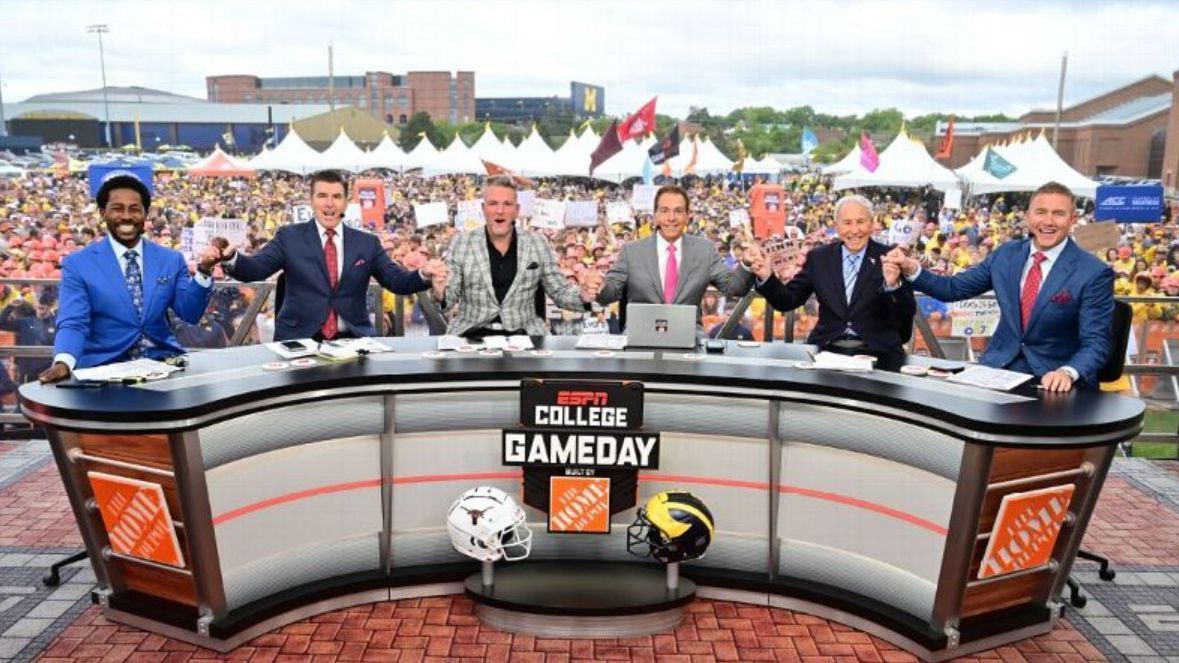
“College Gameday” has been on the air since 1987. Photo courtesy of ESPN.
JAMIE HEALY | STAFF REPORTER | jdhealy1@butler.edu
Overtime, or “OT,” is an opinion column series where the Collegian takes national sports headlines or polarizing topics and gives them a Butler-centric angle.
Waves of screaming fans hoisting humorous signs and a jovial pregame crew excited to break down upcoming college football action have become must-see television every Saturday morning in the fall. All of these are staples of ESPN’s college football pregame show “College Gameday”.
“College Gameday” has been the pinnacle of sports pregame television since its inception in 1987 as a 30-minute preview show. Before this year, one could always count on seeing longtime college football coach Lee Corso as a part of the panel. Corso retired after a final show on Aug. 30 at the age of 90.
“Gameday” began to go on the road in November of 1993, when it went to South Bend, Indiana, to cover No. 1 Florida State at No. 2 Notre Dame. Additionally, the headgear selection that Corso is known for did not begin until 1996 when he put “Brutus Buckeye” on to symbolize his pick of Ohio State in its game against Penn State.
Throughout the years, viewers watched Corso don a mascot head with a sea of fans cheering or jeering the selection, depending on whether he picked the host school or road team.
However, as Corso has left for a well-deserved retirement, the tenor of the show has changed. The ceremonial headgear selection has been lost to time. Instead, it is former NFL punter Pat McAfee who delivers the final pick before the show goes off air every Saturday morning.
McAfee is a polarizing figure in today’s sports media landscape. Some viewers love the open personality and energy he brings to the show, while others do not care for McAfee’s style.
Even among those who believe McAfee’s addition to the show has been good for drawing eyes to the sport, the rapid shift from Corso’s headgear selection to McAfee’s drawn-out, WWE-style promo has garnered mixed reactions.
Campus chaplain James Brockmeier, a self-described McAfee homer, believes that ESPN made a mistake in highlighting McAfee’s selection as the final moment of each show.
“I think it is too much of a change too quick,” Brockmeier said. “I think they should have given the last pick to somebody [who] had been around “Gameday” a little longer.”
McAfee was brought onto the show as a full-time panelist beginning in 2022. Since then, he has grown in stature for “Gameday” and has been a driving force for the show as the college football landscape has shifted.
However, it is not just the loss of Corso that has hampered “Gameday” and resulted in a loss of its mystique.
ESPN’s media rights deal with the Southeastern Conference (SEC) has also been a catalyst for change in “College Gameday’s” style.
After the deal started in 2024, “Gameday” visited an SEC school eight times in a 14-week period last year. So far, through eight weeks in 2025, “Gameday” has visited an SEC school five times.
This has raised eyebrows as “Gameday” seems to have shifted from highlighting old-school rivalries and schools that often do not receive attention in the wider college football space to effectively planting itself in SEC territory.
Sophomore biology major Grant Ipsen contends that the change in the number of locations “Gameday” visits in a year has taken away some of the energy of the show.
“It’s been very repetitive,” Ipsen said. “[As an Illinois fan], it makes me very sad that the University of Illinois did not get some love even though they were playing the number one team [Ohio State].”
The presumed bias of “College Gameday” towards big brands — especially those in the SEC — led to the creation of FOX’s “Big Noon Kickoff”, which tends to host its show at Big Ten universities. However, “Big Noon Kickoff” has also chosen to cover games with high stakes in the Big 12 conference, such as the Holy War and the Cy-Hawk rivalries.
Colin Dwyer, a sophomore creative media and entertainment major, believes that “College Gameday” is missing an opportunity to educate neutral fans about these big rivalries by not going to these types of games.
“There’s definitely been less of a focus on non-SEC teams,” Dwyer said. “It’s definitely a struggle to get fans to care about these games. [‘Gameday’] should not be going to the same places every week.”
Out of respect for Lee Corso and everything that made “College Gameday” must-watch television, the show needs to go off the air.
The loss of airtime for non-SEC programs has also been a driving force as to why “Gameday” has become a shell of itself. The current iteration of “College Gameday” may be serviceable, but without Corso and with the constant SEC-visits, it is just not the same.