
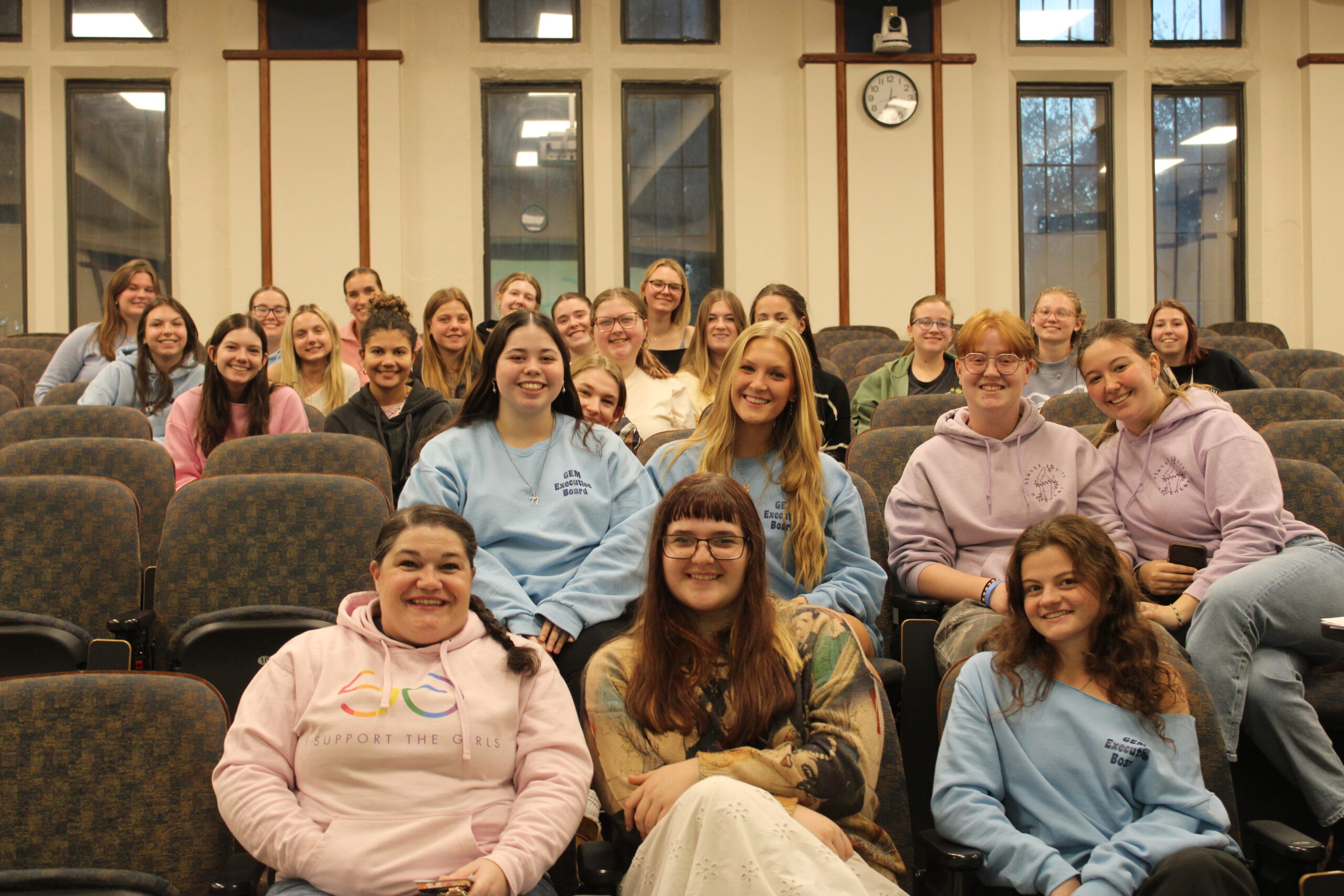
I Support the Girls panel discussing dignity in charity and financial insecurity. Photo by Samantha Noga.
AUBREY MATASOVSKY | STAFF REPORTER | amatasovsky@butler.edu
The Gender Equity Movement (GEM) at Butler University held a panel with I Support the Girls, a nonprofit in Indianapolis that focuses on providing supply kits to unhoused people, domestic violence shelters and people going through poverty came to campus Thursday night.
The panel featured Sara Whitmer, the Midwest operations director for I Support the Girls. Whitmer has been working with the organization for more than two years and is responsible for organizing and distributing aid as well as outreach programs and events.
“I think [college] is a really great time to learn about and maybe start to question things that you took for granted when you were younger,” Whitmer said. “Learn more about what people who grew up differently [from] you deal with in life, ways that you can become a more active citizen of your community.”
Whitmer explained that college students themselves can face the challenges that I Support the Girls aims to mitigate, though it can be overlooked at wealthy institutions such as Butler.
“Financial insecurity is a very common experience in college, but it’s not always super visible because you have housing ostensibly, you have a meal plan,” Whitmer said. “People might not think to wonder if you have pads or tampons, if you can afford your prescriptions or if you’re doing this on your own. I think that it touches a lot more people than we realize.”
The event was organized by Rachel Joyce, a sophomore creative writing and psychology double-major who acts as the community outreach chair for GEM and volunteers with the non-profit.
“I figured this was a really great way for the Indianapolis community to come to Butler and to really pull people into their community because Butler can be a really sheltered school,” Joyce said. “I wanted us to be able to talk about uncomfortable things, and I figured that this nonprofit, paired with our club, does that really well.”
One of the goals of the panel and GEM is to raise awareness for difficulties students may be facing that are not always considered part of the Butler experience.
“Butler is very rich and very privileged, so it is easy to forget that there are people who struggle financially at this school,” Joyce said. “There are people who struggle with hygiene from a mental [and physical] health standpoint, from a financial standpoint. Having these topics brought out into the open, even if you leave a club event with more questions than answers, will just help us understand [those struggles].”
Mackenzie Sizemore, GEM president and senior political science and sociology double-major, has observed a similar environment that may shelter Butler students.
“We call it the Butler Bubble for a reason,” Sizemore said. “Recognizing we have that and actively working to escape that [can help]. Part of [helping] does start with stepping off campus, out of the bubble and recognizing that people have experiences that you don’t have.”
GEM continues its outreach events and efforts at bursting the “Butler bubble” by spreading awareness of gender issues.
“I just want people, if they know anything about GEM, [to know] that it’s a group for everybody and not just a group for women,” Sizemore said.