
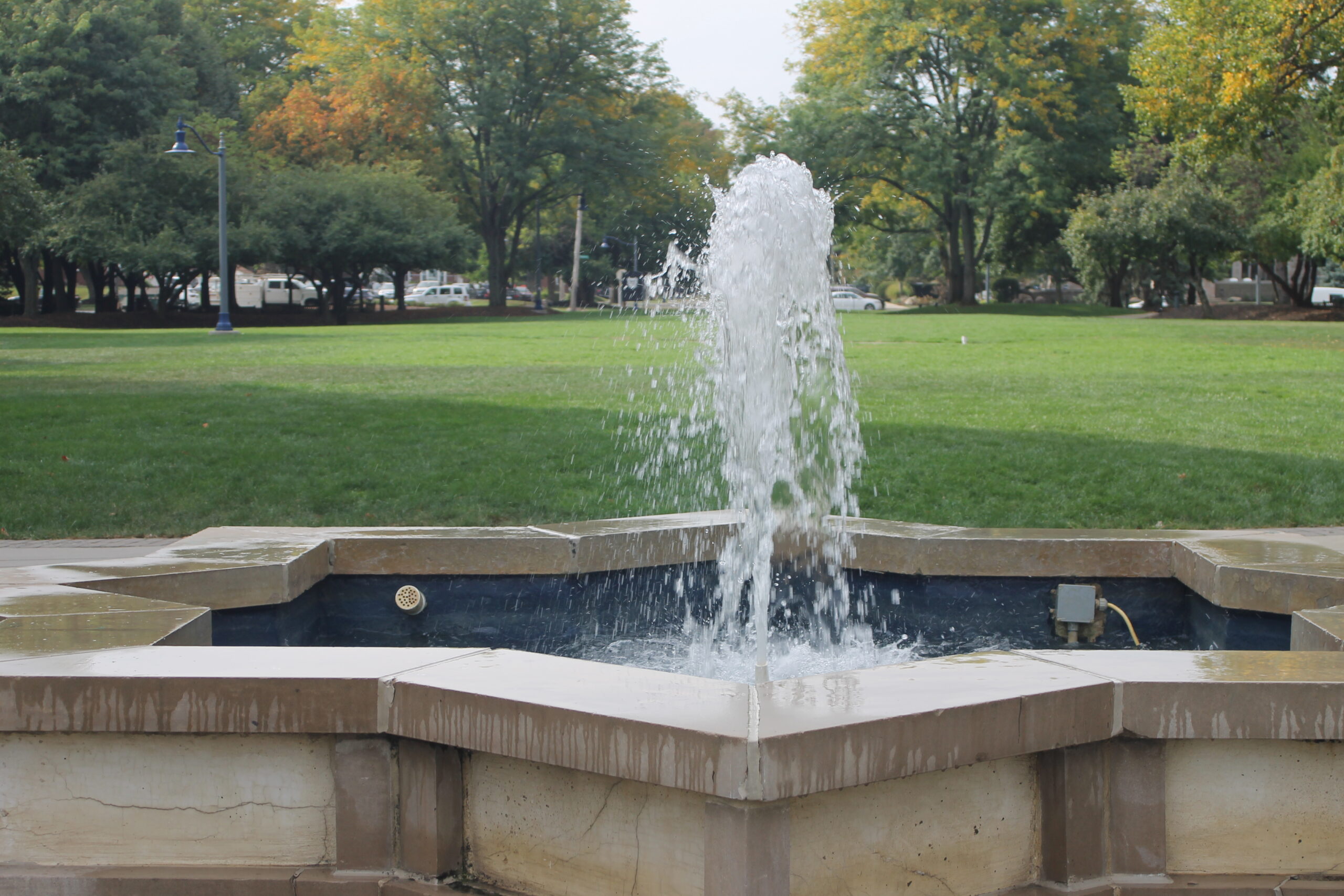
Star Fountain is nice to look at, not to jump in. Photo taken by Delaney Hudson.
SAMUEL DOSTER | OPINION COLUMNIST | sdoster@butler.edu
Every college has its traditions, whether that is visiting a statue before a test for good luck or participating in the annual UCLA underwear run. Butler has its own tradition; some look forward to jumping into the university fountains during their four years here. There are seven fountains on campus — including the pond — but fountain hopping is gross and unsanitary.
The most famous of the fountains is the Star Fountain, located outside Irwin Library, right in the center of the quad. The fountain is usually the first of the seven that the incoming first-years will jump into.
I find the Star Fountain, especially during the first several days on campus, to be particularly unappealing. During orientation week, as many as 100 people would jump into the fountain in one night, making the water look gross and murky. Not to mention people getting their sweat and germs in the water when they jump.
First-year finance major Nate Paumier had a different take on the tradition of fountain hopping here at Butler.
“I’m all for it,” Paumier said. “It’s a great tradition to carry on, and I like how there is an order to it, and you finish at the fountain in the library when you complete your last final as a senior.”
Paumier explained his comfort level with jumping in fountains around campus.
“I’ve seen them chlorinate and clean the fountain in the mornings because I have a 9:30 a.m. class.” Paumier said.”
Even though the pond may be cleaned with chlorine in the morning, who knows how many things could have fallen into the pond during the day? These things could include bird poop, food dropped by passersby, or bacteria building up over time.
Water can contain all sorts of bacteria, and there are many ways that waterborne bacteria and the chemicals inside the water can hurt or damage your skin. According to Clean Water Company, “When Chlorine reacts with organic chemicals like sweat or sunscreen, it can create harmful byproducts such as chloramines and trihalomethanes, which are linked to lung irritation and other risks”. Some of the many types of harmful bacteria that could linger within the pond water, according to Living Water Aeration, are Salmonella and Legionella.
A notable aspect of the Butler Foundation tradition is jumping into the pond located behind the observatory and close to the Holcomb Gardens. For this fountain to count towards your goal of seven before you graduate, you must fully submerge yourself and swim out to the middle of the pond – where the water sprouts up – for it to count. Who knows what lies beneath the water in which the students submerge themselves, but I would not want to find out.
Abigayle Hammack, a sophomore marketing and strategic communications double major, has already jumped into four fountains on campus.
“Honestly, I wouldn’t call it the most sanitary thing in the world,” Hammack said. “But I do love the tradition of it.”
Sophomore biology major Grant Ipsen agreed that fountain jumping may not be the cleanest thing in the world.
“I do find it unsanitary,” Ipsen said. “But there are measures you can take, like washing your clothes right after, and also taking a shower.”
While I agree with Ipsen that showering after would be fine, I would still be concerned about bacteria entering through my ears, nose or eyes.
As I conducted my interviews with fellow Butler students, a common theme occurred: That while fountain hopping has the potential to be unsanitary, some students can look past it. Many have asked, “Why not just shower afterwards?” That being said, it is a practical solution to the problem at hand. Personally, I would still prefer to remain dry and limit my potential exposure to bacteria-ridden water.
Although fountain hopping is a beloved tradition and will remain for students to enjoy for years to come, I will not be participating. The bacteria, general grossness and the risks associated with entering the fountain outweigh the pros for me.