
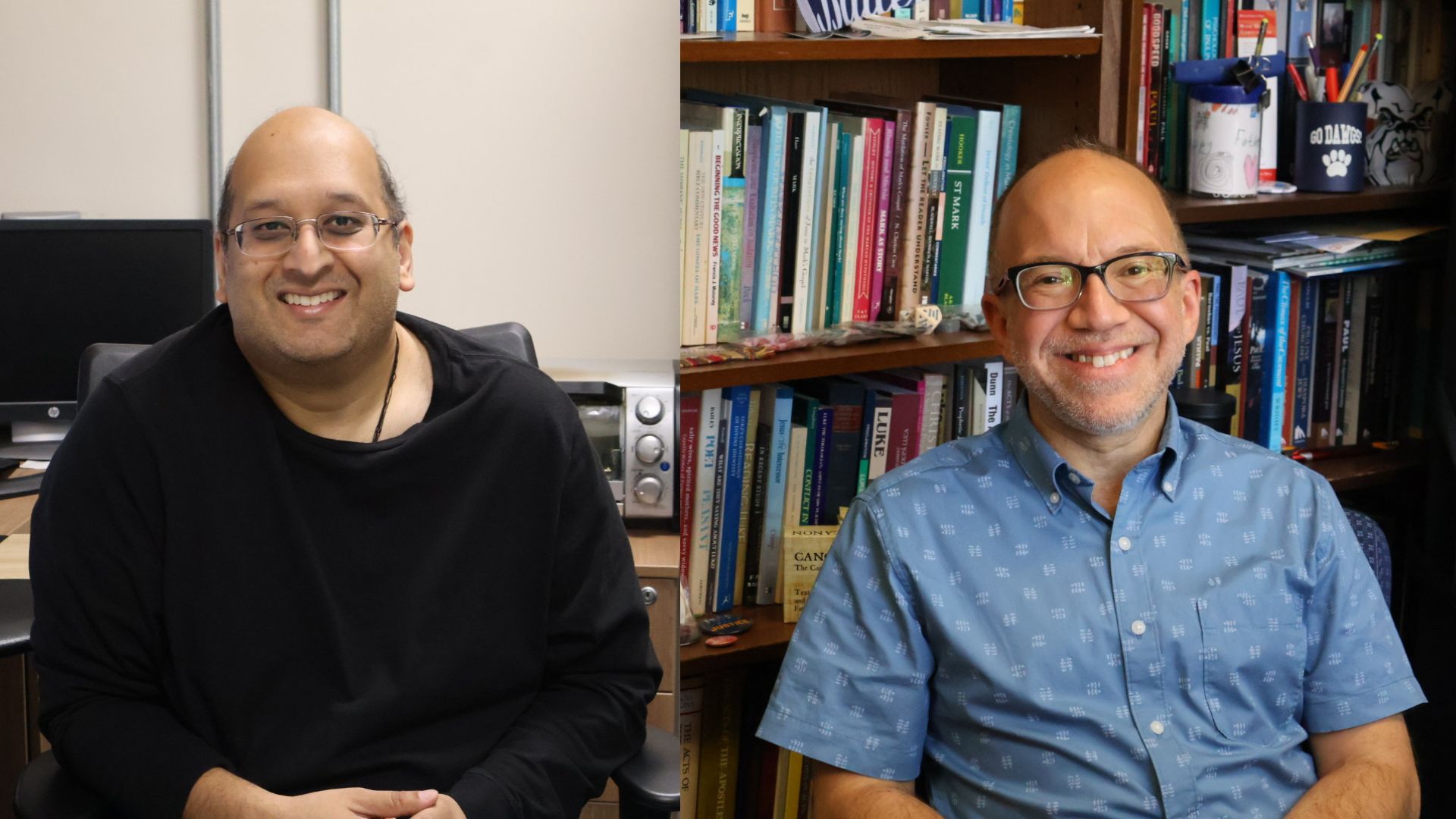
Ankur Gupta (Left) and James McGrath (right), co-authors of a book on generative AI. Photos by Elaa Becha
OLLIE FITZGERALD | ASSISTANT NEWS EDITOR | ofitzgerald@butler.edu
Two Butler professors published a book titled “Real Intelligence: Teaching in the Era of Generative AI” on Sept. 17. Combining the disciplines of humanities and computer science, the book encapsulates how generative AI can be used in the educational world.
Ankur Gupta, department chair of the computer science and software engineering department, and James McGrath, department chair of the philosophy and religion department, began to collaborate when they realized they had overlapping interests in AI. The pair — while an unlikely combination — began by publishing an article together and moved to working on a book.
McGrath’s main field is Biblical studies, but he is a “long-time” science fiction fan who teaches classes that combine the two. He emphasized the strong connection between the genre and the study of religion.
“I got into AI very early [as a research subject],” McGrath said. “One of the topics that comes up when [discussing] science fiction is artificial intelligence, but the very speculative stuff about the distant future, which a lot of that intersects with religion. There are lots of episodes or films that [ask], ‘Can a robot be a person?’, ‘[Do robots] have a soul?’, ‘Do they deserve rights?’ so on and so forth.”
McGrath started writing the book while on sabbatical last academic year, during a period in which he was supposed to be working on research regarding John the Baptist. He proposed the idea — with the topic of how to teach in the era of generative AI — to Gupta over winter break, and when the break ended, McGrath had a full draft.
Gupta significantly lengthened the draft by adding the needed technological knowledge. Gupta’s main contributions also included guidance, specifically for computer science professors who may be building lesson plans and new technologies.
He also commented on his attempt to define wisdom from a computational perspective — which he started researching almost 20 years ago — and trying to find a middle ground on research with McGrath.
“I was coming from computer science, trying to define [concepts] like wisdom and ethics,” Gupta said. “[McGrath] was coming from the other side, as a humanist, trying to figure out what to do with technology and ChatGPT, so the book came out of that combined interest.
Senior computer science major Alexis Wilson has also focused on the interdisciplinary work between computer science and religious studies. Through this crossover, she has taken classes with both McGrath and Gupta, where the applications of AI have been discussed. In one of McGrath’s classes, the book was specifically brought up.
“[Their book] was mainly talked about in [McGrath’s] class about religion and science fiction,” Wilson said. “We even [had a] class [session] with a computer science class where Gupta came in and they both talked about [their research].”
A main point that both McGrath and Gupta emphasized is the need to understand the limitations of generative AI.
“[Generative AI] was not designed to solve all of your problems,” Gupta said. “It was not designed to give you information. It was not designed to give you accurate [information about] anything. If you can understand that and recognize that, then you can contextualize it as a tool for a specific [purpose]… like [with] a calculator.”
In a lecture taught by McGrath, he encouraged his students to use ChatGPT to see if it could help them find sources for a research project. By guiding the AI through a series of questions, his students were given access to source links — all of which turned out to be sources that the AI had fabricated using real authors’ names.
The book aims to remedy the misuse of AI by aiding teachers in how to educate alongside current technology by focusing on the process of using AI in research, instead of jumping straight to whatever response is generated.
McGrath also explained that he wants educators to be wary of over-policing AI usage, especially as “AI detectors” produce false positives, and many “tells” of AI usage — such as em dashes and other forms of more advanced grammar — could result in punishing “better” students for grammar that is too perfect.
“Education is still meaningful and education is still possible,” McGrath said.
“Real Intelligence: Teaching in the Era of Generative AI” can be read online for free through PALNI Open Press or purchased as a physical copy on Amazon.