
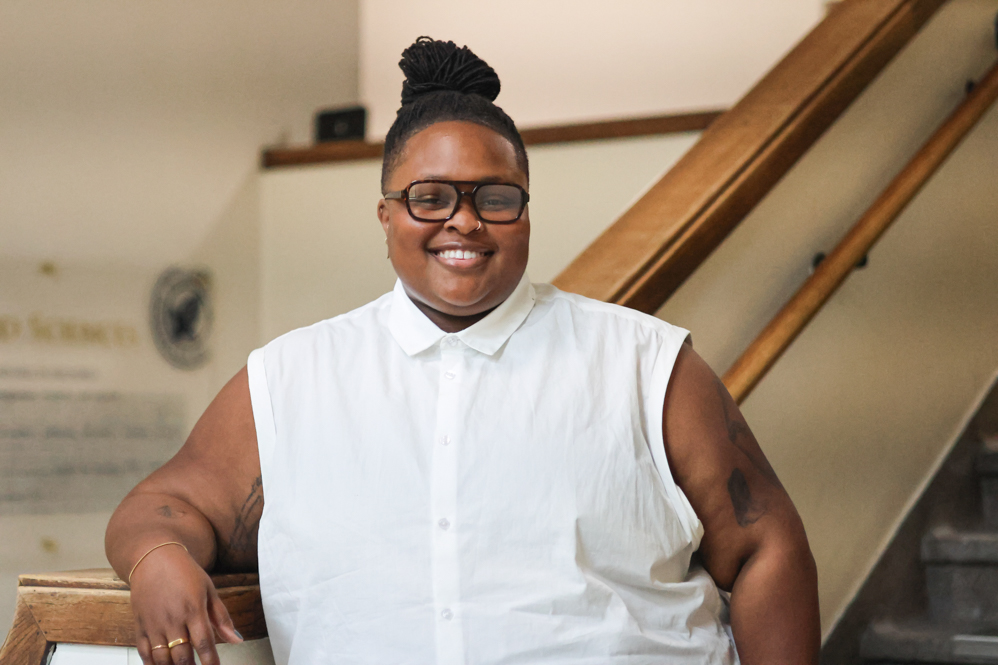
Dr. Moore fills Jordan Hall with joy and wisdom. Photo by Jada Gangazha.
HARRISON PRYOR | STAFF REPORTER | hrpryor@butler.edu
Members of the Butler community are achieving extraordinary things, both on and off campus. From first-years to alumni to administrators and back, each Bulldog has a story to tell. Read on to discover the next of our Bulldogs of Butler through a Q&A style interview.
A new year at Butler always means new students, and this year it also means a new professor. Dr. Cham Moore, Butler’s latest addition to the English department, got their start in teaching in 2015 at the University of Notre Dame, where they earned their PhD in English. Boasting an impressive bibliography of Black feminist literature and a feature on “The Daily Show” with Trevor Noah, Moore is a clear asset to the department.
THE BUTLER COLLEGIAN: What subjects have you previously taught? Which ones have been consistent?
CHAM MOORE: I specialize in African American literature within English, but I’ve also taught in gender studies and film studies departments before. My work has always been very interdisciplinary. Even within [African American literature], I usually specialize and look at speculative fiction and Black feminist studies — Black feminist cultural studies, more broadly, which of course intersects with all these things along the lines of gender and sexuality or just race studies more broadly.
TBC: Your First-Year Seminar class, Worldmaking, has a very broad name. How would you condense that broad subject?
CM: It is kind of what it sounds like — in thinking about who made the world around us and what goes into it, and what it means to make a world on the page. We use the class to bridge the gap between those two in thinking about who has made our country in their image and [the folks who] have started to reshape our country for themselves — thinking about marginalized groups and so forth — and finding paths for themselves in what was meant to be a specific framework.
We get to talk about worldbuilding and speculative fiction itself, but also [asking] how, in and of [themselves], countries, borders and ‘nations’ … are also kind of a created speculative fiction, too. How have they changed over time? How did the boundaries start to change as nations change, as borders move and so forth? We’re thinking through all of those ideas in my FYS right now.
TBC: How does your personal experience and identity as a non-binary, African American professor impact your teachings?
CM: I don’t know if it impacts my teaching style specifically, but I do think, obviously, that being a Black person definitely informs my relationship to Black studies and Black literature. I recently had a conversation with my upper-level courses, which is on Toni Morrison and Octavia Butler … we had a conversation the other day about why my students have felt the need to respond to [the] question of ‘is Black literature important?’, which is not a question anybody posed … I think that says a lot about how, even before coming to college, some of us are taught to talk about Black literature. We’re almost coming in on the defensive, being like, ‘Black literature is important because…’. Toni Morrison and Octavia Butler are important, right? That was never the question.
Instead, I really want [my students] to think about what tools [they] need to come with to engage with these texts while still thinking about [them] as culturally, historically and contextually informative. My experience as a Black person, and my personal relationship to Black literature — having been inspired by it, seeing it as a body of writing that is continually still defining itself and changing, shaping and growing — those two things definitely feel in conversation [with each other].
I am also a non-binary, queer person. I think that there are a lot of great things that can be found in the in-between, in the complex [and] in the nuance. To the degree that [it] informs my teaching, I guess I am thinking [how] it has shaped my walk through life. I want to make sure students are broadening how [they] think about things in my classes.
TBC: You went into what you hope to teach your students and let them take away from your classes. What further impact do you hope to have in your FYS and higher-level studies?
CM: So far, I am surprised and also really humbled by [how] students, particularly students of color, and even some alumni … have really gone out of their way to let me know how important they feel that I’m here, holding this position and teaching the literature that I’m teaching. None of that is anything I could’ve anticipated, but I’ve already felt really touched by that.
I’m definitely thinking about that context and trying not to take it as a weight, but instead as a welcome and, in some ways, as a challenge. I [want] to make sure I’m doing the folks who really care about [my] work justice. I’m very aware of the space that has been created for me and how I’m taking that up, and I’m just really grateful. I hope to honor all of that, and I hope to bring students into the world of [African American literature] in new ways.
TBC: How has your time here at Butler been?
CM: It’s been really great. I’ve really noticed how much Butler already feels like a close-knit community. I make jokes to my colleagues all the time that the [English] department feels like a family I’ve joined. I’m still getting to know all of the ‘uncles’ and stuff, [because] it does have that familial energy that’s really great to step into. Butler is a smaller university than some other places I’ve worked. I really appreciate the intimacy here because [of that] and because folks have that chance to get to know everybody really well.