
Overtime, or “OT,” is an opinion column series where the Collegian takes national sports headlines or polarizing topics and gives them a Butler-centric angle.
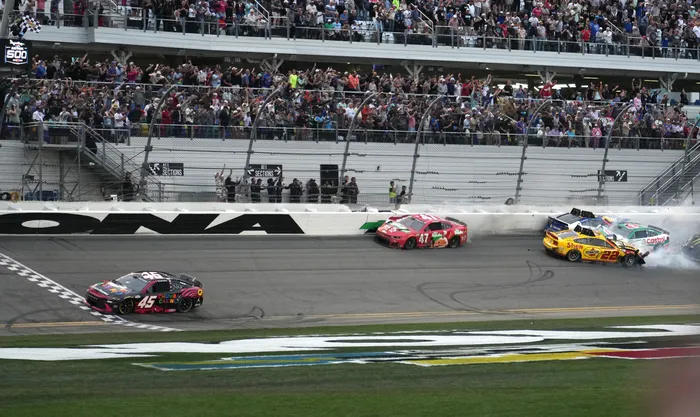
The Daytona 500 kicked off the 2026 NASCAR season with Tyler Reddick taking home the Harley J. Earl Trophy and going into the history books forever. The final lap featured two wrecks, which allowed Reddick to win the race after only leading for the last lap. The race set a new record with 26 different drivers leading at least one lap.
Reddick was awarded 55 points for winning the Daytona 500, an amount that has risen 15 points with the new Chase playoff format. In the NASCAR playoff format used from 2017-2025, a race winner earned 40 points — equal to the number of cars in the field — with second through 35th place receiving between 35 and two points, and positions 36 through 40 earning one point each. The winner also received an automatic playoff spot and five playoff points. The 2017 season also introduced a three-stage system for each race, with the winners of Stages 1 and 2 being awarded an additional playoff point.
At the end of the 26-race regular season, the top-16 drivers with the most playoff points would qualify for the NASCAR Cup Series Playoffs. This was a 10-race format, with four drivers being eliminated after every three races. If a driver won a race in the playoffs, they would automatically advance to the next round.
The now-retired playoff format consisted of three elimination rounds, with three races each round. The driver who ended the playoffs with the most playoff points — or wins the race — would win the championship.
Sophomore sports media major Landen Nelson did not like this playoff format, as it did not reward consistency throughout the entire season. Nelson believes the new format is more beneficial to the sport.
“[The new playoff format] is phenomenal,” Nelson said. “This is what NASCAR fans have been praying and hoping for since 2014. It’s a compromise of consistency, so you’re rewarding the driver who does a phenomenal job throughout the first 26 races. A champion is crowned by the driver who was the most consistent, not by how many race wins they have.”
Having the playoffs consist of 10 races with all playoff members, instead of elimination rounds, helps to get rid of intentional crashing to advance and keeps the integrity of racing intact.
“[In] this playoff format, you’re going to see more clean, hard-nosed, tough racing,” Nelson said. “Wrecking is not racing. When I consider NASCAR racing, it is door-to-door, side-by-side, beating and banging. You’re going to see drivers go for the win, you’re going to see cars spin out. If you’re going for a win [then there might be cars spinning out], but not to the point where you’re really going to intentionally throw somebody in the wall.”
Junior sports media major Matthew Wims believes that the new playoff format, not guaranteeing a spot in the playoffs, does not take away from the spectacle of winning the Daytona 500.
“The Daytona 500 is not only the most prestigious race in NASCAR, but it’s one of the most prestigious in the world and it’s still the race that a lot of drivers want to win,” Wims said. “There [are] still drivers who are really good who haven’t won it, and they have the asterisk next to their name, like Tony Stewart and Kyle Busch.”
Due to the 2026 Milano-Cortina Winter Olympics happening at the same time as the Daytona 500, there may be a slight viewership drop from normal for the big race.
First-year economics major Cooper Owens believes that true NASCAR fans still tuned in.
“I think that people [who] are invested in the Daytona [500] are going to stay invested,” Owens said. “NASCAR is a sport [where] you either watch it or you don’t. If it’s not your thing, then you’ll watch the Olympics. But if it is your thing, you’ll probably watch it more than the Olympics.”
Whether you were watching the Daytona 500 or the Olympics, you saw some entertaining finishes. The Great American Race was only the start of a new and anticipated NASCAR season.