
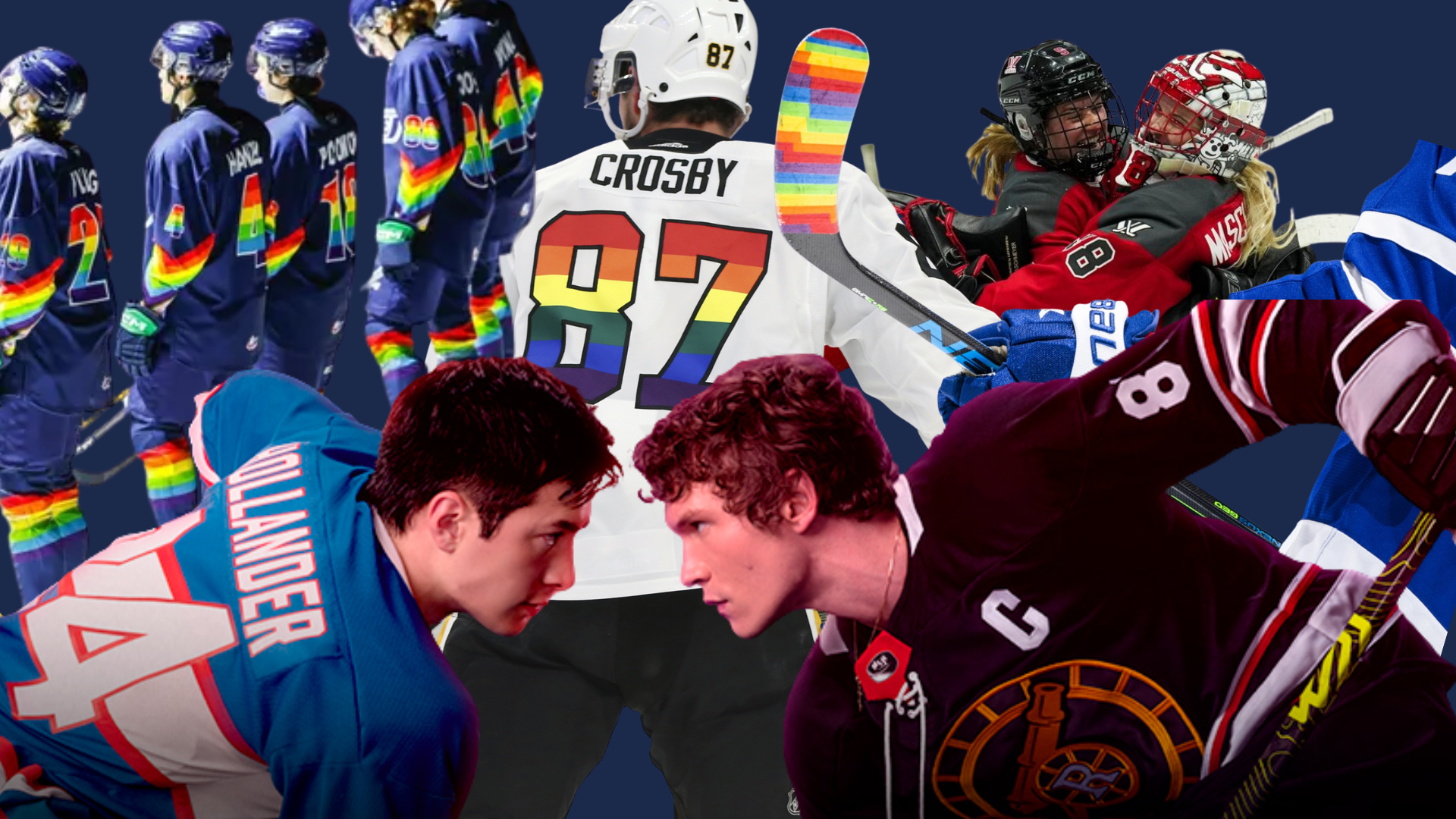
Starting as a production with a small budget and only intending to air in Canada, ‘Heated Rivalry’ took the world by storm. Writer-director Jacob Tierney’s adaptation of author Rachel Reid’s ‘Heated Rivalry’ aired its first episode on Nov. 28, and five weekly episodes following until Dec. 25, with episodes five and six being among the top-rated TV episodes of all time on IMDB. A queer romance — thinly masked as a hockey show — reaching such a level of recognition, even across the sports world, proves how much representation matters.
Reid’s story — while following a traditional romance novel plotline — highlights the frequent use of homophobic and hateful language to insinuate that being gay is bad and unwelcome. It also showcases that the language has often been a deep-rooted part of hockey culture. However, when All-Star player and Team USA captain Scott Hunter kisses his boyfriend after winning the Stanley Cup, everything starts to change for main characters Shane and Ilya, and their ten-year situationship/rivalry.
‘Heated Rivalry’ — despite being a gay romance — has garnered a large younger female audience, leading many people who were not previously hockey fans to search for guidance on the rules and which teams to root for.
Ella Lind, a junior finance and accounting double major, is a big baseball and Los Angeles Dodgers fan, but has become further introduced to the hockey world due to the popularity of the show. She noted that the “traditionally masculine” sports world is harder to be involved in as a woman, and that it must be even more difficult for LGBTQ+ players.
“There are obviously queer players in the sports world,” Lind said. “The world [as a whole] is still not accepting of those people yet — especially [in sports] like hockey, football and basketball [which are considered] very masculine. [Often, if] you show that you’re gay, it means [to other people that] you’re more feminine in a way.”
Enter Empty Netters — a hockey podcast run by two brothers and their Irish friend/producer, analyzing rosters and how well teams are doing — who decided to react to the episodes in between their normal content. These reaction videos garnered hundreds of thousands of views, leading them to live-react to the finale and invite several actors from the show on the podcast.
Lind also discovered the podcast, but mentioned that the overwhelming positive reaction that she has seen to ‘Heated Rivalry’ has come from mostly women.
“Everybody that I’ve talked to that’s watched the show loves it; they’re obsessed,” Lind said. “I don’t know exactly because [most people are] just behind a Twitter account, but it’s only women reacting. The only male reaction I’ve seen is from Anderson Cooper’s New Year’s Eve [show].”
The self-proclaimed straight men of Empty Netters had refreshing takes on the show and watched it as if it were any other romance show. They occasionally commented on how the hockey was not entirely accurate, but proclaimed that they absolutely loved the characters and their stories. They also mentioned how they hope the hockey world, and just the world in general, becomes a safer space where people are not afraid to come out and are embraced with love.
In fact, real-life hockey player Jesse Kortuem recently came out publicly, citing ‘Heated Rivalry’ as his inspiration to do so. In a Facebook post, he wrote that he “wondered how I could be gay and still play such a tough and masculine sport. To my younger self, that identity could never be revealed. I did not think those two worlds could occupy the same person, let alone the same locker room.”
Part of the way Kortuem fell back in love with hockey was discovering a small league of LGBTQ+ teams, which made him feel like he could be himself and also play the sport he loves. However, in the NHL, there has only been one openly gay prospect, who has played solely in the minor leagues.
Even without being gay, hockey can be hard to access for many, as it is typically very expensive and full of predominantly white, male players. However, in many cities — often where there are established professional teams — there is an NHL-hosted program called Hockey is for Everyone.
Alongside the implementation of the program in 2017, the NHL introduced ‘Pride Nights’ where teams would use gear such as rainbow colored tape. Since then, Pride nights were temporarily discontinued — removing one of the biggest physical representations of Pride in the sport — after a handful of players refused to participate.
By the 2024-25 season, the NHL reintroduced the nights, with the option to use memorabilia such as Pride tape, but changed it from being league-mandated during warmups. Some teams have gone beyond small symbols; for example, the Philadelphia Flyers have hosted Pride festivals before their games and donated significant amounts of money to charity.
Senior biochemistry major Micah Zile is the starting goaltender for the Butler club hockey team. He did not start playing competitive ice hockey until he was 11 and began at a local rec team that was funded by Columbus’s Hockey is for Everyone initiative. When he moved to Indianapolis, he was fortunate enough to continue his goalie career at Butler.
Zile hopes that more cities have the opportunity to host Hockey is for Everyone programs, as they make the sport much more accessible.
“[Hockey] is traditionally very expensive, and [therefore] kind of reserved for the people that have the money to play it,” Zile said. “I think those programs are a great way to include people who might not normally be able to be included in the sport.”
While Zile loves hockey, he also acknowledges that there are barriers to the sport and stereotypes that come with “hockey culture” and “locker room culture.”
“It can be pretty one-dimensional in the sense that hockey locker rooms often are, at least stereotypically, not the most diverse,” Zile said. “My team in high school was pretty much all Catholic boys, so you can imagine what the humor is like in those types of locker room scenarios. It’s not an extremely definite difference here at Butler.”
Sophomore exploratory studies major Abby Huening grew up playing hockey outside of Chicago. Due to the popularity of the sport in her hometown, she was able to join programs at a fairly young age, but much older than when most boys start playing.
She acknowledged that hockey can be made much more accessible for women if it is offered more to young girls and if posters for the sport also include pictures of women.
“Just seeing a woman like in advertising is a pretty new thing for sports that are [stereotypically] ‘men’s’ sports,” Huening said.
Huening hopes that more colleges and universities will introduce women’s club hockey teams to match the prominence of men’s teams.
“At Butler, I would love it if we had a women’s club team, even just for fun, but we don’t,” Huening said. “The guys always say, ‘Oh, [the team] is co-ed,’ but I’m not [comfortable joining].”
Even though there is still much room for growth, Zile mentioned that the hockey world has been trying to make significant progress, especially within the past decade. Specifically in the NHL, while most of the players are still white, the teams are slowly becoming more diverse. The PWHL — the Professional Women’s Hockey League — is gradually adding more teams and has several players who are in relationships with other women, and even fellow players.
Not just in hockey — but in all sports and the world as a whole: representation matters.
“[Some people may] feel a little bit reluctant to change their viewpoints,” Zile said. “I think there’s definitely growth that a lot of people could have in the sense of their willingness to accept.”
As shows like ‘Heated Rivalry’ are becoming successful, open-minded individuals who use their platform to encourage diversity, and even hockey players who are willing to be interviewed about hockey culture and their experiences, show that there is room for tolerance and acceptance in places where it has not always been.