
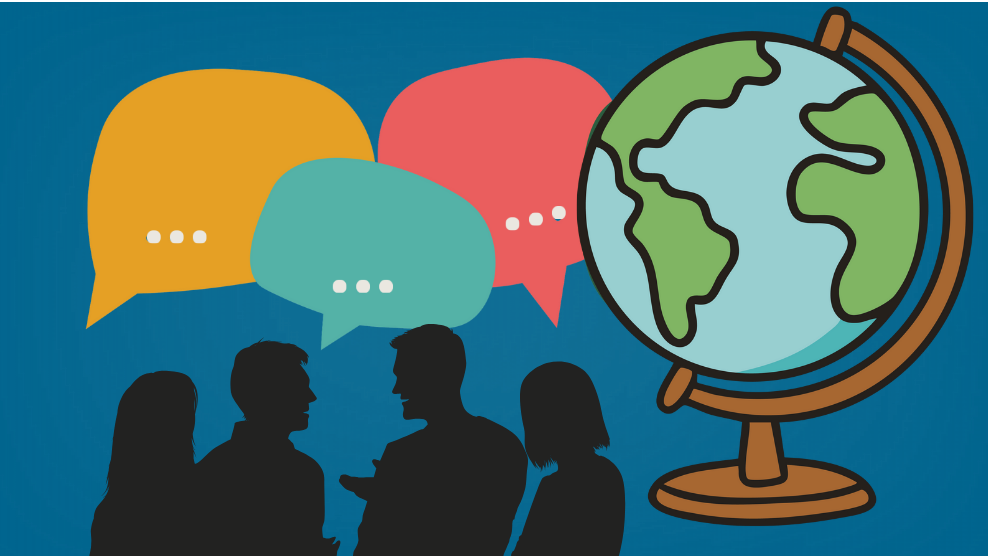
Up until recently, I’ve never understood the many benefits of being multilingual. It makes sense, growing up in an environment surrounded by multiple languages, that you would naturally pick them up. But for the households that strictly speak English, it seemed like a long, strenuous process to venture into a new language.
Although learning a new language is challenging, the numerous skills acquired make it worth the hard work and commitment.
Not only does learning a foreign language teach you another form of communication, but it also improves your academic performance and concentration, strengthens your memory, creates greater communication skills and makes you more creative.
In fact, the experience of learning a second language can actually offset dementia and dementia symptoms. So, when you learn a new language, your entire brain works together in order to do so, keeping it young and healthy.
The College of Communication recently changed its list of requirements and no longer requires a foreign language credit. Unfortunately, Butler now only requires a foreign language credit for the College of Liberal Arts and Sciences. Upon discovering this, I was shocked and genuinely confused as to why more of Butler were not taking a foreign language credit.
Butler should make foreign language a general education requirement for all students. The benefits of learning a second language are numerous and too grand to ignore. If more students took a foreign language class, I strongly believe that, in just a few years, we would see a significant improvement in the student body through cultural immersion.
Maéline Bringuier, a sophomore journalism and French double major, spoke about her first impressions of America.
“When I moved to America, I was very shocked that people don’t speak multiple languages,” Bringuier said. “Many Americans, which isn’t a bad thing, only speak English.”
Sometimes, it’s easy to forget English isn’t spoken everywhere, and there’s more to the world than the United States. However, learning new languages allows us to dip our minds into the richness and diversity of all these societies beyond our nation — not only to speak the language, but to understand the culture as well.
French professor Eloise Sureau highlighted the skills a student develops through learning a foreign language.
“It develops your problem-solving abilities and your critical thinking about your own language,” Sureau said. “You improve your speech, you improve your writing abilities, because you have learned a different language and it gives you cultural awareness.”
When thinking about practicing cultural awareness, it is wise to be aware of just how much of the population speaks English. As of 2024, about 22% of households don’t speak English at home.; however, 91% of the US population is reported to speak English very well.
French instructor Ouafaa Deleger expressed the meaningful benefits we inherit from speaking multiple languages.
“What I love most is when you speak another language, you open the doors also to understanding music, food and other cultures’ way of thinking,” Deleger said. “It’s not just learning how to translate words. It’s really how to understand someone else’s conceptions of the world.”
Now more than ever, our world needs to genuinely understand each other. There is so much division and hurt because we are ignorant to cultures different than our own. Being multilingual opens us up to truly understanding each other, holding compassion and sympathy for one another and creating a way for more connection.
This semester is my first time taking French in almost a year and I remembered how much work it is learning a new language. With all the new information I’m acquiring, it can be overwhelming and challenging — but the payoff will be rewarding.
Not only should students be required to take a foreign language, but we should also think of it as a lifelong skill we can take beyond campus to different parts of the world. It is so important that we understand how good learning a new language is for you. Such as how much it benefits your mind and deepens your ability to connect with different kinds of people.
If we can evolve our mindset on learning a new language from something we’re doing just to get the credit, to something positive and full of possibilities, we are going to enjoy it. We will enjoy it because we want to learn a new language and we want to learn about the culture that comes with it.
Don’t let the thought of work keep you from exposing yourself to all the possibilities of acquiring another language. Yes, learning a foreign language is indeed a commitment, but it is also an investment in yourself, your future and the meaningful relationships you’ll be able to create. Anyone is capable of being multilingual and it is never too late to push yourself to achieve it.