
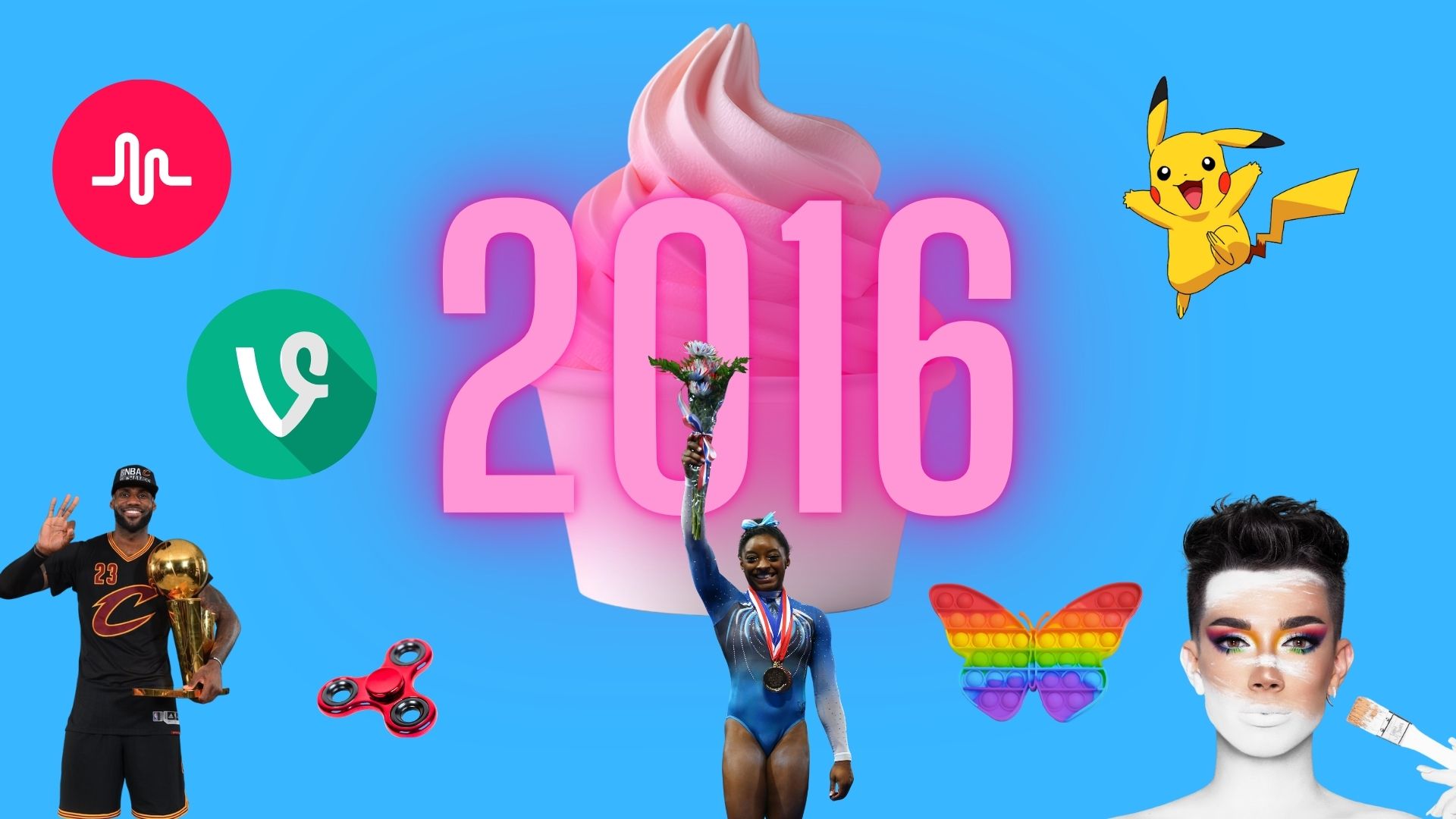
Imagine this — it’s 2016, and you’re listening to “Closer” by the Chainsmokers, on a walk with your friends and searching for the next rare Pokémon in Pokémon Go. The sun is setting, and the air smells cleaner. Life is good. After dinner, you’re planning on watching PewDiePie, followed by a series of Vine compilations, followed by a makeup tutorial by James Charles.
Even though we’re all very different now, most Zoomers can agree that 2016 was a time when things were simply the best. While the political landscape may have begun to snowball into a polarizing new environment, as pre-teens, that was none of our concern.
What was on our minds? Fro-yo, Musical.ly and doing the mannequin challenge with our friends. With college students now reminiscing on simpler times, here are our collective memories of what made 2016 the best year ever.
Social media
Back in ‘16, social media wasn’t all of our lives, but it played a role in the trends and pop culture that made up our adolescence. If you were “cringy,” you weren’t judged for it. In fact, it was celebrated. Vine compilations of interesting characters like the “when life gives you lemons” guy were stupid and silly, and weren’t AI slop or influencers trying to sell you products. In fact, influencers weren’t anything more than idols, and those “influencers” were never trying to shove products down our throats.
For Jordan Stivers, a junior psychology and theater double major, the evolution of social media and technology marked a significant change in how childhood looks.
“I think the advent of technology and how prevalent it is to be online now has really changed the way people interact,” Stivers said. “Especially the younger kids.”
A decade later, social media has influenced kids to the point of not acting their age. Influencers prey on the younger generation, encouraging them to have complicated beauty routines, buy from TikTok shop or become child influencers themselves. In 2016, social media had an air of innocence incomparable to the modern-day mess of problematic online characters.
Sports
LeBron James delivered the anticipated NBA championship title to Cleveland in 2016. The three-game run was perhaps the most famous comeback in NBA playoff history, as James kept his promise to the team and city that raised him through the first seven seasons of his professional career. James’ unforgettable season escalated the NBA GOAT debate, where online discourse debated whether Michael Jordan or James is the greatest player of all time. Whichever way you slice it, “2016 LeBron” was one for the history books and — the four-time NBA champion hasn’t slowed down yet.
Another notable sports moment was the 2016 Summer Olympics in Rio de Janeiro. Simone Biles, the 19-year-old American gymnast, won four gold medals in her Olympic debut. Biles showed the world that a four-foot-eight girl who faced much adversity in her youth can become a champion. Her story from foster kid to gold medalist echoed through all the aspiring young athletes watching and thinking, “I can do this, too.”
Being a kid
While the fun trends and music in 2016 were pivotal, what might be causing our collective yearning for 2016 is the childhood elements that we’ve had to move past. For many Zoomers, 2016 marked a year like no other.
Senior sports media major Gaby Whisler reminisced on the feelings of childhood joy that 2016 evoked.
“A lot of us were still in upper elementary school or middle school,” Whisler said. “I feel like everything was very colorful. We were all so young. It was very bright and happy through our eyes.”
Everyone can remember the feeling of riding bikes, wind ruffling through their hair, and summers spent eating unicorn colored fro-yo or other rainbow treats. Now, things are more cohesive, less colorful, and the products we consume are not marketed to be fun, they are marketed for their simplicity. The color is gone, and we want it back.
Pop culture
A year of multiple chart-topping music including the album releases of Beyoncé’s “Lemonade”, Rihanna’s “ANTI”, and Frank Ocean’s “Blond” played a pivotal role in the 2016 pop culture renaissance. Especially “Lemonade”, an album that featured undeniable storytelling with deeply personal grit and character. “Lemonade” currently leads Rolling Stone’s Greatest Albums of the 21st Century So Far, followed by “Blond” in third place.
Over the last few weeks, many songs, albums and trends from the year have returned to their popularity due to the 2016 trend. Media users have taken to social media to post their memories of 2016 through pictures and videos. Even Butler’s social media participated in the trend, posting throwback pictures of campus with the caption “They’re saying 2026 is the new 2016.”
Trinidy Charles, a digital content specialist for Butler’s communications and marketing department, noted how the posts performed.
“We received pretty good engagement,” Charles said. “Especially on Facebook, as the older alumni were seeing things and engaging with it. It was fun to go back through [Butler’s] Instagram and scroll to 2016, and also how Instagram has changed over the course of 10 years.”
The trend is not only nostalgic, bringing camaraderie to people everywhere, but it also has created a hopeful outlook for 2026 of pop culture, sports and beyond.
If we can bring the same energy to 2026 as we did 2016, then we can make this year the most memorable one yet. Especially with events like the FIFA World Cup and the Olympic Winter Games, and anticipated movies like “Avengers: Doomsday” and “The Odyssey”.
But above all else, the biggest lesson we can take from 2016 is that what unites us as a society is bigger than what divides us. It’s refreshing to remember that we can share memorable moments with each other even in times of turmoil and chaos.