
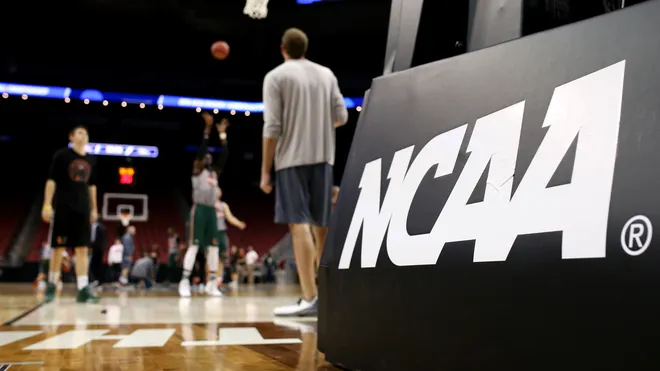
The NCAA’s recent eligibility rulings have drawn renewed scrutiny this season. Photo courtesy of USA Today.
OWEN PRISCOTT | STAFF REPORTER | opriscott@butler.edu
When legendary Michigan State men’s basketball head coach Tom Izzo says “the NCAA needs to regroup,” and “they’re afraid they’re going to get sued,” you know that college basketball’s eligibility crisis has reached a breaking point.
In recent weeks, players with previous NBA G-League experience have declared themselves eligible to play NCAA Division I basketball. Santa Clara’s junior guard Thierry Darlan and Louisville’s 2026 commit guard London Johnson headline the trend. Both played in the G-League before the NCAA decided, seemingly overnight, that they could suit up for college programs. Even more recently, on Oct. 28, On3’s Joe Tipton reported that another G-Leaguer — 22-year-old junior forward Kok Yat — was hearing from power programs Louisville, Xavier and Providence.
These cases mark more than eligibility rulings — they signal a seismic shift in what college basketball is going to mean in the near future. In 2020, the NBA’s G-League Ignite program was created specifically as an alternative to college, offering top prospects a chance to earn a salary without playing in the NCAA. G-League Ignite has seen 13 players drafted to the NBA, notably Phoenix Suns guard Jalen Green and Golden State Warriors forward Jonathan Kuminga.
Under old rules, players who signed professional contracts or accepted paychecks would have been permanently ineligible. Now, the very system designed to keep pros out is letting them back in. These decisions mark a sharp turn for an organization that was once obsessed with maintaining its “amateurism” line. That line is not just blurred anymore — it is gone.
For decades, the NCAA used amateurism as both a shield and a sword — punishing athletes and coaches for the smallest infractions while claiming to protect integrity. Now, those same standards seem optional. Darlan and Johnson can cash professional paychecks and still be declared eligible, while others — like Gonzaga forward Tyon Grant-Foster — nearly lost their college careers because of factors out of their control.
Grant-Foster, who collapsed from a serious heart condition during his first game with DePaul in 2021, fought to secure a medical hardship waiver just to continue playing at Gonzaga this season. Despite missing nearly two full seasons for significant health concerns, the NCAA initially denied his extra year of eligibility, citing technicalities related to his time at junior college (JUCO) that pre-dated his first Division I season.
Grant-Foster eventually won his appeal, but the message was clear: health and fairness came second to bureaucracy.
Butler’s own forward, Michael Ajayi, has a connection to this debate. Ajayi spent two years at Pierce College in Washington before transferring to Pepperdine and later Gonzaga before committing to Butler for the 2025-26 season. Under current NCAA rules, JUCO participation can count against a player’s eligibility clock — a rule now under fire because of the Grant-Foster situation. Ajayi could potentially gain an extra year of eligibility depending on how the NCAA handles ongoing JUCO eligibility reviews.
It’s hard to justify welcoming paid professional players while making injured or medically vulnerable players fight in order to play.
Purdue head coach Matt Painter was as blunt as he could be to the media when he heard the news.
“You’re just kind of at a loss for words. Like, you don’t know what’s next, right?” Painter said. “Why are we taking away from high school players? The portal, all that stuff, takes away from the recruitment, especially Division II, low-major, mid-major recruitment.”
First-year finance major Monty Goss agreed, saying that the NCAA’s decision is a big change.
“I’ve always grown up thinking that college basketball is that amateur level,” Goss said. “It’s college athletes and student-athletes, not professionals. To bring in G-League players is a big difference, and I feel like that looks bad for the NCAA.”
Goss also noted that giving eligibility to older, more experienced players creates an uneven playing field for incoming first-years or transfers.
“If I’m a senior in high school and I’m looking at a top university to play for, but then all of a sudden my competition is G-League players, I have to start looking down at smaller schools,” Goss said. “It takes away that incentive for those incoming freshmen to try harder and to get [into] those bigger schools.”
First-year sports media major Korey Festian had not heard about the NCAA’s new rulings, but shared a mixed reaction.
“It’s a little shocking,” Festian said. “Even if it is the G-League, that’s still a professional level, and college is technically still considered amateur. Being allowed to play professionally and then go back down to college is interesting and a little confusing.”
Louisville head coach Pat Kelsey defended his recruiting, saying that he sees no difference between his G-League commit and a school recruiting a player who has played professionally overseas.
“I don’t think there’s any difference [between signing G-League and International players].” Kelsey said. “There [are] a ton of schools that are signing players that were professional players and signed professional contracts, what’s the difference?”
At its core, the NCAA’s eligibility problem is not about Darlan, Johnson or even Grant-Foster. It is about identity.
The NCAA wants to protect its “student-first” image, yet it has made a habit of changing rules only after public backlash or legal threat. The transfer portal in 2018, NIL in 2021 — NCAA v. Alston — and now post-professional eligibility — all reactive moves rather than forward-thinking changes.
“The NCAA needs to regroup,” Izzo said, but that is a massive understatement.
Festian disagrees, saying that while the situation raises questions, she believes the NCAA’s decisions come from careful consideration rather than chaos.
“They have a lot more knowledge about why they’re making these decisions,” Festian said. “Even if fans don’t understand the reasoning, it’s not made for no reason. They work with coaches, players and staff, so they’re looking out for the best interest of the league in general.”
Max Haley, a sophomore sports media and strategic communication double major, on the other hand, believes the NCAA is going to lose the trust of some players and coaches, and they may have already.
“The world of sports is going to change no matter what happens,” Haley said. “Injuries, controversy with players and coaches, but especially with this, I think it will have an impact — most likely negative — if it hasn’t already on the world of athletics.”
As college basketball continues to blur the line between amateur and professional, the NCAA stands at a crossroads of its own creation. The organization can no longer hide behind the student-athletes first tagline while rewriting its rulebook to fit public pressure. Players like Grant-Foster fought for fairness, while G-League players are walking through an open door.
Whether the NCAA’s flexibility is viewed as progress or hypocrisy depends on perspective. For some, it is a long-overdue adaptation to the modern era of college sports; for others, it is another — and possibly the final — blow to what made the college game different
Either way, one thing is clear: if the NCAA truly wants to “regroup,” it must first decide what — and who — it stands for.


