
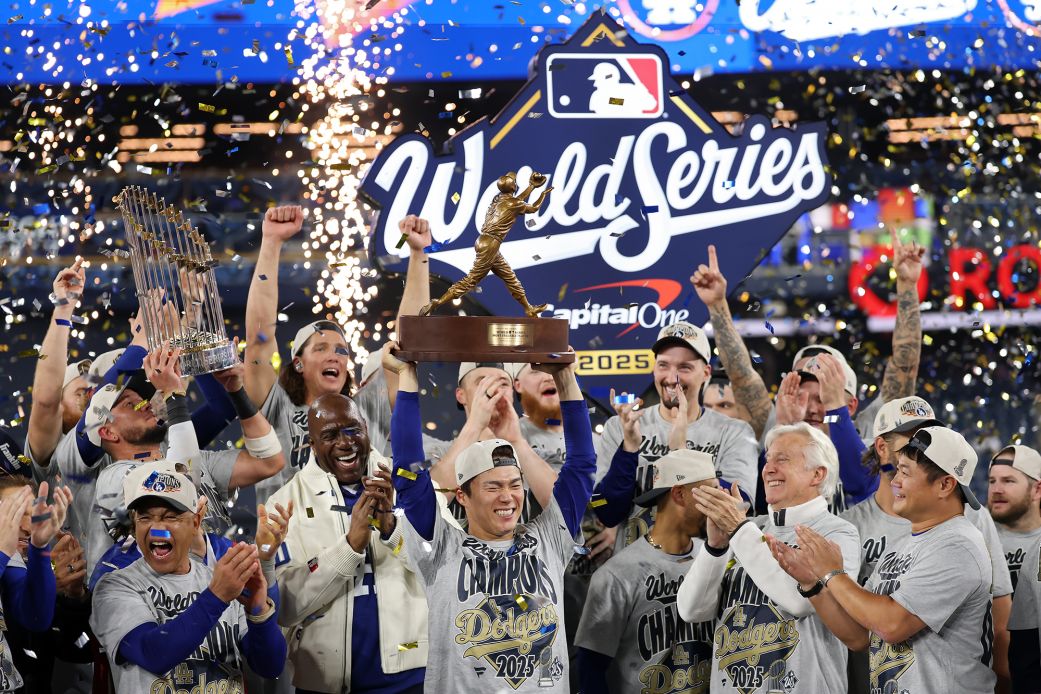
The Los Angeles Dodgers won the 2025 World Series. Photo Courtesy of CNN.
JAMIE HEALY | STAFF REPORTER | jdhealy1@butler.edu
Overtime, or “OT,” is an opinion column series where the Collegian takes national sports headlines or polarizing topics and gives them a Butler-centric angle.
The 2025 MLB season ended with the Los Angeles Dodgers winning the World Series in a hard-fought seven-game series against the Toronto Blue Jays.
This series did not merely highlight which team was the best in baseball, but also showed that baseball has a major spending problem.
Both the Dodgers and Blue Jays ranked in the top five for total payroll allocations in 2025. The over $350 million spent by the Dodgers is over five times higher than the Miami Marlins, the team with the lowest total payroll this past season.
In fact, there were five teams this season — the Marlins, Athletics, Chicago White Sox, Pittsburgh Pirates and Tampa Bay Rays — who spent less than $100 million on their payroll in 2025. None of the five teams made the playoffs nor finished above .500 in the 162-game regular season.
This is a problem in modern baseball where some owners refuse to pay to keep talented players and instead let them go to free agency. These players often end up signing with teams that are willing to spend exorbitant amounts of money.
The Dodgers are a prime example of a team that finds tremendous success in acquiring top talent available on the market. Players such as designated hitter and pitcher Shohei Ohtani, as well as starting pitchers Tyler Glasnow and Blake Snell, all became Dodgers through free agency.
Meanwhile, teams like the Pirates have no interest in spending money to make their team more successful. Pirates Owner Bob Nutting has taken a hard-line stance against spending money unless attendance at games improves, which would also mean an increase in revenue.
The disparity between successful teams, such as the Dodgers, and unsuccessful teams, such as the Pirates, is made evident through one’s desire to spend money and field a team that contends, while the other continues to struggle every year.
For example, the Pirates have not made the playoffs since 2015 and have been mired in mediocrity at best, and among the dregs of Major League Baseball at worst.
The divide has caused rumblings of a lockout in 2027 when the collective bargaining agreement expires between the owners and the Major League Baseball Players Association.
As an avid fan of the St. Louis Cardinals, Vince Cook, adjunct professor of strategic communication, asserts that a potential lockout could turn fans away.
“If [the owners] lock out the players, the Players Association will make sure it sticks to the owners and not them,” Cook said. “People can live without baseball.”
Prior to the 1994 MLB Players’ Strike, viewership numbers for the World Series hovered around 34 million viewers. Post-strike, this number has dipped to around 13-19 million viewers.
Lockouts and strikes are not new in professional sports. The 1994 MLB Strike cancelled the World Series for the only time since 1904. Additionally, the NHL had its season cancelled entirely in 2004 and partially disrupted in the 2012-13 season due to lockouts.
Sophomore P1 pharmacy major Spencer Van Peursem argues that the players are only seeking fair compensation and that cheap owners are the major issue in this dispute.
“[Players] want to afford their lifestyles,” Van Peursem said. “If teams want to pay them as much as they do, I think [the players] deserve that.”
The MLB does impose a competitive balance tax on teams whose payrolls exceed $241 million. However, this does not deter teams like the Dodgers from continuing to spend above the threshold.
There are punishments for exceeding the tax, like the forfeiting of a top draft selection, but there is nothing that forces owners of low-spending teams to do their part in maintaining parity across the MLB.
Sophomore sports media major Jackson Roemer advocates for the punishment of the owners if they refuse to spend money to help their team.
“I think the league has a responsibility to give fans what they want,” Roemer said. “I think the league should step in and [demand] the owners to spend money or threaten to revoke their ownership.”
While some small-market teams may advocate for a hard salary cap that would place a limit on teams’ spending, it is imperative that there is a salary floor as well.
If the MLB wants to continue the growth of the game, there is a need for all teams to spend money and attempt to be competitive. When one-sixth of all teams do not put even $100 million into their team, it defeats the purpose of a salary cap.