
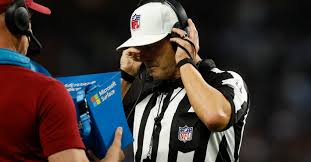
The NFL Instant Replay System was formally introduced in 1999. Photo courtesy of NFL Football Operations.
JAMIE HEALY | STAFF REPORTER | jdhealy1@butler.edu
Overtime, or “OT,” is an opinion column series where the Collegian takes national sports headlines or polarizing topics and gives them a Butler-centric angle.
The modern-day system of instant replay was developed and introduced in the NFL. The system allows for close calls on the field to be reviewed, such as possession of the ball, whether the feet of a player were in-bounds or not and more. This also allows referees to look at a play again in slow motion, ensuring fairness throughout the game.
However, it is college sports where instant replay adjustments are altering the way the game is played and how viewers see the game.
College basketball adopted replay reviews in 2000, and after 25 years, the system is finally starting to make changes in a positive direction.
This season, the NCAA rolled out a coach’s challenge system similar to the NBA. Following years of fan ire towards officials going to the replay monitor seemingly after every whistle in the final two minutes, the rulebook changed so that coaches must have a timeout to initiate a challenge, such as an out-of-bounds call.
Senior sports media major Brayden Martin believes this challenge system can be an improvement to a system in dire need of it.
“Before [the changes], if [teams] were down and [they] needed a timeout, [they] would try and get the refs to replay something,” Martin said. “I think it gave teams who were out of timeouts an unfair advantage at times.”
Additionally, this recent change will hopefully solve the problem of longer games as well.
According to a study by college basketball statistician Ken Pomeroy, regular-season game times increased to a record-high two hours and five minutes in 2025, an increase of six minutes since 2021.
Similar to college basketball, college football has an issue of game times continuing to increase year over year, and recently made changes to try to speed up games.
Unlike the NFL, a college game used to stop the clock to reset the first-down chains after every first down. A 2023 rule change now means the clock will continue to run after a first down unless it is in the final two minutes of the half.
Even as game times have become relatively stable since 2020, the length of replay reviews has continued to be scrutinized.
In 2020, the NCAA oversight committee instituted new guidelines for replay review in college football. Reviews were to take two minutes or less unless they involved end-of-game issues or were deemed exceptionally complicated.
However, the average time of reviews is one minute and 54 seconds, with 18.6% of reviews going over two minutes. While that may not seem like a lot, it is imperative that there are more concrete rules regarding replay timing to speed up the process and, subsequently, games.
First-year sports media major William Marrs contends that stricter timing of reviews would improve sports as a whole.
“When [refs] are spending over two minutes looking at a review and they can’t figure it out, I am irate,” Marrs said. “If you can’t figure it out with all camera angles in a minute, then move on to the next play.”
If stricter rules are put in place with regard to replay timing, it will lead to shorter game times and, most importantly, continued fan engagement.
Additionally, some conferences in college football are adapting to calls for transparency in their review systems, which is further laying the groundwork for continued regulation and improvement.
Following several game-altering calls that went in Miami’s favor against both Virginia Tech and California in 2024, the Atlantic Coast Conference (ACC) is now working in conjunction with ESPN to give viewers an unprecedented look inside the ACC control center as they help referees make the decision to uphold or reverse the call on the field.
Owen Gohr, a sophomore strings-based performance major, appreciates the ACC’s commitment to transparency and hopes that fellow conferences will follow suit.
“I think it is really interesting to see under the hood [about] what is going on with these calls,” Gohr said. “I really like seeing what is going on behind-the-scenes and it would be cool if that was utilized more.”
What began as a way to help officials on the field make the correct calls has turned into a behemoth of its own, and there is some belief that replay has gone too far in trying to assist.
“[Replay] takes away some of the human aspect of the game,” Martin said. “Players make mistakes, refs make mistakes and mistakes are a huge part of the game.”
While instant replay is now highly-regarded as an integral part of sports, it does still need improvement in order to ensure the human element is still a part of the game.
Expedited replay reviews help to achieve this goal, as does full transparency of why a call is being made a certain way. It is of the utmost importance that the good in replay is continued to be built upon in order for players, coaches and fans alike to enjoy the games they love dearly.