
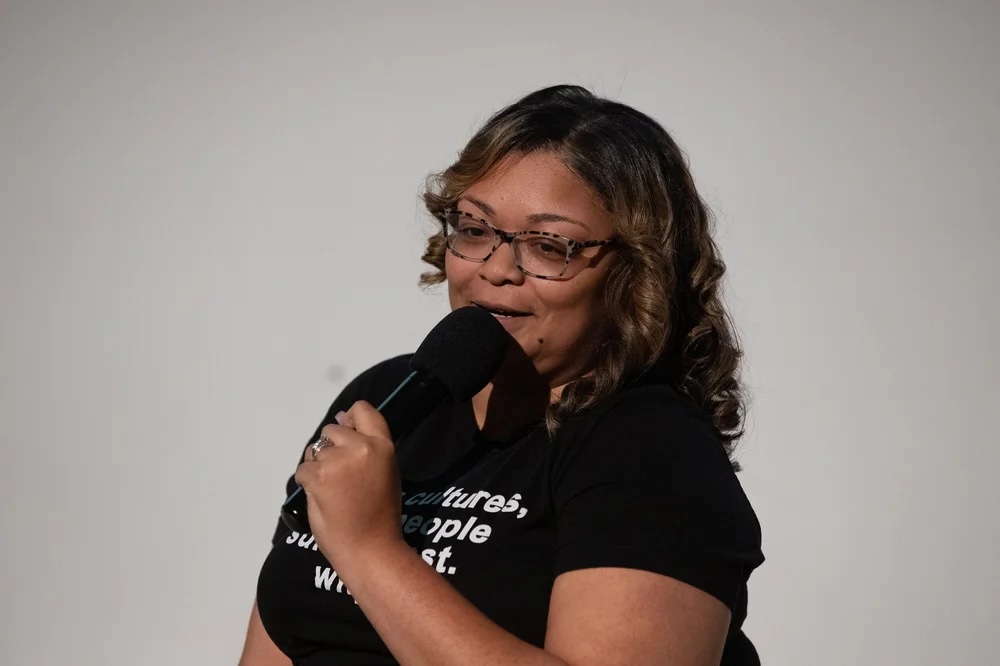
Dr. Bradley’s work focuses on the experimental nature and cultural impact of Southern hip-hop. Photo courtesy of Red Clay Scholar.
SAMUEL DEMIS | STAFF REPORTER | sademis@butler.edu
Hip-hop is more than a music genre — it is a powerful tool to represent lived experiences. The Black Intellectual Series welcomed Dr. Regina Bradley, a Harvard University scholar and music critic, on Nov. 6. Bradley discussed the evolution of Southern hip-hop and its relation to the changing identity of the American South.
Much like her book “Chronicling Stankonia”, most of the discussion centered on OutKast and their unique sound. Bradley views the group as a driving factor in helping the Civil Rights Movement continue in present-day.
Isabella Faidley, a junior critical communication and media studies major, resonated with Bradley’s ideas.
“Hip-hop and Black civil activism are not something that can be boxed up and defined,” Faidley said. “[Dr. Bradley] discussed how there are different ways that hip-hop has helped further the Civil Rights Movement [and] the expansion of Black success.”
What Bradley mainly wanted to emphasize was that OutKast had laid out a narrative that “Dr. King’s mountaintop was not flat”, and that Southern hip-hop helped to define an identity that furthered the goals of the past and emphasized healing and fighting for a better future.
First-year dance performance major Eleanor Brown felt that Bradley’s thesis was enlightening.
“My lack of knowledge proved her point because I had kind of stopped considering how impactful the South is in many ways — more than just music,” Brown said. “I often associate [gospel music] with the Civil Rights Movement… She exposed a lot of biases, just holes in education about music.”
Another hot topic was Drake, and how his attempts to imitate elements of Southern rap reveal his lack of individuality; she described him as a “musical carpetbagger”, chasing trends instead of strengthening his own identity.
“I think it is fine [for] artists to sample,” Brown said. “I think that’s what you have to do to survive in any industry. From her perspective — which is obviously well-researched — [Drake] has taken from a lot of people and hasn’t credited them.
On the subject of unoriginality, artificial intelligence (AI) in the music industry was a point of contention. AI R&B singer Xania Monet recently charted on Billboard, and while the “singer” was used mostly as a tool for Mississippi poet Telisha Jones, the success of the song raises questions about the future of the industry.
Dr. Corey Reed, assistant professor of philosophy and co-director of the Black Affairs Hub, found the discussion around Monet and Jones particularly interesting.
“I thought [Dr. Bradley made] really important points about what artistry means and what music production is,” Dr. Reed said. “[She also discussed] how much of the [artistic] process can be offloaded to technology [while still being considered art].”
The Black Intellectual Series has several upcoming events related to the intersection of hip-hop and philosophy, feminism and the Global South.
“In early January, we will be hosting DJ Spinderella, who used to tour with the group Salt-N-Pepa,” Reed said. “She will be inducted into the Rock & Roll Hall of Fame.”
The discussion with Bradley was an excellent opportunity to view history, philosophy and intellectualism through a musical lens while simultaneously learning how various artists define the Southern Black experience.
“When it comes to American history, I feel like people do not necessarily think about Black intellectualism as a [major influence],” Faidley said. “[Only] within the last 30 to 50 years has Black intellectualism really been taken seriously within academia and professional settings … I feel like [conversations like this] truly broaden your horizons intellectually.”