
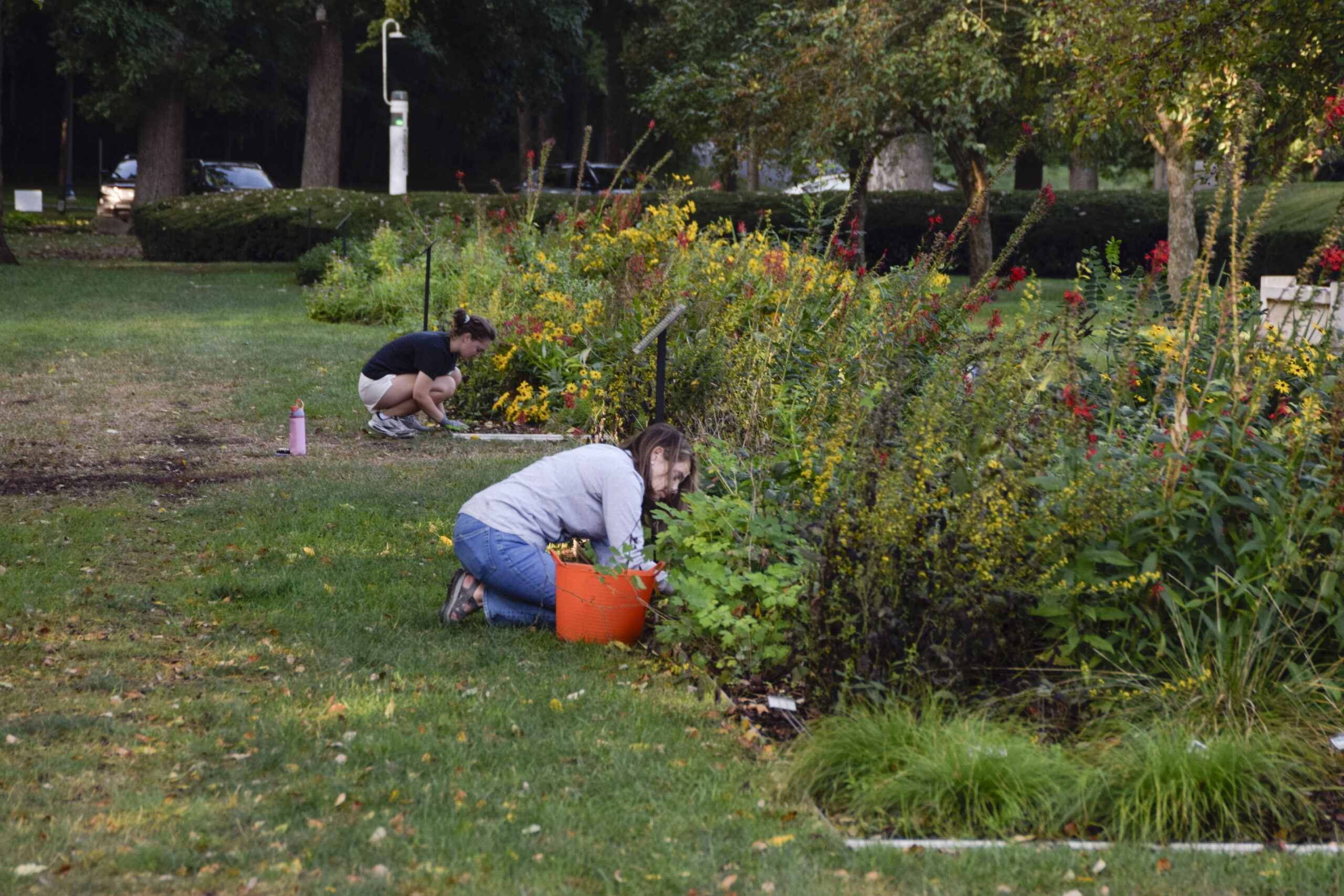
Volunteers from Butler and the community help maintain the plant beds at Holcomb Gardens through a new program. Photo by Ella Beu.
LAUREN FISCHER | STAFF REPORTER | lrfischer@butler.edu
Rooted in community, the Friends of Holcomb Gardens (FROHG) program allows volunteers to care for natural habitats and give back. Last September, Holcomb Gardens held a replanting day where 12 of the original flower beds were seeded with fully native plants. After the successful replanting, help was needed to maintain the new plots.
Noelle Schacht, Butler’s Sustainability Programs coordinator, developed the FROGH program. The program allows for students, faculty and local community members to join the initiative and foster thriving ecosystems at Holcomb, including bringing together a community.
“People [get] engaged here, and students [will] just come down and hammock,” Schacht said. “People have a connection [with Holcomb Gardens], and they want to get involved in taking care of that very special place on campus, so we built the volunteer program to meet both of those needs.”
As of May 2025, the program began accepting volunteers. Over the summer, the program relied on faculty and community volunteers, working closely with the Indiana Native Plant Society (INPS).
Mike Clust, an INPS volunteer, has attended sessions twice a month since May 2025. He was drawn to this program due to its focus on preserving native habitats.
“Native plant gardening is its own thing,” Clust said, “[It] is more gardening for habitat…not strictly for aesthetics.”
The concept of “gardening for habitat” entails making sure that native species are able to flourish, but they may not appear as aesthetically inclined as a typical garden.
Students have now begun to volunteer after returning to campus.
First-year strategic communications major Tess Elliott is among those new to campus, looking to get involved.
“I like being outside, and worked at a nature camp when I was back at home,” Elliott said. “I really wanted to continue finding a way to stay active and help the environment.”
She explained that most of the work involves weeding, pruning and cutting any dead plants in the plots.
The volunteer groups consist of two to five individuals who volunteer twice a month. There are around twelve to fifteen opportunities each month.
Schacht explained that they have been able to fill most of the volunteer spots due to the support from the community.
“It’s a big camaraderie piece,” Schacht said. “You are pulling from a lot of different communities who all care about Butler.”
This program has become something that showcases Butler’s emphasis on sustainability.
“We do prioritize these natural areas on campus, and we want to make sure that we show people what a campus can look like,” Schacht said. “You can have a beautiful, maintained area that has these native, ecologically beneficial plants.”