
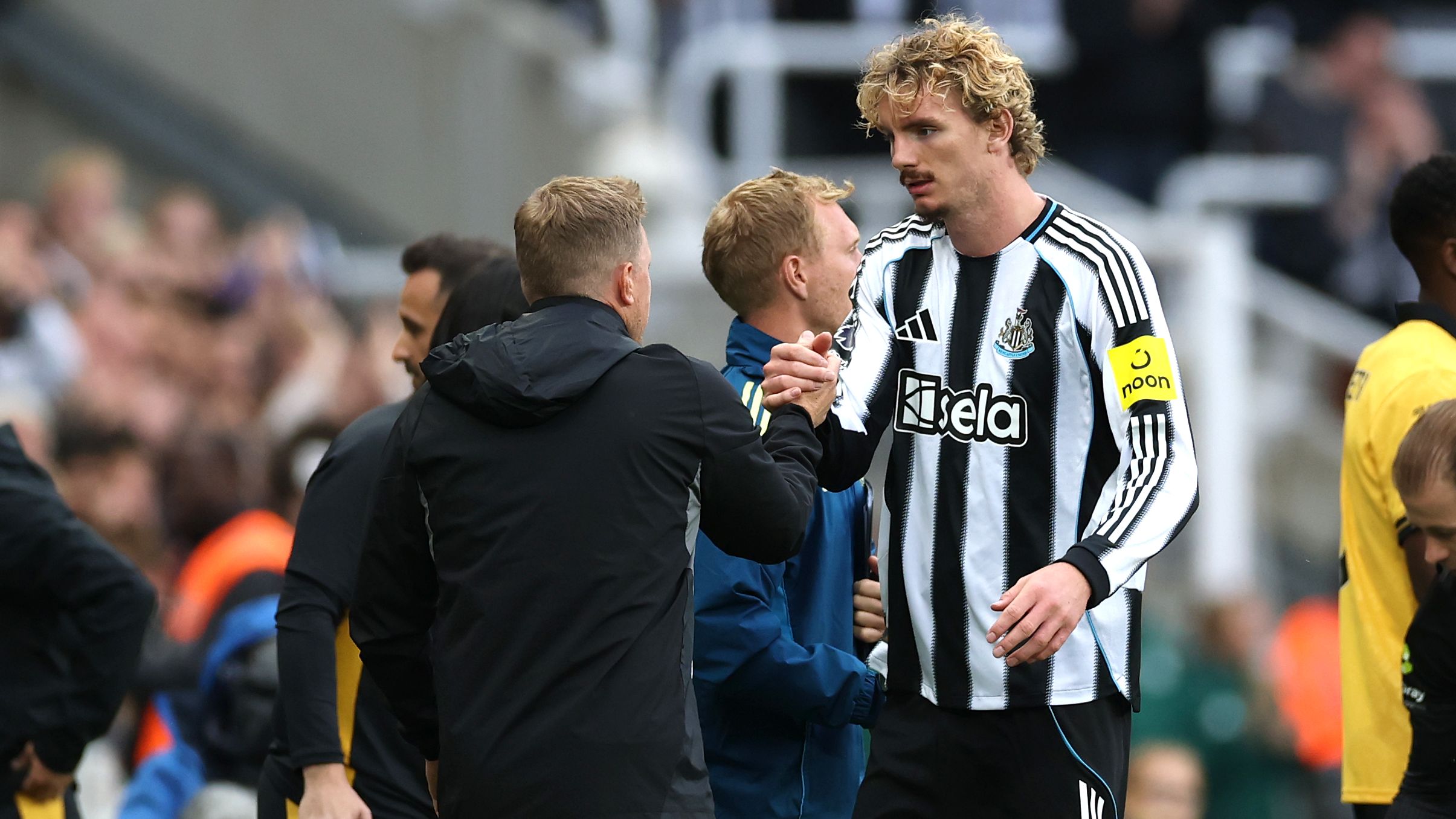
Nick Woltemade was bought by Newcastle for €80 million. Photo courtesy of Getty Images.
MARIA CLARA KOLLER | STAFF REPORTER | mkollerfernandez@butler.edu
The summer transfer window, which closed on Sept. 4, saw some eye-watering transfer fees as the Premier League topped the spending charts once again. Some of the top transfers included forwards Alexander Isak and Florian Wirtz, who went to Liverpool for a combined €270 million, forwards Bryan Mbeumo and Matheus Cunha, who joined Manchester United for a combined €150 million and forward Nick Woltemade who slotted in with Newcastle for €80 million.
This transfer window has shed light on a problem that has plagued soccer for the last couple of years. Ten years ago, the most expensive transfer was midfielder Kevin De Bruyne, who joined Manchester City for €75 million— a fee which, at the time, landed him in the top-10 most expensive transfers of all-time. The other notable transfers of that window included forwards Angel Di Maria to Paris Saint-Germain (PSG) for €63 million and Raheem Sterling to Manchester City for €60 million.
The exaggerated rise in transfer fees sheds light not only on the inflation of the market and the commercialization of the sport, but also on the cost-quality ratio — or lack thereof. In today’s game, most players are sold for huge fees, raising the expectation of the players’ quality. After one or two years, these players are written off as “underwhelming”, when in reality their price tag never represented their true value.
Player quality
De Bruyne and Woltemade’s transfers put this dilemma into perspective. This summer, Woltemade sold for €5 million more than De Bruyne’s record-breaking transfer in 2015. However, before De Bruyne moved to the Premier League, he played 73 games for VfL Wolfsburg and contributed 20 goals and 37 assists. Woltemade, on the other hand, only had 35 appearances while contributing 18 goals and three assists for VfB Stuttgart. Newcastle paid €80 million for him.
The same can be said for Mbeumo and Cunha. Brentford sold Mbeumo to Manchester United for €75 million, while Wolverhampton sold Cunha for €74 million. Although both Mbeumo and Cunha are more experienced and established players than Woltemade, their prices are much higher than they should be.
In 2015, Aston Villa sold Belgian forward Christian Benteke to Liverpool in a transfer almost identical to Cunha’s. Both joined big-profile teams from a mid-table club, had around 100 appearances for their respective former teams and were starting forwards.
Both players found themselves in almost identical situations; however, the difference in the transfer fee paid for them was drastic. Benteke was sold to Liverpool for €35 million, while Cunha was sent to Manchester United for €75 million. That is a €40 million difference for a player who had 12 fewer goal contributions in the same number of appearances.
The inflation of the transfer market can be attributed to one transfer: in 2017, Barcelona sold Neymar to PSG for a record €222 million. The transfer of the Brazilian winger to the Parisians completely changed the way the transfer window worked.
Senior sports media major Lachlan Norrie credits inflation and Neymar’s transfer to the current transfer fees for players.
“I think the rise in transfer fees for players is partially due to natural inflation of the market,” Norrie said. “I think that [Neymar’s transfer to Al-Hilal in 2023] set a precedent for players that really should be worth €50-70 million go for over €100 million. I don’t exactly see a way to reverse it.”
Before the transfer in 2017, the highest fee ever paid for a player was €105 million when Paul Pogba joined Manchester United from Juventus. Now players regularly hit the €105 million mark, with 16 players going over €100 million since Neymar’s transfer to PSG.
Financial concern
The inflation in the transfer window also embodies another consequence of the intense commercialization of soccer. Many mid-range and lower table teams do not have the means or the resources to keep up with the spending habits of top clubs. As a consequence, the same teams are winning while others keep falling behind.
“Teams like Manchester City, Chelsea and PSG [are] either state-funded clubs or essentially treated as an investment by their owners,” Norrie said. “In comparison to smaller clubs with less money, I do agree that it is not fair and not good for the game.”
In modern-day soccer, teams that have found the most success are those that have the means to buy players with essentially no limitations. For example, Manchester City was bought by Sheikh Mansour‘s Abu Dhabi United Group in 2008 and since then, he has invested over £1.3 billion into the team, according to The Guardian.
Before Mansour’s takeover, the Citizens had not won a trophy in seven years, when they won the EFL second division league. After the takeover, the Manchester-based club became a giant, winning eight Premier Leagues, seven FA cups and a Champions League trophy.
First-year business major Nico Garcia spoke on how financial restrictions can be used to limit bigger teams.
“The competition is not going to be the same,” Garcia said. “I think there should be a market cap for each team [like the NBA]. Having more financial restrictions will be better.”
In today’s world, teams cannot compete if they do not have a huge funding behind them. However, since world soccer leagues are very connected, implementing a salary cap in one league could impact all.
Sophomore journalism major Elliot Muehlhausen spoke on the difficulties of implementing financial cap rules.
“It would just be hard to regulate across different leagues because [they] have different rules,” Muehlhausen said. “How does that influence all the other leagues and all the other teams? I think it’s a really complicated issue.”
Not only is there a huge gap between top clubs and the rest of the field, but the inflation of the transfer fees paid for players points to a larger issue. During the last 20 years, soccer has become more and more of a business rather than a sport. As clubs pay more for players, many clubs have turned to ticket prices and sponsorship deals to compensate for their transfer window spending.
“The more the sport is commercialized, the less it is the people’s,” Muelhausen said. “It just takes away from the whole sport; it isn’t as powerful.”
Premier League ticket prices have risen 800% since 1990. For the last couple of years, fans have protested, saying ticket prices are unreachable and clubs are “exploiting loyalty”, an issue which in part stems from the rising transfer fees.
The inflation in the transfer market is a nod to the changing landscape in the sport, while a tug-of-war goes on between club owners and fans. As the businessmen who run the sport are looking for more ways to squeeze out more money from the game, fans are becoming increasingly fed up.