
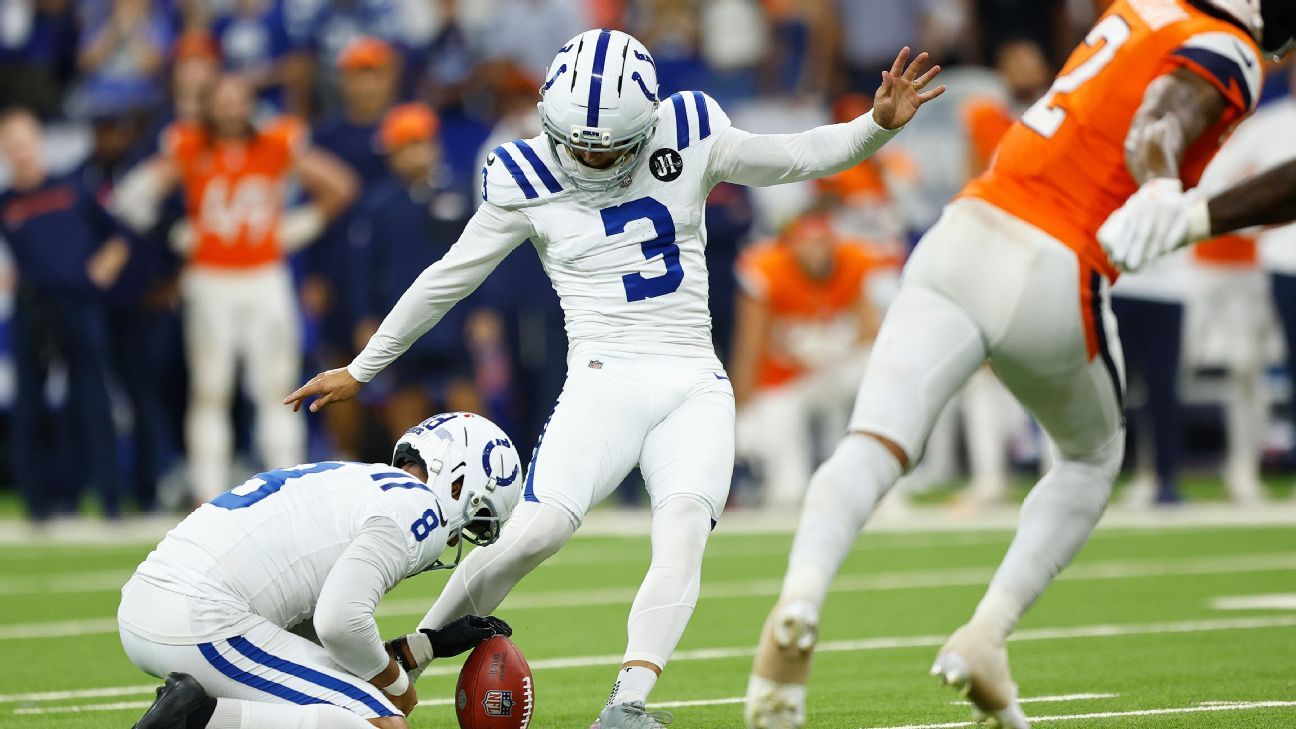
Indianapolis Colts kicker Spencer Shrader sweeps his leg for the game-winning field goal in their Week 2 win over the Denver Broncos. Photo courtesy of ESPN.
OWEN PRISCOTT | STAFF REPORTER | opriscott@butler.edu
Overtime, or “OT,” is an opinion column series where the Collegian takes national sports headlines or polarizing topics and gives them a Butler-centric angle.
The Indianapolis Colts should have lost in Week 2. Their 60-yard field goal attempt in the final seconds missed, the Denver Broncos celebrated and the game looked over — until a flag came in. A leverage penalty on Denver wiped away the miss, moved Indianapolis 15 yards closer and the Colts converted the second chance for the win.
One week later, special teams were back in the spotlight. Week 3 turned into the week of blocked kicks, with momentum-shifting plays across the league. In Philadelphia, Eagles defensive tackle Jordan Davis broke through the Los Angeles Rams’ line to block a potential game-winner and rumbled back to the endzone for a stunning walk-off touchdown.
In Cleveland, the Browns denied the Green Bay Packers on a late 43-yarder, setting up their own game-winner. The New York Jets also got in on the fun with a blocked kick returned for a touchdown in a dramatic come-from-behind effort, although they would fall short against Tampa Bay. All of the plays stood and were celebrated as moments of chaos and drama — exactly what fans love about the NFL.
In Jacksonville, however, there was more confusion. It appeared that a Jaguars third-quarter field goal attempt was good and their lead would be extended to 10-3, only for Houston Texans lineman Derek Barnett to be flagged for leverage. Instead of the three points, Jacksonville got a first down and new life inside Houston territory, ultimately cashing in three points anyway. Like in the Colts win, a rule most fans had never heard of was called in a big spot.
The leverage penalty has existed since 2009, meant to prevent dangerous pileups and protect long snappers. Leverage is defined in the NFL rulebook as “a defensive player jumping or standing on a teammate or an opponent to block or attempt to block an opponent’s kick.” In theory, it is about safety. In practice, it’s rarely used. It’s only been called 52 times in 16 years — about three calls per season, or 1.25% of games. Most fans don’t recognize when it’s called, and players rarely practice around it. That’s why leverage calls in back-to-back weeks felt so jarring.
In Indianapolis, the Broncos thought they had escaped with a win after the Colts’ missed field goal. However, defensive lineman Dondrea Tillman was whistled for leverage, accused of placing his hand on another player to propel himself higher in his block attempt. The penalty gave Indy 15 yards and a retry from 45 yards away. Spencer Shrader drilled it, the Colts won, and Denver was left stunned.
The controversy was not just about the result, though it did decide the game. It was about consistency: two plays that looked nearly identical; one flagged, one not. Fans and analysts pointed out dozens of similar plays that weren’t flagged in recent seasons. Even in Week 3, side-by-side comparisons from the Texans-Jaguars game showed contact that seemed just as borderline.
Earlier in that same Colts-Broncos matchup, Denver kicker Wil Lutz had a field goal attempt sail off the upright after Indianapolis’ defensive line — defensive linemen Neville Gallimore and Grover Stewart — used leverage tactics that looked strikingly similar to Tillman’s. However, no flag was thrown on the play. If the rule is designed for safety, why is it applied only sporadically and in the highest-leverage moments of a game?
Adding fuel to the debate, Colts center Danny Pinter admitted after the game that his unit intentionally baited the Broncos into the foul by shifting their leverage mid-snap. That reveals that teams can reframe the rule as not only a safety mechanism but also a potential strategic weapon — something coaches can scheme for to draw flags. When a penalty that obscure can be used as a tool, it’s fair to question whether the rule is functioning as intended.
Jackson Stewart — a first-year exploratory business student and Colts fan — thought the referees had it backwards.
“From a Colts fan perspective, it looks like there was even more contact with the long snapper on the Lutz kick than with the Colts kick,” Stewart said.
For Stewart, the missed calls seemed more egregious than the flagged ones — a reflection of just how ambiguous leverage can be.
“If anything, I think the two that weren’t called are more of a penalty than the two that were called,” Stewart said. “I think it’s a little obscure. 15 yards is game-defining, and I feel like if you’re going to give a team 15 yards, you need a better definition.”
That feeling of inconsistency has been echoed across the league. If leverage is truly about protecting players, fans are left wondering why only certain moments draw flags while nearly identical plays go unnoticed.
That inconsistency, while frustrating to those without a dog in the fight, was infuriating for Broncos fans who saw a flag as the difference in a crucial game. Nolan Hamilton, a senior sports media and strategic communications major and lifelong Denver fan, put it simply.
“It’s an obscure rule,” Hamilton said. “I don’t think it should be left up in the air if it’s leverage or not.”
Hamilton, similarly to Stewart, pointed out that Lutz’s 42-yard attempt looked just as aggressive by the Indianapolis defense.
“They should have both been called, of course,” Hamilton said. It’s hard to get that call all the time, just because there’s so much action in a split second. But that’s a call you can’t mess up, right?”
Hamilton also pointed out that the NFL may be leaving a gray area in the penalty for drama.
“The NFL loves their clips,” Hamilton said. “Last weekend [with] how many winning field goal blocks were there? They love controversy; Any kind of press is good press. They don’t care that deeply who wins and loses.”
For those without a rooting interest, the frustration is more about the rule itself than the result. Sophomore biology major Grant Ipsen admitted he had not even heard of the leverage penalty before the dramatic finish in Indianapolis. He had a similar view as Stewart and Hamilton when looking back at the instances, however.
“I think they all look very similar,” Ipsen said. “I could see all of them being flagged. [The penalty] should be more descriptive, and maybe come with video examples. A replay system would be pretty crucial.”
The trend of kicks being blocked carried into last Sunday’s Week 4 action. The Chicago Bears defeated the Las Vegas Raiders in the waning moments with a blocked field goal, and the Dallas Cowboys returned a blocked extra point for a two-point conversion. No flags for leverage were thrown.
The NFL prides itself on balancing safety with competitive integrity, but the leverage penalty shows how fragile that balance can be. A rule most players barely practice for and fans did not know existed has now swung games, sparked outrage and left many — winning and losing teams alike — questioning its place in the rulebook. Until the league decides whether to enforce leverage consistently or scrap it altogether, the penalty will remain what it is now: an obscure technicality that is capable of rewriting outcomes in the biggest moments.