
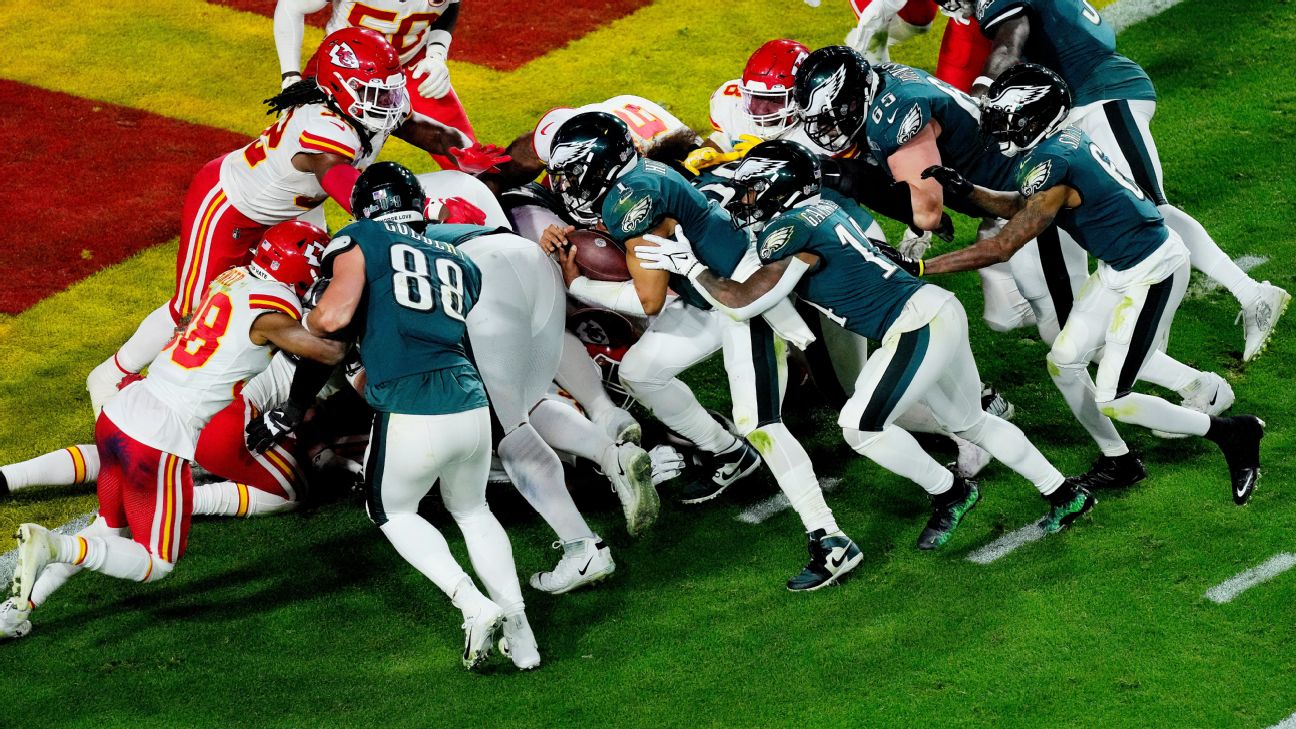
The Philadelphia Eagles ran the “Tush Push” seven times in their win against the Kansas City Chiefs. Photo courtesy of ESPN.
CALEB BALL | STAFF REPORTER | cdball@butler.edu
Overtime, or “OT,” is an opinion column series where the Collegian takes national sports headlines or polarizing topics and gives them a Butler-centric angle.
A single yard may not seem like a lot, especially when a football field spans a hundred of them. In fact, most successful plays in football grant five yards on average. Still, the Philadelphia Eagles have created havoc across the NFL with a play designed to pick up one singular yard.
The “Tush Push” or “Brotherly Shove” is a quarterback sneak that the Eagles have used for the past few years. It has been so successful that owners voted this offseason on whether or not the play should be allowed. The vote did not pass for a few reasons: the play can be run by any offense across the league, it has not been evaluated as an illegal formation and it only picks up one yard.
The Eagles have designed their offense to have short third and fourth downs to give them opportunities to use the Tush Push. All credit goes to their coordinators for implementing it into their game plan. Philadelphia has also built up the best offensive line the NFL has seen in years. A little cherry on top is a quarterback who can squat over 600 pounds.
Redshirt junior tight end Ethan Malafa appreciates the play and does not think it should be removed from the sport.
“I think what the Eagles are doing is a good thing,” Malafa said. “They kind of created the play, and they shouldn’t be shamed, or it shouldn’t be taken away from them just because they’re having success with it.”
The Eagles did not reach the Super Bowl because of the Tush Push, but it certainly aided their run to it. The victories have come in bunches, winning 20 of their last 21 games, and it seems like the viewership fatigue is settling in around the league. People are tired of seeing them win, and they are tired of seeing how they win.
The city of Philadelphia may appreciate this play and what it has done in terms of success, but that same emotion cannot be shared across the league. The play is tasteless, over-abused and in some cases, used illegally.
While running the Tush Push against the Kansas City Chiefs in week 2, it became obvious that the Eagles’ offensive line had a false start penalty that was not called. It raised concerns about how many times they may have gotten away with this, and what other rules they could be bending.
Complaining about penalties getting called, or in this case, not getting called, is simply what football fans do when they do not get what they want. However, a larger concern involves an aspect outside of football: injuries and long-term mental health.
First-year finance major Jonathan Naylor raised a point about the long-term conditions of player safety.
“I think the Tush Push shouldn’t be a play that’s legal in the NFL,” Naylor said. “It puts a lot of players at risk for a head-on-head collision at the line, which is already known for causing minor concussions, and one of the biggest factors of CTE in the NFL.”
Chronic traumatic encephalopathy (CTE) is a serious brain disorder that can be caused by numerous brain injuries. This is why football has been addressing the safety of concussions in recent years to prevent more cases. CTE cannot be diagnosed unless a brain autopsy has been performed. There are former players who have not been diagnosed, but have had a severe shift in character and mood swings. Wide receiver Antonio Brown and defensive end Chandler Jones are two perfect examples of this with outbursts seen on the field and in the media.
Brown’s character change could be seen while he was still playing when he quit during the middle of a game on live television. He removed his jersey and walked into the locker room when he played for the Tampa Bay Buccaneers. Jones’ mood swings were seen when he posted videos of a mental breakdown on X, alarming the football community.
First-year finance major Nathan Vanden Boom suggests this is part of the reason other teams in the league are not attempting this play.
“That’s a lot of wear and tear if you keep running that play over and over again,” Vanden Boom said. “I think some offensive coordinators are just scared to beat the players up in that kind of fashion. They’re not going to run a play that they don’t want to run; there’s a lot of injury at risk.”
Player safety is something that has come a long way since the league’s inception, and every year, changes are made to try to improve it. This play will continue to be evaluated, and it seems as if it may be on its last legs.
The Eagles continue to run this play and even do so on back-to-back occasions. It could suggest they do not value player safety at the same capacity as the rest of the league.
The fatigue has shown in play creativity and improvisation. Teams are tired of seeing it, and fans cannot stand to watch it on their screen. The Eagles have proved they are a good team, but what are they good at?
They excel at running the ball one yard at a time; they have guys who can squat a lot, their city does well destroying their surroundings when they find victory, but they do not care about their players’ health.