
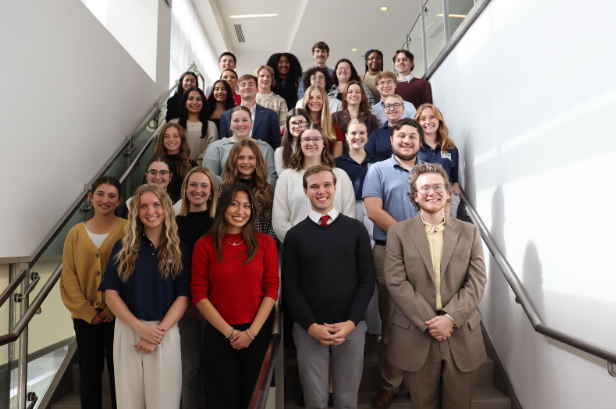
Universities throughout Indiana formed the Indiana Student Government Coalition and worked to expand the Indiana Lifeline Law. Photo courtesy of IU Student Government.
LAUREN FISCHER | NEWS REPORTER | lrfischer@butler.edu
The Indiana Lifeline Law now grants immunity from prosecution to both those who seek medical assistance when an alcohol-related medical emergency takes place and the individual in need, as of July 1, 2025.
This change follows Gov. Mike Braun signing the bill on April 23, 2025, after it passed through the Senate and the House.
In 2012, the Indiana Lifeline Law was first passed in hopes of reducing the number of alcohol related deaths among minors. The law protected the caller as long as they were compliant with law enforcement.
According to the Indiana Lifeline Law’s website, the law now additionally protects the person called for by “provid[ing] immunity for the crimes of public intoxication, minor possession, minor consumption and minor transport.”
This change was made possible through the work of the Indiana Student Government Coalition (ISGC), a collection of student governments from Butler University, Purdue University, Indiana University (IU), DePauw University, Valparaiso University and Grace College. The charter was established on Oct. 25, 2024.
Sydney Haworth, a senior speech, language and hearing sciences major, served as the Student Government Association (SGA) president for the 2024-25 school year. She worked alongside the IU student government president to form the coalition. Upon the first meeting in October 2024, students from each school discussed potential areas of improvement.
Purdue’s student government was in the process of expanding the Lifeline Law and asked for help from the other Indiana student governments. From there, Butler’s SGA representatives, along with other students in the coalition, worked with Indiana legislators to master the verbiage of the law.
“We were really just there and making our name known, and [saying that], Butler student government is in support of this, and we want this to happen,” Haworth said.
Throughout the process, the coalition received a lot of support with minimal concerns. However, the main worry with this expansion was that students would take advantage of the law to engage in careless underage drinking.
Both Haworth and other students in the coalition gave testimonies on how they believe that this expansion will protect students rather than harm them.
“I do think that they pretty quickly understood that this was something that was gonna help,” Haworth said.
John Conley, Chief of Butler University Police Department (BUPD), credited Butler’s SGA with Butler’s role in this change and explained that supporting this law was a “no-brainer” for BUPD.
“None of us want to see any of our kids in this situation,” Conley said.”We want to do the best we can for them.”
As the initial law only protected the caller, the ISGC worried that the law was not being used in emergency situations as it should have been, as the injured individual was more worried about getting in trouble rather than getting the help they needed.
Senior biology major Gracie Walls, who served as the vice president of SGA during the 2024-25 school year, explained that the ISGC hopes that the actions of college students in emergency scenarios will shift.
“Your first thought shouldn’t have to be ‘Oh, am I going to get in trouble?’” Walls said. “Your first thought should be ‘Am I going to be okay?’”
The ISGC believes that not only will this change impact students on Butler’s campus, but it will also impact young adults statewide.
While Butler has its own rules for alcohol-related emergencies among students, if an incident were to occur elsewhere, students would have to go through the local police. With more legal repercussions at risk, there is a lower chance of correctly responding to the emergency by calling for help.
Walls believes that the Indiana Lifeline Law serves as a reminder to value the safety of others, and this expansion should reduce the number of incidents that go unreported.
“I think, especially now, [the Lifeline Law is] even more important for people to know that this is a thing, because it can really make a difference,” Walls said.