
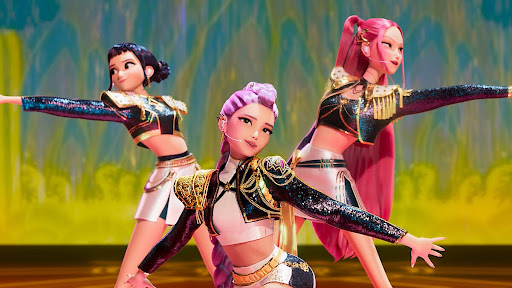
From the music to the outfits, Huntrix feels like a real K-pop group. Photo courtesy of Netflix.
HARRISON PRYOR | STAFF REPORTER | hrpryor@butler.edu
“Film Fanatics” explores Hollywood’s recent releases, cherished classics and everything in between. These thought-provoking reviews invite fresh perspectives and weigh whether a film deserves attention — or if it’s best left in the past. Read on to find out what our writers think of this week’s film.
Action. Emotion. A killer soundtrack. “KPop Demon Hunters” has it all. Netflix’s animated hit quickly became its most-watched movie of all time, and for good reason.
“KPop Demon Hunters” centers around the fictional K-pop trio known as Huntrix — stylized as HUNTR/X — as they attempt to close the barrier between the human and demon worlds through the power of song and blade.
The band’s name mirrors their true purpose and title; Huntrix is the most recent in a long line of Hunters who upheld this duty before them. While these musical warrior trios have always fought to stabilize the fictional Honmoon — literally translating to “soul door” — their ultimate goal is to make the Golden Honmoon that will permanently seal the barrier.
Junior music industry studies major Shelby Thickstun studied abroad in South Korea last semester and found an appreciation for the movie’s detailed depiction of Korean culture and mythology.
“It is great because it gives you another perspective,” Thickstun said. “Korea has lots of religion. Shamanism is a really big belief there, so I feel like it dives into showing other religions rather than just basic concepts.”
Despite being an animated musical, “KPop Demon Hunters” is very much for all ages. The story explores the struggles of loving oneself and others in the face of seemingly unforgivable differences, all while using its animation to deliver hilarious visual jokes. This film unites ages, cultures and all music fans in a truly impressive display.
Junior dance arts administration major Trinity Gomes thought the soundtrack was so good that it single-handedly sparked her interest in K-pop as a genre at large.
“I was not [into K-pop before watching the film], but I did listen to the movie’s soundtrack,” Gomes said. “I [looked] into K-pop playlists on Spotify. I’m still going through different artists’ discographies and exploring that. It did open that up for me.”
The team behind “KPop Demon Hunters” worked closely with various K-pop groups to bring the film’s musical vision to life. Each character’s singing voice was performed by a real K-pop star distinct from the voice actors, and the girl group TWICE both provided their song “Strategy” and a remix of the film’s original “Takedown”.
This collaboration paid off well. The film’s soundtrack topped charts soon after its release, and the cast still sits at over 50 million monthly listeners. With numbers like these, a surge in recognition seems inevitable for K-pop.
Sophomore psychology major Kylie Cline expressed that the film’s accessibility is what might help most in this rush of new fans.
“I think it was definitely a good introduction for audiences that are not familiar with K-pop,” Cline said. “A lot of the songs are sung in English, [so] it is [also] a good introduction to the culture and how the industry works.”
The K-pop industry is not without its faults; Huntrix’s rigorous training mirrors the lives of real K-pop idols, who often begin their careers very young. Even without being world-saving demon hunters, K-pop stars are subject to immense pressure from both fans and record labels. Perhaps Huntrix’s extra duties are just a subtle metaphor for what idols deal with regularly.
Gomes likened the pressure put on both the Hunters and real K-pop idols to the intensity of the dance industry.
“I related to … Rumi’s desire to keep a perfect mask [so] that nobody would know something was wrong,” Gomes said. “In dance, if your superiors or your classmates know something is wrong, it can be taken as a sign that you are too weak … or [that] you are just not ready to perform something. I really connected with Rumi’s struggle of hiding what she thought was weakness or imperfection when it really was what made her beautiful. I think that is something I can take with me into my dance studies.”
Hopefully, the positive depiction of K-pop stars not just as idols, but as people, will push forth a change in the toxicity of all music industries. As more people become aware of K-pop music, they should be sure to take note of its background.


