
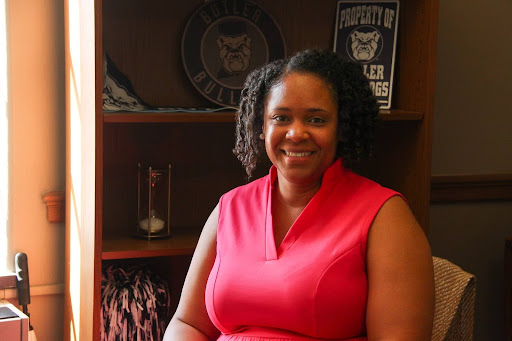
Rhyan Smith takes the helm of the Title IX office, located in Atherton Union 200. Photo by Faith Delemarter.
ELLA HALL | STAFF REPORTER | erhall@butler.edu
Butler University appointed Rhyan Smith as the new Title IX coordinator this year, following a period of turnover and controversy within Butler’s Office of Institutional Equity.
Committed to making a difference in the office by promising to enhance communication efforts, Smith is working closely with the Student Advocacy Office and other campus groups in overseeing the university’s approach to handling and preventing sexual misconduct.
Smith also emphasized her desire to fill the gaps that often occur when a survivor reaches out seeking solace as they tell their story. She explained that communication is an integral part of making this happen.
“We want our community to feel safe and for everyone to have access to proper care and accountability,” Smith said. “One thing I want to make sure [is that] everyone has an equitable experience.”
Smith’s hiring came on the heels of an investigative article The Butler Collegian published last spring, highlighting frustrations students expressed with the Title IX process. The major concerns included a lack of communication and support, along with lengthy investigations, as the last several years saw much turnover within the position.
Lily Steele, a sophomore psychology and sociology double major and the secretary of Butler Survivors Alliance, expressed that she wants to see the Title IX office “take the way they handle cases more seriously” moving into the new school year.
Steele emphasized that all cases should be treated with the same amount of care and respect for the survivors.
“Having as much empathy as possible is so important, especially because a lot of the cases [are] sexual assault cases and sexual misconduct, and there’s a lot of like trauma and stigmatism surrounding those cases,” Steele said. “Having someone that’s empathetic is, I would say, one of the biggest things [Title IX should have].”
Steele stressed the importance of having a reliable Title IX process at Butler. As it is a smaller campus, she noted that building trust within the system is essential.
“There’s a lot of stigmatism around going to Title IX and sharing what happened to you, because things spread like wildfire here,” Steele said. “It’s very easy to feel isolated.”
Smith said she did not take on the position unaware of the discourse surrounding it, and is ready to face the challenges, taking small steps toward big improvements. She began by “committing to sitting in the tension and discomfort of what was” and has moved forward with investing in the team surrounding the office through training and tools.
Smith highlighted a desire to celebrate the strengths of the office while also acknowledging and searching for opportunities for improvement.
“I expect to see a turnaround in this office, [and] I’d like to see it by the end of this year,” Smith said. “We are [already] seeing an increase in reports in both Title IX and bias, [which] means that people recognize change is happening in our office.”
A significant aspect Smith identified as important for the Title IX office this year was creating stronger collaborations with supportive resources. She highlighted that efforts are being made to improve the communication aspect through technology. Smith also mentioned that the office is doing more to make sure people know about the connections the office has to a pool of trained advisors and the counseling services they are partnered with.
“The resources are there, but I don’t know if our office has always been the best bridge to these resources,” Smith said. “That’s our focus this year.”
One of the resources that the Title IX office works closely with is the Office of Student Advocacy, a safe space for students to turn to for assistance when experiencing difficulties in life.
Director of Student Advocacy Jules Grable works as a confidential survivor advocate for survivors of sexual misconduct and is currently working with Smith to assemble a collaboration providing “the best support for students as possible.”
Grable is conscious of the delicacy the situation demands.
“It’s important to make sure that everybody who is going through the [Title IX] process has equitable rights as they move through the process,” Grable said. “[It’s also important] that we know what’s going to happen from step to step in that every case is going to be treated with the respect that both parties deserve.”
Grable has a very hopeful outlook on the effect that Smith’s vision and the working collaboration between them will have on the climate surrounding Title IX on campus.
“We’re just going to keep doing what we’re doing,” Grable said. “I am going to continue to support survivors in the best way that I know how. Rhyan is fabulous and wonderful, and so hopefully we can start rebuilding some trust with the student body.”
Steele also sees Smith as a promising leader in shaping the future of the Title IX experience.
“You [can] tell that she’s very dedicated to what she does as a Title IX Coordinator,” Steele said. “She’s very passionate about getting students the help they need.”
Smith reiterated that, though progress has already been made in the approximately 90 days she has held the position, “fixing” the Title IX process will not happen overnight. She likened the process of renovating the system to building a plane and flying it at the same time.
“One of the things I hope people take away is that working in the Title IX process is grueling,” Smith said. “Navigating these traumatic moments is not ever something that I take lightly.”
Students who have experienced sexual misconduct can access the Title IX office in Atherton Union 200 to make a report. For those seeking confidential resources, the Office of Student Advocacy can offer additional support. They are located in Atherton Union 311B, and the Victim Advocate phone number (317-940-2047) can be called to access additional resources during non-business hours.