
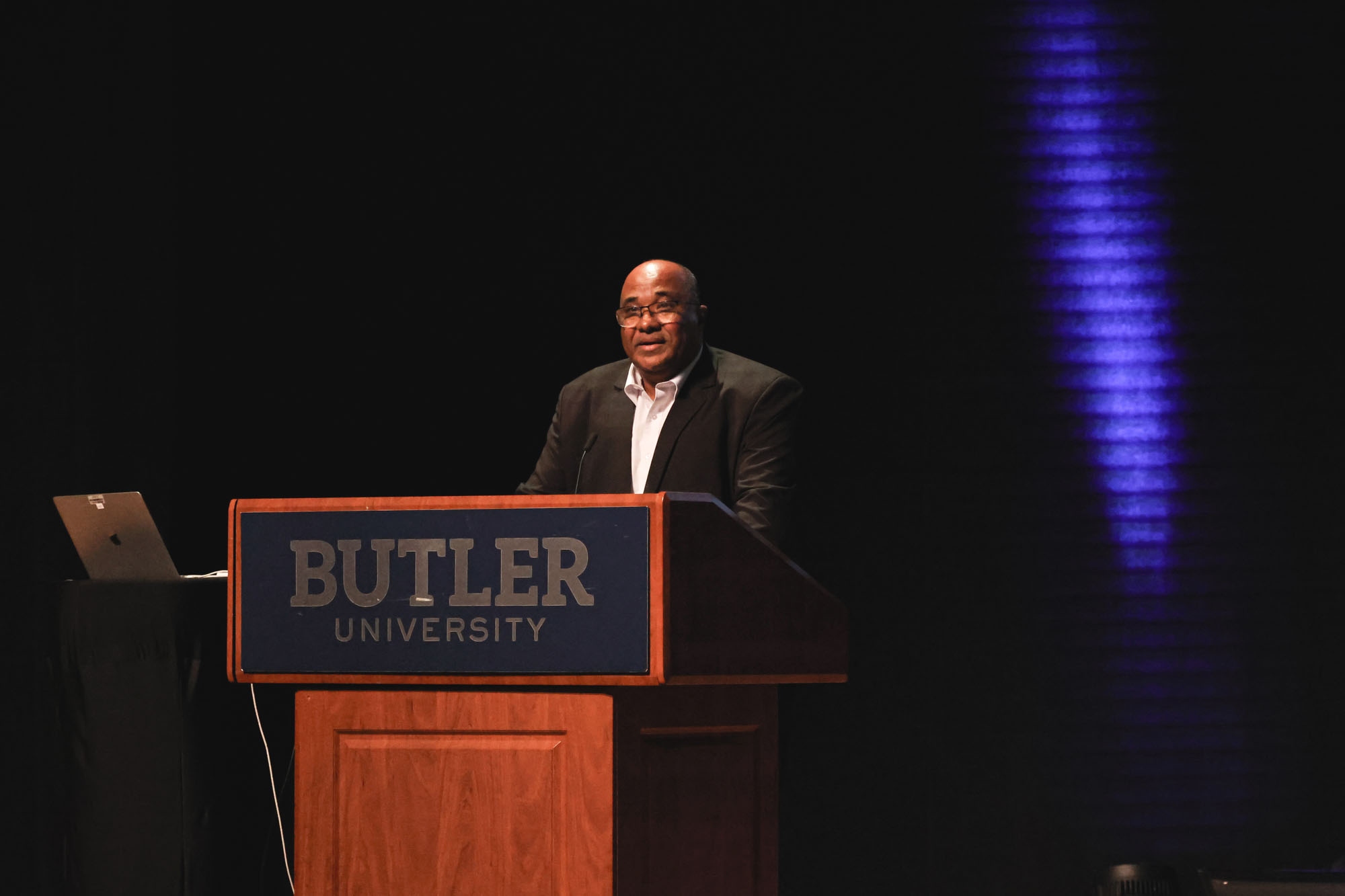
Dr. Lily-Arison René de Roland speaks at the Woods Lecture series. Photo by Jada Gangazha
ANA DOLLARD | ASSISTANT CULTURE EDITOR | adollard@butler.edu
Dr. Lily-Arison René de Roland is a Malagasy conservation biologist and the 2025 winner of the Indianapolis Prize Award, known as one of the most prestigious international conservation awards. René De Roland has a remarkable list of achievements, including the rediscovery of two different extinct species.
René de Roland is also the national director of The Peregrine Fund in Madagascar, a non-governmental organization he has been involved with since 1992. Briefly after the start of his research there, René de Roland earned both his master’s and PhD at the University of Antananarivo.
In 2006, René de Roland set out to discover a species of duck that had been classified as extinct since the 1990s. The endemic duck, known as the Madagascar Pochard, had faced threats from the Madagascar fishing industry and its resulting habitat loss. Using a community-based conservation approach, Dr. René de Roland and his team effectively restored the population of the Madagascar Pochard from nine individual birds to about 200 currently in the wild. In addition to the Madagascar Pochard, René de Roland was part of the expedition to rediscover the Madagascar Serpent-eagle, a species that had not been sighted for more than 60 years.
After a lifetime of conservation work, René de Roland traveled from Madagascar to visit Butler for the Woods Lecture Series. The Butler Collegian sat down with Dr. René de Roland in an interview to learn more about his achievements.
THE BUTLER COLLEGIAN: Can you tell me about your early passion for conservation? What do you think has drawn you to conservation?
RENÉ DE ROLAND: I began [my research] with the Peregrine Fund [in 1992] and then [completed it] for my master’s and PhD degrees … After we rediscovered these [species] with my colleagues … We changed our policies in Madagascar … I discussed with my colleague why we [should work on conservation for not only] Raptors, because Madagascar has a lot of biodiversity that needs protection, [including] mammals, reptiles and plants. They accepted my suggestion. So from the beginning of 2000, we increased our activities to learn about mammals, reptiles and plants … In 2003, our former president [asked us to increase] the protected areas in Madagascar [by] three times. The Peregrine Fund also participated [in] creating [four] protected areas in Madagascar [in 2004].
Currently, these four sites [are still] protected areas … Around 118,000 hectares. In Northern Madagascar … I rediscovered a classified extinct bird. It [was] not a raptor, but an endemic duck. This bird was classified as extinct in 1993 and I rediscovered [it] in 2006. When we protected this site just a few years later, we observed a lot of threatened species. [In Northeast] Madagascar, we have two protected areas [made up of] rain forest, marshes, savanna and volcanic lakes. [On the] West Coast we also have two protected areas. Lots of fishermen have done fishing activities on the site, [so] we also protect [that]. Madagascar fishing is very [threatening to] endangered species … So there [is] a conflict [there] between humans and [biodiversity]. In the 1990s, [we developed an] approach of community-based conservation … To resolve the conflict between humans and biodiversity.
TBC: What is it like to rediscover a species, and what can you take away from an experience that is as revolutionary as that?
LR: [When you] rediscover [a] species, [the] first [thing you feel] is happiness. The second point … For example, in Madagascar, when [scientists] said in 1993, [that] the Madagascar Pochard [was] extinct, [it was] very bad news for my country, because it looked like we didn’t [try to] protect [them]. So, when we rediscovered the species, it [was nice] to say to the environment minister that we continue to protect our biodiversity. The third point is, [now], future generations always have our biodiversity to develop. I think [this is] the most important point at the time we rediscovered the species. It’s for the future generation and for the image of the state, and also to continue to protect biodiversity.
TBC: Part of your work involves supporting communities through conservation. How do you think we can make conservation and support of local communities intersect more?
LR: If I take an example [from the] West Coast [of Madagascar], when we began to work at this site, as I said, the West Coast is a dry forest and many lakes [are] inside of the site. Before we came to the site, there were a lot of fishermen using the lake for fishing activities. [Which meant] that their life depended on the lakes having more fish, or to have money. But when we arrived at the site, our objectives were to … Decrease the activities of fishermen. We explained to them that our project will protect one species, [that] is [unique] to Madagascar. The life of Madagascar fishing depends on fish, so we needed to write a contract between the fishermen and us.
Our approach was [based] on community-[oriented] conservation, so we explained to them that the opening period of the fishing season must be limited. [Additionally,] they camped [for fishing season on] almost all of the edge of the lake, but the Madagascar [Fish-eagle] needs a very quiet place for breeding. We explained to the fishermen that this bird needs a quiet area, so you must stay in a few [different] points for camping. [We told them to] regroup, to stay together in a few areas and that the fisherman camp must [be] at least 500 meters from the [bird’s breeding grounds]. They accepted these rules.
[Because of our work], Madagascar fishing life and populations increased. We resolved the conflict between human and biodiversity. [This is] one example of what we have done on local communities and biodiversity, but we have different methods, following the different sites we have worked on.
TBC: You have lived a veteran conservation career. You started with the Peregrine Fund in 1992. If you could tell me just one thing that you have learned, and if you could sum it into a sentence, what would that be?
LR: … I have worked in difficult sites. For example, on the north side [of Madagascar], sometimes the average [rainfall] is 7,000 millimeters. Just a few days in one year are dry. It’s a very difficult site, and all of our sites are in remote areas, but we need to protect the biodiversity. Conservation work needs patience, perseverance and motivation. It also needs discipline, because the work is not only mine; I have worked with many colleagues, local technicians and students. To have a good achievement of conservation, we need to have passion, perseverance, motivation and discipline.