
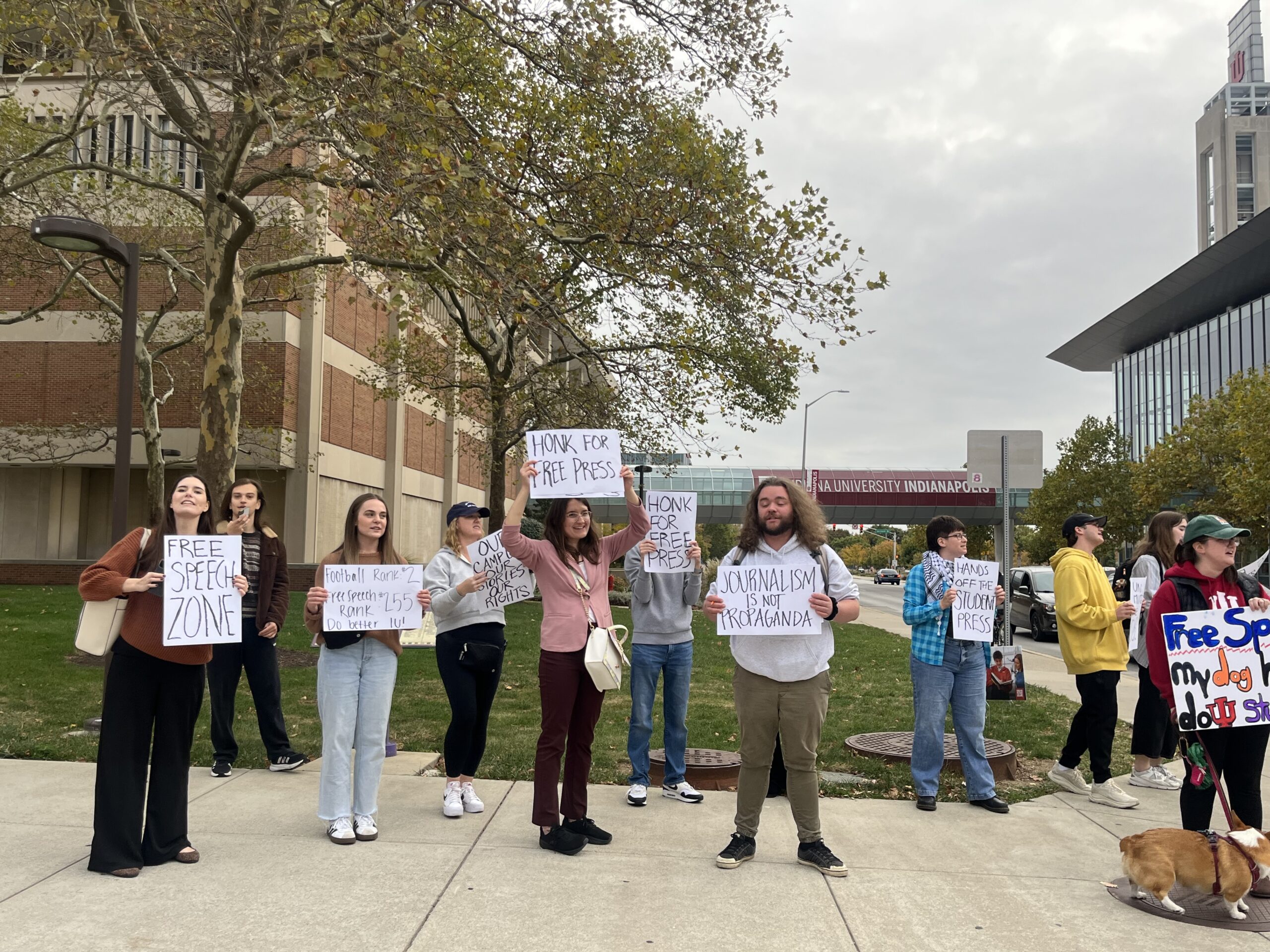
IU Indianapolis students gather at a campus intersection to advocate for student journalism. Photo by Ollie Fitzgerald.
OLLIE FITZGERALD | ASSISTANT NEWS EDITOR | ofitzgerald@butler.edu
PIPER BAILEY | MULTIMEDIA EDITOR | pcbailey1@butler.edu
Following Indiana University’s (IU) decision to cut print publications of The Indiana Daily Student (IDS) — and alongside the firing of former IU Student Media Director Jim Rodenbush — other universities throughout the state joined in defense of student journalism and free speech.
On Oct. 28, there was a student-organized protest on IU Indianapolis’ campus — which is part of the larger IU system — in support of the IDS and to criticize IU’s decisions regarding student journalism.
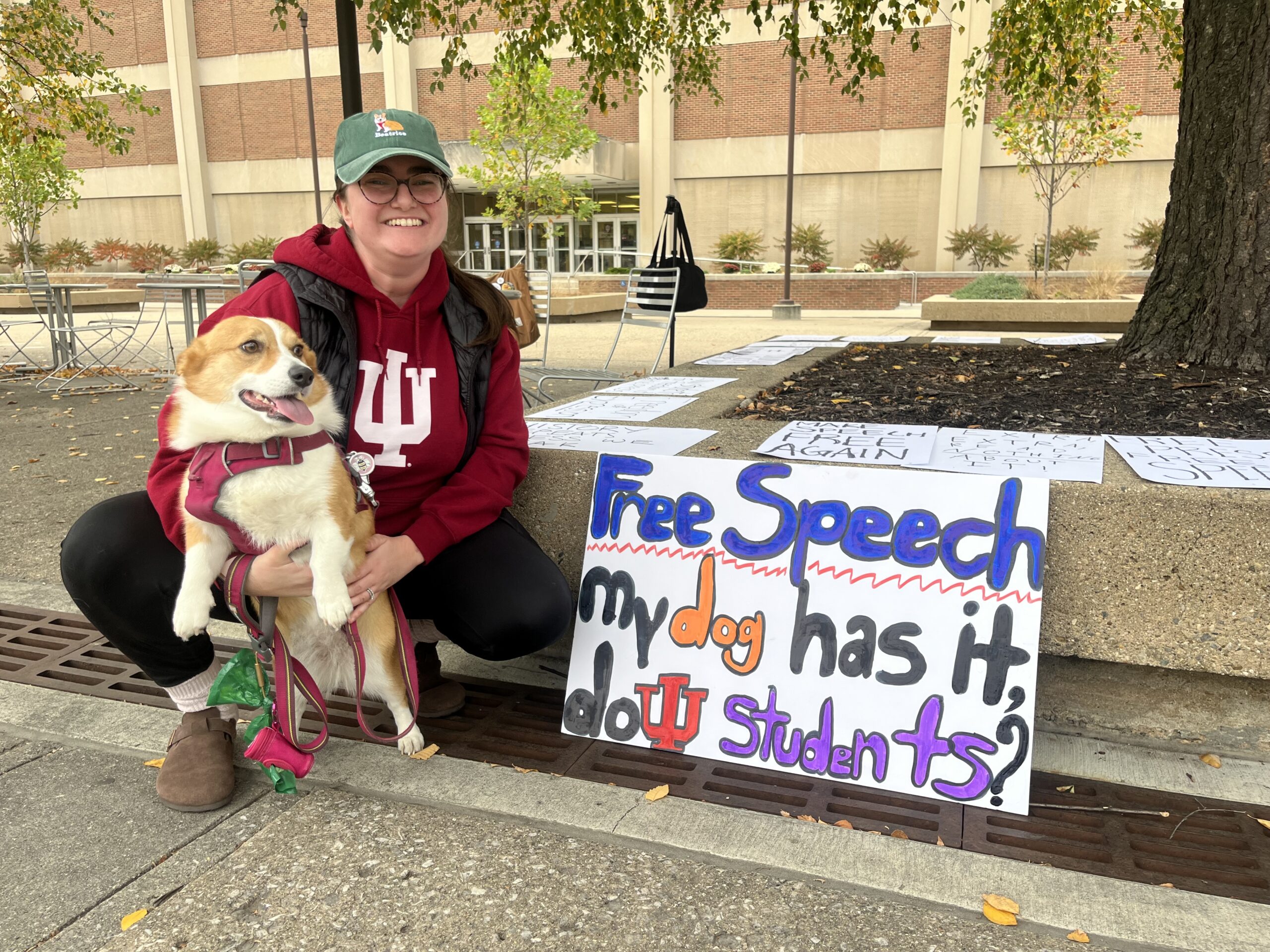 Beatrice the corgi advocates for free speech. Photo by Ollie Fitzgerald.
IU McKinney law student Maggie Hutton and her husband organized the protest, which garnered attendance from fellow law students, various passerbys and staff of The Campus Citizen — the current student-run paper on IU Indy’s campus. The event started with a small group of students creating and holding signs and gradually grew in size, moving to walking up and down Michigan Street.
Hutton has no experience in journalism, but decided to organize the protest to stand in defense of student press regardless.
“[I want] to show younger students than me that anybody can do this,” Hutton said. “You don’t need a degree. You don’t need to be in government … This is our right to have our voices heard, and you don’t need to be afraid.”
Safety was a large goal of Hutton’s throughout the protest. She mentioned that they did their best to promote the protest on campus, but were also being cautious since the original censorship came from the larger IU network as a whole. Hutton — who has three kids herself — emphasized that she aimed to uplift younger voices and to make sure that what would be many students’ first protest, a positive experience.
“Free speech is in the Constitution [and] I plan to defend the Constitution,” Hutton said.
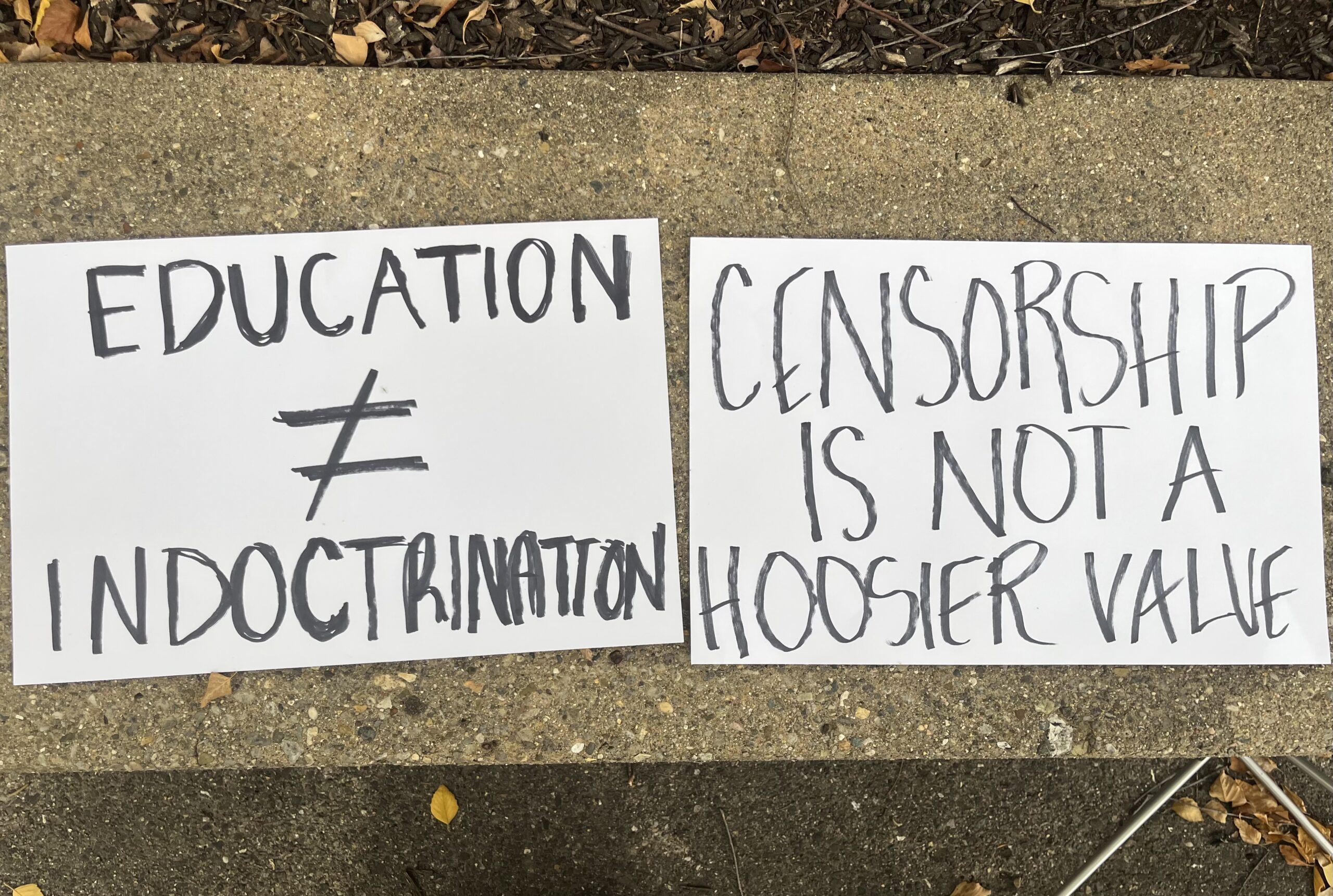 Hutton and her husband made signs for students to carry during the protest. Photo by Ollie Fitzgerald.
Abby Godsen, senior applied information and data sciences major and Editor-in-Chief of The Campus Citizen, attended the latter half of the protest after discussing protest etiquette and her support of attending staff during The Campus Citizen’s Tuesday meeting.
Godsen explained that The Campus Citizen has not explicitly been censored by IU or the IU Indy administration, but understands the standard that has been set on a “main” IU campus could soon affect satellite campuses.
“Free speech is a focal point of what we do,” Godsen said. “We want our students to be heard and seen. By censoring the IDS, IU is setting a precedent about how they feel about student journalism and students’ right to speak their minds in general.”
Melanie Contreras, a sophomore journalism major at IU Indianapolis and the Culture and Politics Editor of The Campus Citizen, attended the protest while taking pictures.
Contreras explained that The Campus Citizen has not yet had to worry about censorship, as it is independent from the university. However, the IDS censorship has made staff increasingly wary of what they cover and say.
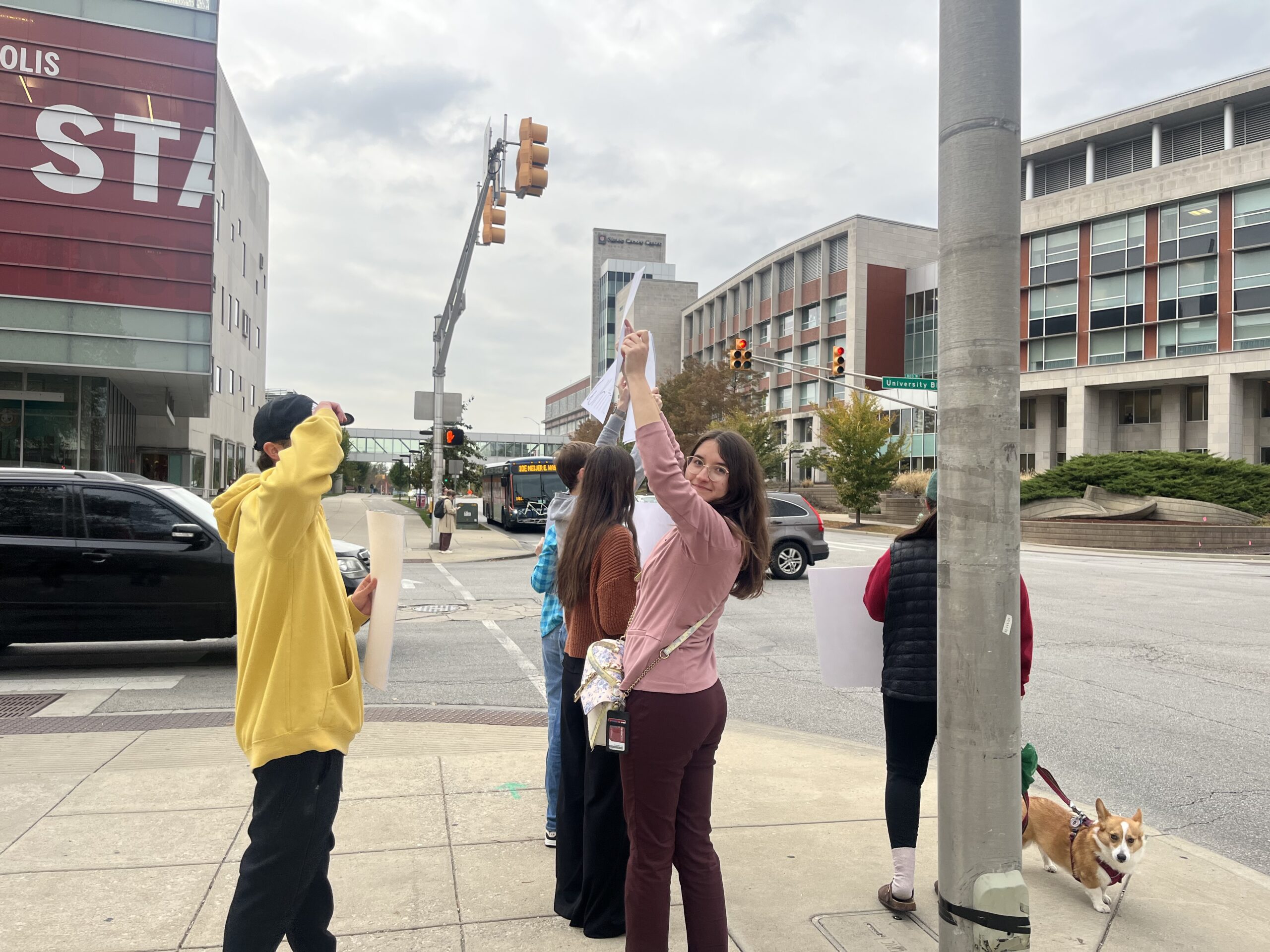 Protesters gather by an IU Indianapolis sign that says ‘It All Starts Here.’ Photo by Ollie Fitzgerald.
Jackie Lawrence, a Butler alumnus and IU McKinney law student, is one of Hutton’s law school friends in attendance for the protest. She did not understand what a large difference there was between a private university like Butler and a public university such as IU until beginning law school.
“I realized we were lucky at Butler to go to a private university where we didn’t necessarily have these issues of free speech,” Lawerence said. “I realized this was a bigger issue, and Maggie really encouraged us to get politically or civically involved [in] activism.”
Lawrence also encouraged students not to take student journalism for granted, as it tells stories from the lens of peers.
Contreras echoed similar sentiments with the added experience of being part of a student-run newspaper. She explained that by participating in student journalism, people are voicing issues that they want to be heard.
“Please support student-run publications, especially while we’re taking a huge hit right now,” Contreras said. “I think if you’re really for the cause, please just support us by reading us.”
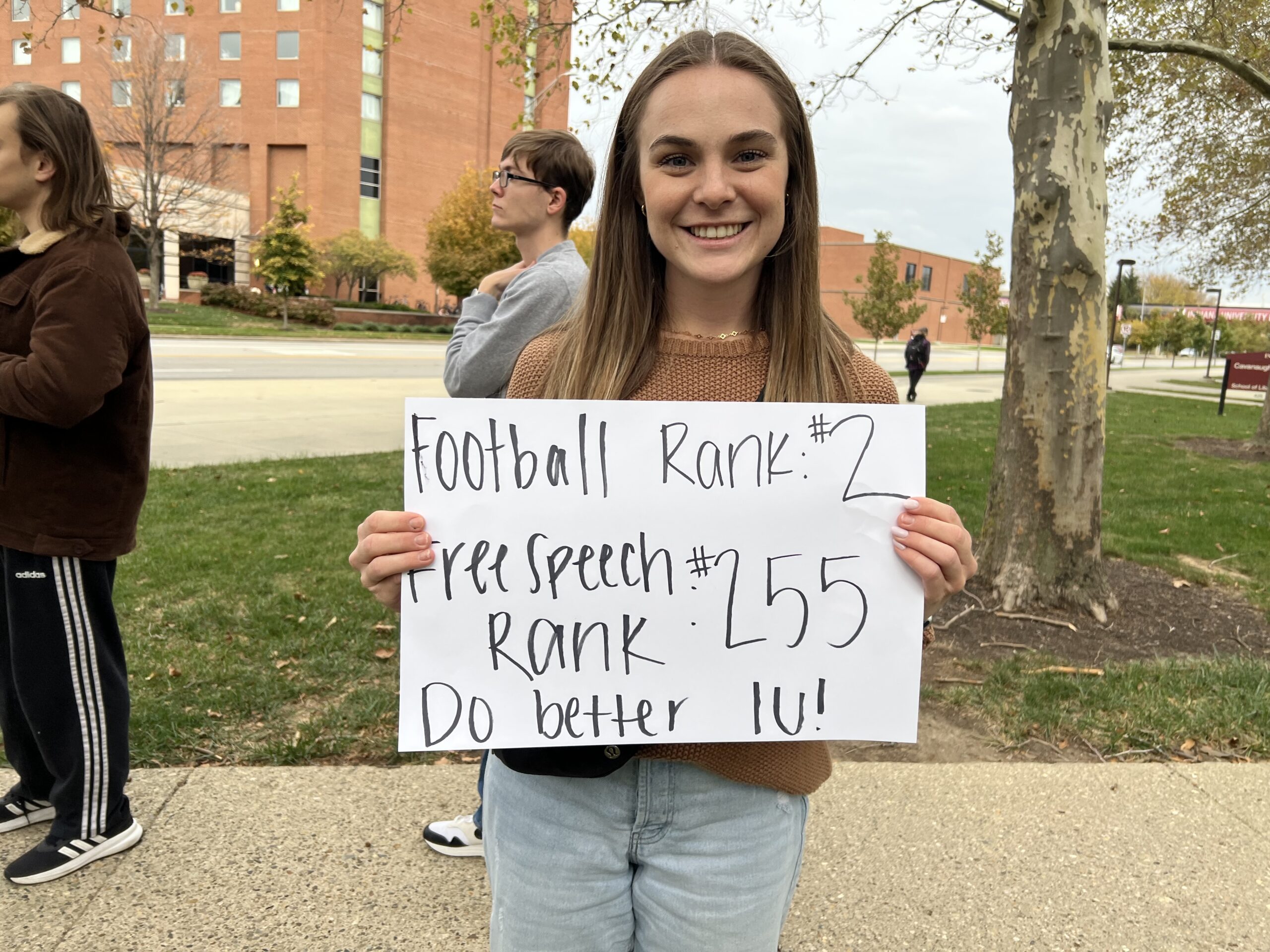 Jackie Lawerence and her sign calling out the Indiana University administration for their unequal treatment of programs. Photo by Piper Bailey.
Ethan Umshares, an IU Indy student and health sciences major, heard that a protest was happening outside and decided to check it out. He had no idea what the protest was about, but decided to join the crowd after learning the cause.
“I came down here [wanting] to see what was going on,” Umshares said. “When they were holding the signs about the IDS being censored and removed from the Bloomington campus … I had to join in because I think it’s a topic that needs to be discussed more at IU.”
Umshares encourages more people to get involved in local protests and civic action. He referenced the Kent State shootings and the student protest against the Vietnam War, discussing how such historical events have shown that free speech should be protected — especially on college campuses.
“Protests are a really good way to figure out what needs more attention,” Umshares said. “Without protests, there would be no Civil Rights Act [and] no end to the Vietnam War. It doesn’t matter where you protest — in person [or] online — it’s amazing and it’s effective to get your voice out there.”
Throughout the event, Umshares held a sign that read: “Witten has me at my wits’ end.”
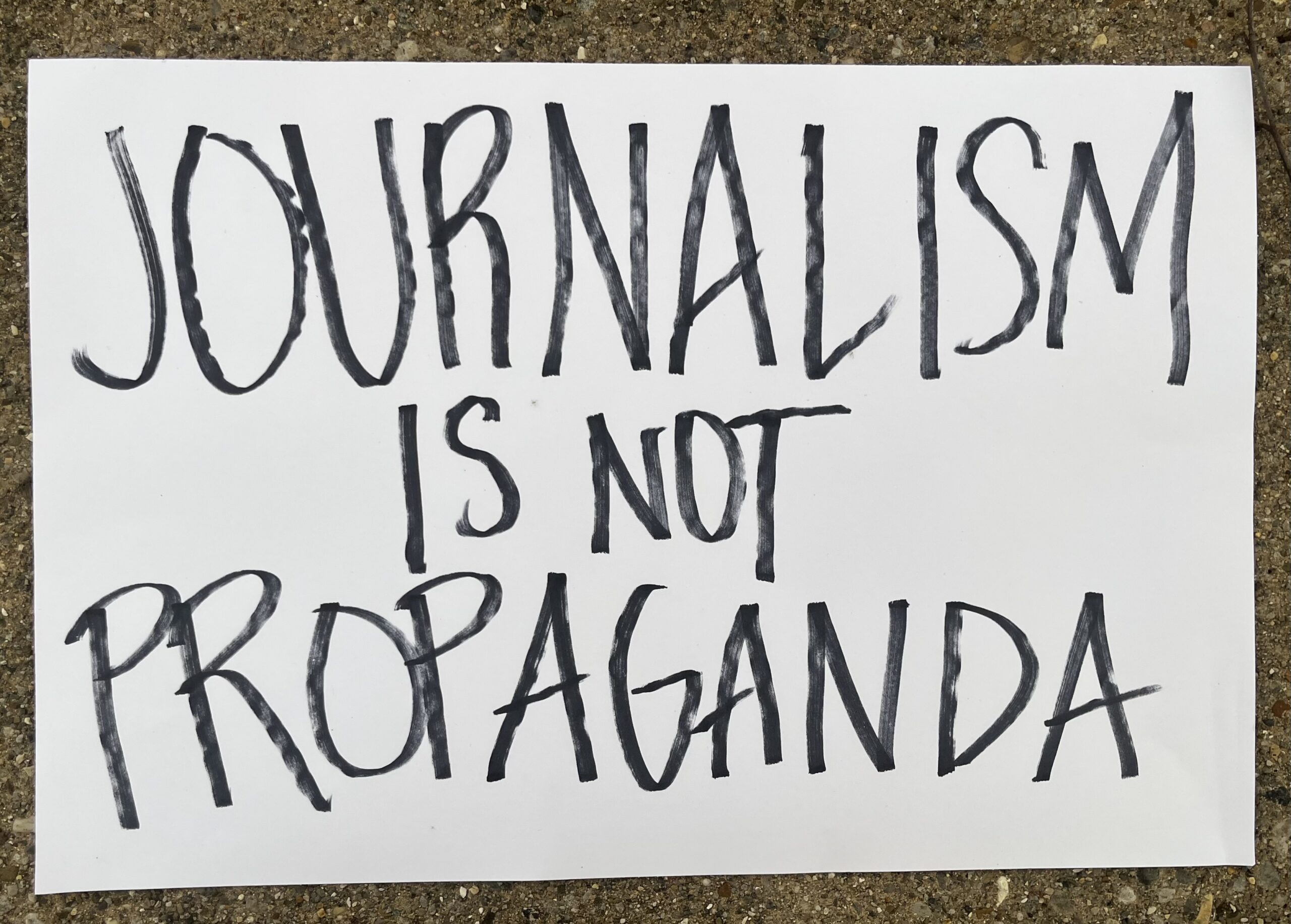 Signs made by participants emphasize the message of the protest. Photo by Ollie Fitzgerald.
Hutton seconded the points Umshares mentioned, but used her law school background to emphasize the importance of democracy and how the censorship of the IDS could legally be considered a violation of the First Amendment.
“Public universities are laboratories for democracy,” Hutton said. “We have to be able to ask questions, [have] freedom of expression, and let those things be here in order for it to be a democracy.”