
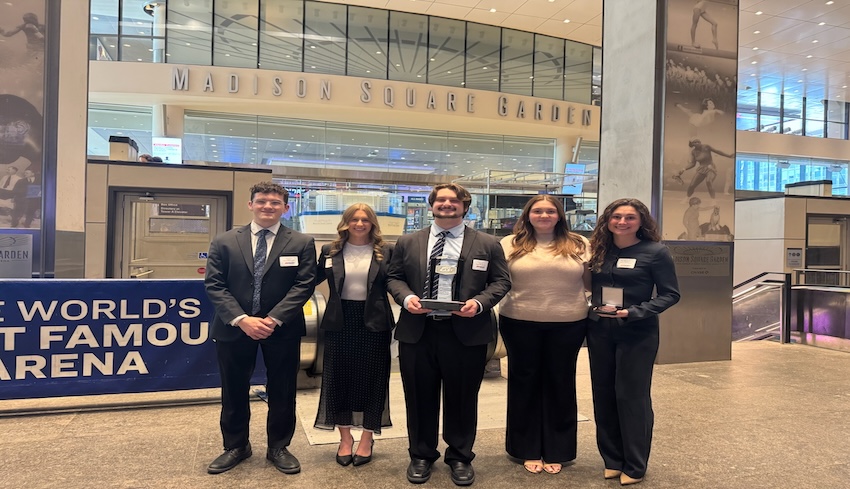
Before spring break, a team of five Butler students competed in the Big East Research Symposium. Butler placed third overall, with senior biochemistry and biology double major Milica Nenadovich placing third in an individual.
2026 is the first year Butler has placed in the top three in the five years the conference has been hosted. Compared to other Big East universities, Butler is the second smallest in total enrollment, only ahead of Providence. The event occurred at Madison Square Garden, simultaneously with the Big East Men’s Basketball Tournament.
The Butler team consisted of Nenadovich, junior biochemistry major Jason Garcia, senior astrophysics major Chase Nixon, junior biology major Abbey Shafier and junior biochemistry major Julia Harmon.
Nenadovich received an individual award in the engineering, physics, chemistry/biochemistry and biology, or the non-health sciences category. This was her first time attending the event.
“Five years ago, the Big East decided that they didn’t want to just celebrate athletic achievement in their conference,” Nenadovich said. “They also wanted to celebrate academic achievement, so they started an undergraduate research symposium.”
Nenadovich’s research was specifically in biochemistry, but other students can compete in the humanities and health sciences.
“My research is investigating the function of a protein in the model organism C. elegans and how that protein is involved in the nervous system’s responses to oxidative stress,” Nenadovich said.
Like Nenadovich, Garcia also presented his work in the non-health sciences category. Garcia worked with biochemistry and chemistry professor Michael Samide, and they are now in the process of trying to publish their research.
“My work focuses around art conservation chemistry,” Garcia said. “[That means] making sure that artworks and artifacts in museums aren’t damaged by the materials that are used to construct the enclosures to let everyone see them.”
Nixon was the only participant in the entire competition to present in the field of astronomy. Their research looked to distinguish rare calcium supernovas from common supernovas, using spectroscopy to analyze their individual helium profiles.
“I was the only person at the entire research symposium doing astronomy,” Nixon said. “[Being the] only representative, I had a bit of extra energy.”
Shafier did her research on dissecting fruit flies’ ovaries, looking to manipulate proteins that can reverse infertility. Julia Harmon, a junior biochemistry major, did her research on finding more sustainable and less hazardous ways to use the cancer-treating drug YK-4-279.
“Butler is unique in that it offers these opportunities for undergraduate students because we don’t have any PhD programs,” Nenadovich said. “You learn skills from doing research that you don’t learn from other types of activities because you’re taking responsibility for your own project.”
All five of Butler’s team members have taken advantage of the university’s undergraduate research opportunities, including participating in the Butler Summer Institute.
Research students are excited that Butler’s undergraduate research is getting recognition.
“Winning both third overall and an individual award means a lot,” Garcia said. “A lot of the other universities in the conference — especially those who have won and continue to win — have a lot of money to spend, both on research and in general.”