
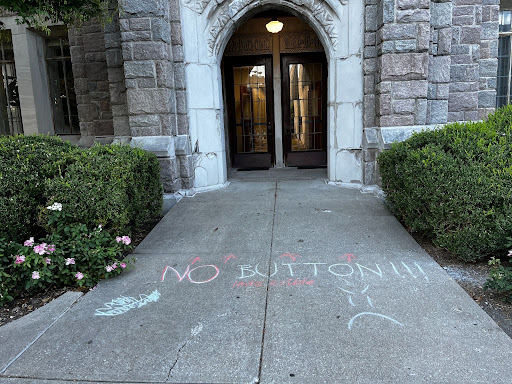
Jude Gardner was in the middle of an exercise for their Disability in American Literature class when they found themself stuck in the elevator of Atherton Union, calling out to their classmates for help.
Each student in Gardner’s class was assigned a profile of someone with disabilities based on a character in the literature they were reading. Gardner, who has fibromyalgia — a medical condition that causes widespread body pain and mobility issues — was given a profile of someone who presents similar barriers to themself. Their professor tasked the class with assessing campus infrastructure with the disabilities of their character. When Gardner attempted to use the elevator for the class activity, they realized that they could not take the elevator back up on their own.
When they tried to exit the elevator, the door was locked. Gardner soon realized that another person had to assist from outside by pressing a button upstairs.
Gardner, a sophomore English major, noted the impact of this experience on their understanding of their ability to navigate campus structures.
“The conversation that we had in class afterwards was about [how] people with disabilities deserve independence too,” Gardner said, “I deserve to be able to use [the elevator] and use it on my own and not have a companion here with whom, in action, would have had to be outside of the elevator itself.”
Elevators
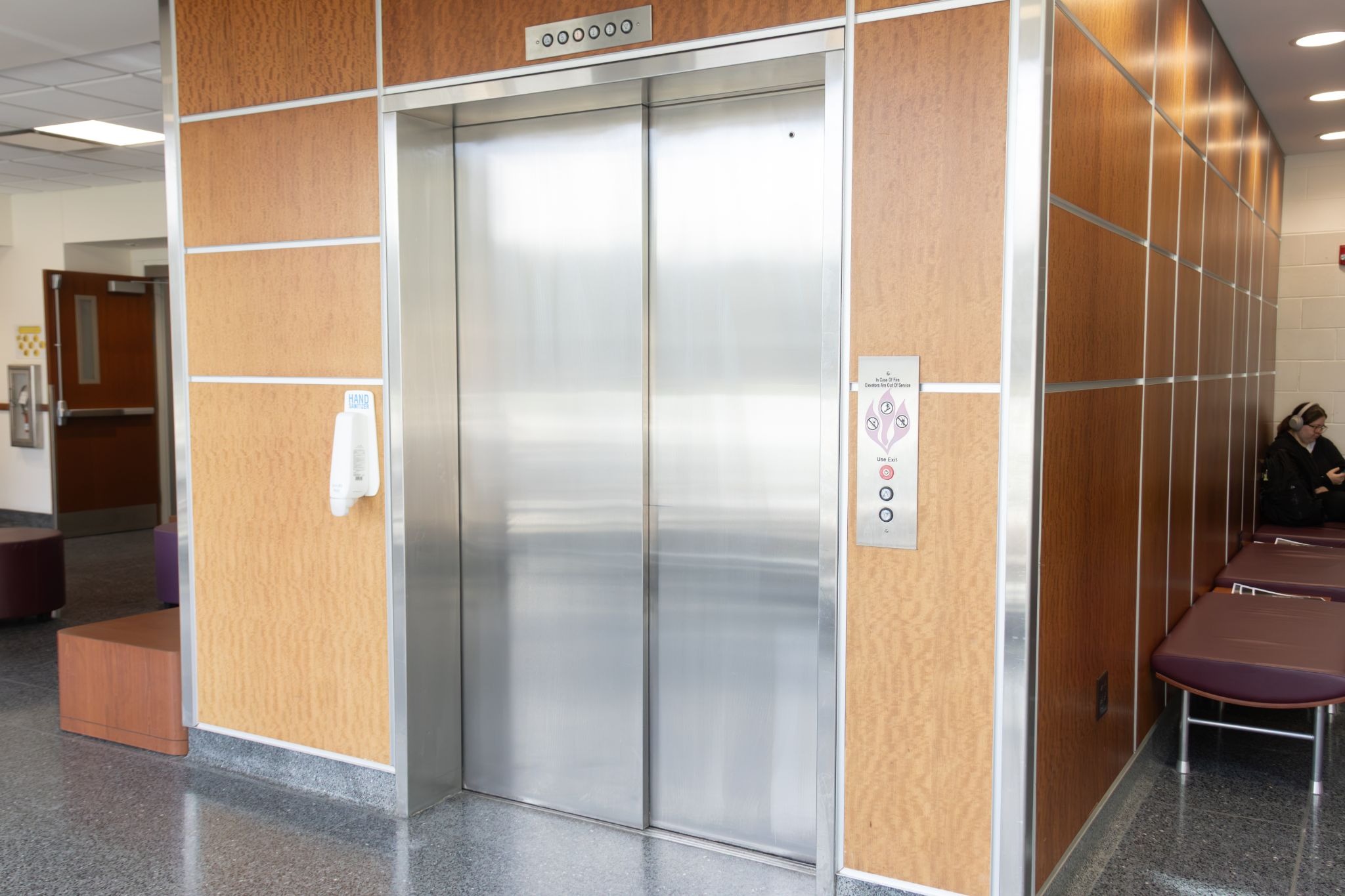
This is not the first time a Butler elevator has left students waiting for help. In 2024, three different individuals got trapped in the parking garage elevator, requiring assistance from the Indianapolis Fire Department. Throughout the last year, several elevator entrapments occurred in Fairview House. On Sept. 2, an elevator in Lilly Hall broke down, leaving two parties trapped inside.
When elevators break down, the Student Disability Services (SDS) office has a protocol in place. If an elevator outage is reported, Butler Facilities works to notify SDS, who will then alert students with elevator needs.
Kathleen Camire, the director of SDS and Butler’s 504 coordinator, encourages students to file Barrier Reports if something is limiting access to university participation.
“What I want students to do is let us know if it’s creating a barrier to something, because if we don’t know, then we can’t help coordinate that kind of thing,” Camire said.
If facilities are not made aware of the issue, students with disabilities who require elevator use to access spaces on campus will not be notified, leaving those students with limited access to classroom spaces.
Inspections are required annually for all elevators in the state of Indiana. The Indiana Department of Homeland Security (IDHS) website, however, does not list updated inspection dates, and instead lists the last inspection of the Lilly Hall passenger elevator as 2020.
The Collegian was able to independently verify with the senior director of facilities and maintenance services, John Lacheta, that all elevators, including Lilly Hall, Jordan Hall and Fairview House, are inspected annually and certified yearly by an external vendor. Lilly Hall’s oldest inspection dates back to September of 1997, providing three decades of inspection history.
However, students have noticed consistent issues not just with elevators, but other sectors of campus accessibility.
Before Block Party began this year, Oli Barnett, a senior arts administration major and president of the Bulldogs for Universal Design (BUD), emailed the student activities office to ensure the event would be accessible for him and other BUD exec members — besides just generally following ADA guidelines. While the floor plan for the event was created with the required accommodations in mind, students still had difficulty navigating the crowded space.
Sophomore journalism major Leah Cloud was unable to attend Block Party for more than 15 minutes due to accessibility issues.
“I had both of my forearm crutches with me, and I would be trying to follow the flow of people walking, but then people would just stop, turn around, and then run straight into me, and then stare at me like it was my fault,” Cloud said. “I’m like, ‘Hey, I can barely walk. It is not my fault [that] you are not paying attention.’”
Cloud has Postural Orthostatic Tachycardia Syndrome (POTS) and uses crutches as a mobility aid. While the crowds caused issues, the ramps in Hinkle Fieldhouse were even more limiting for them.
“I don’t even think if I wanted to, I could have [gone] upstairs because those ramps are way too steep,” Cloud said. “I would not have been able to make it [up]. I left because I couldn’t do it. It just didn’t seem like there was much thought for any students in mind.”
Elevators and ramps are not the only factors affecting campus accessibility. Construction that blocks or alters accessible paths can make navigating campus difficult for students with mobility issues.
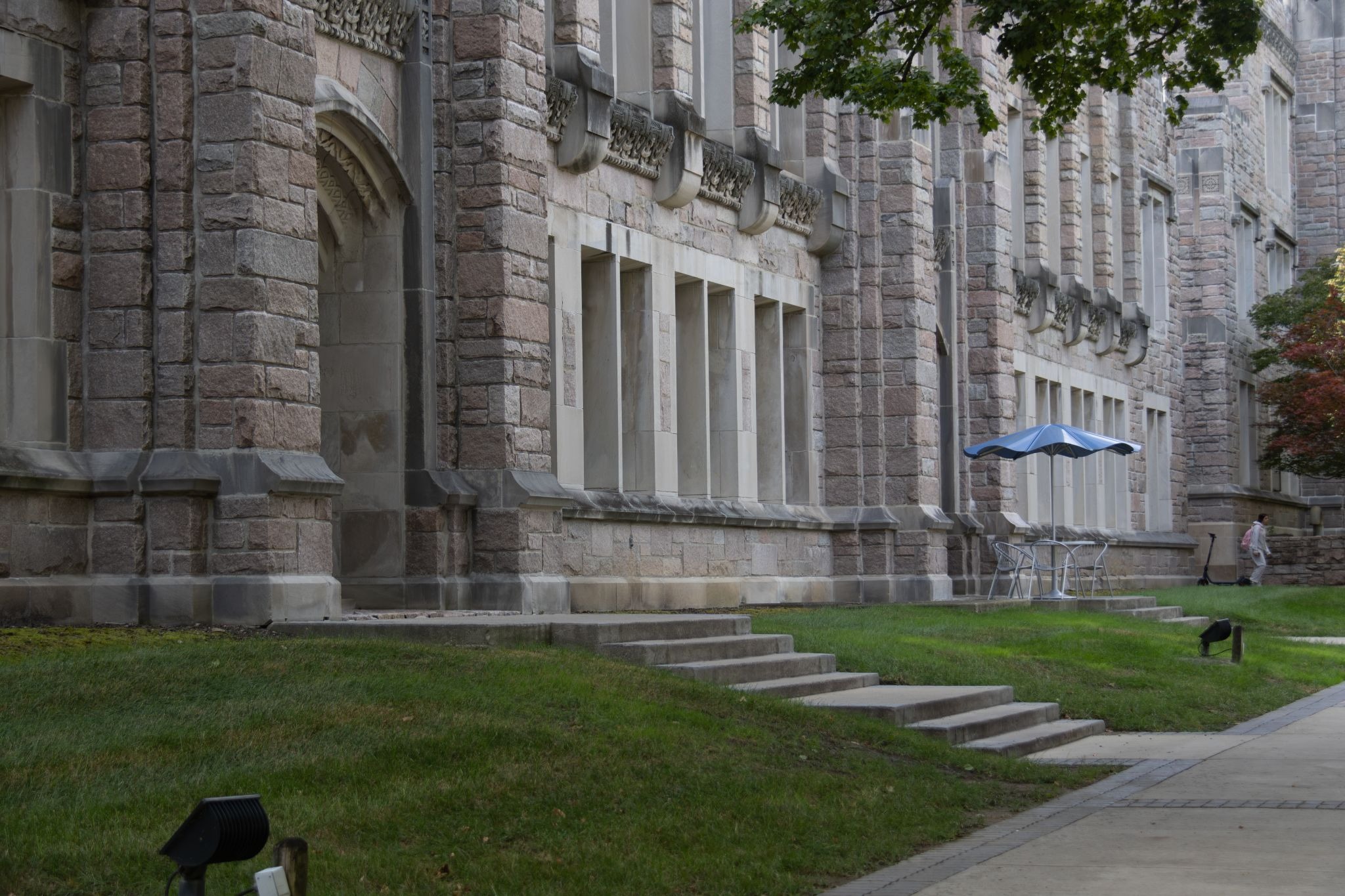
Barnett explained the struggle of attending classes when construction creates inaccessible routes.
“If construction is adding 10 minutes to your walk to class, you are probably not going to be able to show up to class if you’re physically incapable of walking that distance, which then impacts your grades, which then impacts your GPA, which then impacts your diploma, which then impacts your future jobs,” Barnett said. “Construction may be happening for one week, but missing one week of classes can be a huge deal. I think it’s important that Butler pays attention to things like that.”
SDS accommodations
SDS at Butler operates with the idea of free one-on-one support that follows ADA guidelines. According to Camire, SDS aims to go above and beyond these legal guidelines.
Students who use SDS for accommodations and other resources report a variety of experiences. According to Barnett, some students have struggled to get accommodations their doctors have recommended. One student described to Barnett how when she had explicitly written out exactly what she needed, SDS did not allow the student to receive the accommodation.
Barnett believes that a doctor’s note should be prioritized over the opinion of an SDS staff member.
“[It] is quite frankly crazy because what do you mean you, as an SDS [representative], know more about someone’s disability than their doctor, who is a specialist in their field,” Barnett said. “That’s quite frustrating to be a person [saying] ‘I need this. My doctor, who has treated me for years, knows that I need this and told you that I need this, and you have met me for all of 15 minutes and decided that I don’t need this [accommodation].’”
According to Camire, SDS is responsible for establishing functional limitations of a diagnosis before providing accommodations. That means that SDS must determine if the barrier that a student is experiencing due to their disability is limiting their institutional access.
“When we get documentation, sometimes what we get is a letter from a doctor or from a therapist or whomever that might say this student has X; you should give them Y,” Camire said. “I appreciate recommendations. [They are] useful, but not the same as getting a doctor’s note for high school. We need to be able to determine the barrier to access, and if we don’t have the specific functional limitations, that recommendation doesn’t help us.”
Camire further explained the reasoning behind this decision making.
“Disability is not dictated by diagnosis,” Camire said. “Simply having a diagnosis does not mean it rises to the level of disabling. That is not to mean that a person doesn’t have a certain identity, and if they feel that they’re disabled, they should absolutely [say that]. Disability rights are human rights, [but] at the same time, we have to look at the condition and how it’s specifically impacting [a student].
Camire described the legality behind implementing SDS accommodations for students.
“When I say functional limitations — [those are] the legal words — what I really mean is ‘What are the specific impacts, the specific symptoms that you are experiencing? How does your ADHD look for you?’” Camire said. “That is going to help me determine what the appropriate accommodation is, but if I just get a [piece of] documentation that says ‘Student has panic attacks, please give student X Y Z.’ That doesn’t tell me the in-between piece, which is the important piece.”
A system that requires specific types of documentation falls short for those who have more specific needs.
For example, Gardner has arthritis, which makes it difficult for them to complete written tests in a timely manner. When Gardner attempted to get an extended time accommodation, they had to work with the limits of the SDS office and ADA legislation.
“They made me put it down as an anxiety accommodation because they didn’t have the language to put it down as something else,” Gardner said. “I think when you bring [SDS] more individual-specific issues, it’s a lot harder for [SDS] to accommodate because they’re having to go off of the legislation that they have.”
Under the ADA, an individual with a disability is defined as a person who has a physical or mental impairment that substantially limits a major life activity — such as seeing, hearing, learning, reading, concentrating or thinking — or a major bodily function — such as the neurological, endocrine or digestive system.
Aside from the elevator incident and complications with accommodations for arthritis, Gardner had another experience with an unmet need in the SDS office. Due to their Fibromyalgia, Gardner has issues with regulating their body temperature. While inside an extended testing time room in the SDS office, Gardner ran into a problem with the heat inside the room.
“There was no moving air, and so I was like, ‘I’m gonna pass out,’” Gardner said. “I went out to the front and I [asked], ‘Can I just take this sitting right in front of you? I feel like I’m going to pass out.’ They basically [told me], ‘No. If you leave, you forgo your test.’ So, I went back, and I finished it, went to the bathroom, and I threw up and blacked out a little bit from it.”
Gardner found this experience to be another reminder of their difficulties with autonomy on campus.
“It was one of those things where I felt like I [was] being dramatic, but I knew in my heart that I [was] not,” Gardner said. “So much of what I do nobody sees because I have become very adapted to being independent. It was very hard to then have to go back to the SDS office and [tell them], ‘Hey, this happened.’”
Gardner clarified their experience with SDS in an email to The Butler Collegian. While they did communicate with their professor about what happened, they did not speak with the SDS office about the issue again until the next semester. Their new SDS contact person explained that Gardner had to be physically visible on the cameras inside a testing room, not just at the front desk.
“She said she would try to get me a fan in the room, but that if it disturbed other students I should consider a cooling vest,” Gardner stated. “We basically mutually agreed that it’s plausible that I would be anxious about not being able to finish the test due to my physical pain/condition — which is true but obviously not the root cause — and therefore needed extra time for that, so the wording we had to use [to receive the accommodation] was super weird.”
Universal design as a solution
For many disability rights advocates, solely helping those with disabilities is not the primary goal — it is making society more accessible for everyone involved.
For Barnett, accessibility is part of a larger whole.
“I’m looking out for your grandma when she comes on campus to visit, and she can’t get into your dorm because you have to go up three flights of stairs, ” Barnett said. “I’m looking out for the person who’s pushing a stroller on campus. I’m not just focused on disability. I’m focused on making the world accessible for every human being, because at the end of the day, we all deserve to be able to access all of the resources, all of the fun, and all of the things that we could ever need, or want.”
Barnett has described his focus for BUD with the term universal design, which aims for a simple concept — accessibility improves everyone’s lives.
Curb cuts — slopes or depressions in sidewalk curbs used to help people cross streets — are examples of universal design. Curb cuts are used to help blind people and people in wheelchairs cross streets, but also benefit those with strollers, luggage, deliveries and cyclists. In essence, the design principle of a curb cut is universally beneficial.
Across the nation, accessible design is a large-scale conversation. At universities like the University of Illinois Urbana-Champaign, a Disability Resources and Education Services Bus gives students rides to class, on-campus residence, medical appointments, university events and even The University of Illinois Willard Airport. At some universities, however, access to student services for those with disabilities requires an extra fee.
Gardner’s experience inside an Atherton elevator, Cloud’s inability to be upstairs during Block Party and Barnett’s insights on what construction does to students with disabilities point to a larger conversation about accessibility on Butler’s campus.
“It doesn’t get more simple than just being able to access everything that you need, everything that you want at the same rate as non-disabled peers,” Barnett said.