
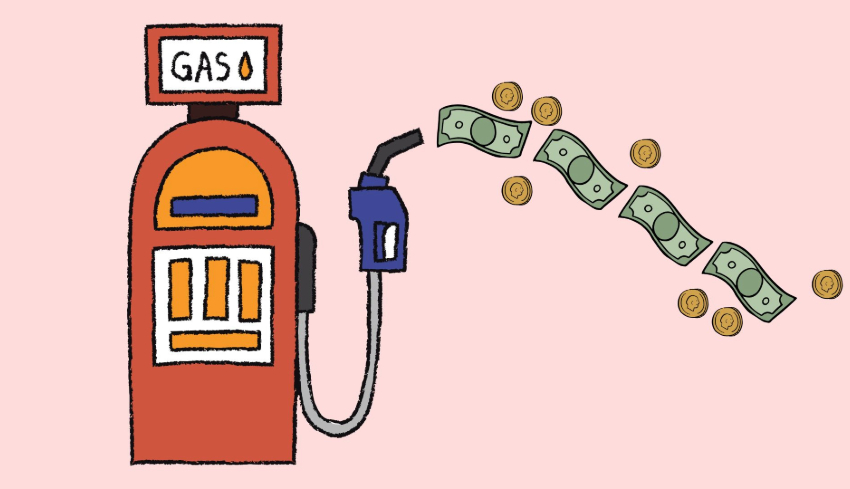
For those who drive, it has likely been difficult to not notice the recent spike in gas prices. For most, this change has been alarming, impacting their transportation and sparking other concerns.
The national average gas price for regular gasoline was $4.118 as of April 14 — a 13.19% increase from the March average of $3.638.
This increase has been impacted by the war in Iran, as traffic in the Strait of Hormuz — an oil chokepoint — has been disrupted. This blockage leads to fuel shortages, impacting the global economy.
Economics professor William Rieber explained the ways in which the war has impacted the supply and demand for oil.
“Economically, oil is a world market,” Rieber said. “In terms of pricing, it is not local, it is [global], and so much oil is produced in the Middle East, and without that flowing, you get drops in supply, [which] affects the entire world economy, including the U.S., Indianapolis and Butler students.”
He also mentioned the many ways students could be impacted, as those with cars may have a difficult time financing trips outside of the “Butler Bubble.”
“There’s not much public transportation in Indianapolis,” Rieber said. “Students who have vehicles here feel the pinch, and you can’t easily reduce your driving … It means you cut back on other items, and oil prices not only affect gasoline, but energy costs generally. Energy affects the production of so many goods and services.”
Many students have become more conscientious about traveling home or other places, as they watch the impact of increasing gas prices hit.
Jake Ward, a sophomore accounting and finance double major, spoke about how his four-hour drive home to Michigan has become more tolling on him as a student who works and pays for college.
“Gas prices, especially lately, have [impacted] a lot of my driving,” Ward said. “I’ll [run] down my car till almost empty, because it’s been expensive. College is not cheap and prices are going [up]. When you work a nine an hour job, it’s rough out there … It’s definitely made me more conscious of how much I really need to drive to places. I’ve had to charge people when I drive [them], because I need the gas money.”
Recent global and statewide developments have the potential to impact current gas prices.
On April 8, the United States began a two-week ceasefire with Iran, putting a halt to any direct strikes. However, the United States is blockading the Strait of Hormuz, which continues to affect oil exports.
Later that day, Indiana Gov. Mike Braun signed an executive order that declared a 30-day temporary tax holiday, suspending state gas tax. Braun hoped that the action would relieve residents from some of the financial burdens they may be facing.
Ward mentioned that he does not anticipate prices to decrease anytime soon, despite recent state and government actions.
“I think we should really expect prices to go up,” Ward said. “Almost all of the states have burned through their reserves, other than [the] southern states that have deeper ones. There’s a lot of concern with that. Our prices are going to continue to rise [and] gas affects everything.
With high fluctuation within the economy, there are many ways students may be impacted. Rieber said that current gas prices should especially spark concern for graduating seniors, as there is always a risk of a recession.
Chloe Grubb, a junior psychology and political science combined major, spoke about how times like these should encourage students to keep up with current events and politics, paying attention to how individuals can influence government actions as well as how government actions impact individuals.
“I believe that students should kind of look out for what’s going on and how it actually affects [their] individual self, as well as [the] community around [them],” Grubb said. “This is a great time for students to get involved and figure out what’s going on around us and in surrounding countries. This is a great chance for us to get informed and help us in the future, coming to elections and actually making positive, informed decisions going into the future.”
There is no way to know whether gas prices will increase or decrease in the coming months, but it is important to stay aware of how individuals may be impacted. Many impacts appear negative, but there could be positive effects from an increase.
“I feel like we might see a trend of either students just not having cars [or] maybe biking more, [which] could be healthy,” Ward said.