
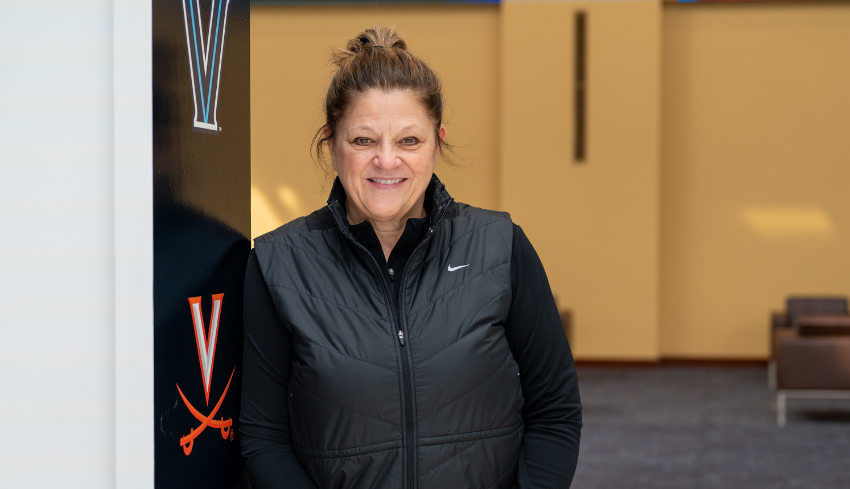
While March Madness fans held their breath and watched a 19-point comeback unfold between UConn and Duke, JoAn Scott, vice president of men’s basketball at the NCAA and Butler alumna, was not watching the ball in the air. She was thinking about everything that could have fallen apart behind the scenes.
Was there a timing issue?
Did something happen with the officials?
Was there a complaint she had not heard yet?
“I don’t watch it like you do,” Scott said. “I’m always thinking, ‘Did something go wrong?’”
That is the paradox of Scott’s career. She is the person behind some of the most high-stakes events in men’s collegiate basketball — the Division I, II and III Men’s Basketball Championships and the National Invitation Tournament (NIT) — but her job is to make sure no one notices her work at all.
“These tournaments bring the highest highs and the lowest lows,” Scott said. “But for me, it’s always about making sure everything runs the way it’s supposed to.”
However, long before she worked in packed arenas, Scott grew up in Ansley, Nebraska — a town with a population of 631 people. Her graduating class at Ansley High School was just over 30.
Scott stressed that in a high school that small, it was not about specializing in one extracurricular activity, but having a hand in almost everything. Especially when it came to joining sports, her mom emphasized that to be necessary.
“You work on our yearly yearbook, you’re on the cheer squad, you play in the band, you do it all,” Scott said. “But with Title IX passing in 1972, my mom never got to play sports, so she was like, ‘You girls are going to play sports and it’s going to teach you so many lessons.’”
Scott took her mom’s word and joined volleyball, basketball and track, leading her volleyball team to two state titles and her basketball team to a state championship appearance. For track, Scott was a disc thrower and shot putter, and every now and then, she would be put in for a relay.
In college, it was volleyball that stuck with Scott, as she walked on as an outside hitter for the University of Nebraska-Kearney team.
Scott emphasized that her time as an athlete was crucial to how she goes about her job today.
“I couldn’t do the job I have right now without playing sports,” Scott said. “I learned how to be able to motivate teammates, be coached and have honest conversations with people. I think as a high school athlete, you are constantly being told what you need to do better, and you have got to have thick skin. When things go wrong, you know how to pick yourself up and prepare for the next game.”
Despite playing in sports, she never planned to work in sports. She started in computer science until she realized she did not want to spend weekends alone in a lab coding.
“I was way too social,” Scott said.
So, she pivoted to business — almost accidentally — taking a work-study job in the Nebraska-Kearney athletic department for men’s basketball for one simple reason: it was closer to volleyball practice.
With the men’s basketball team, she typed up recruiting letters and practice plans, ran the shot clock and helped run camps — all things that got her prepared for her first job out of college with USA Basketball.
Scott spent nine years at USA Basketball, working her way up to director of basketball operations and serving as a staff administrator for the 1992 Dream Team and the 1996 Olympic team.
That experience set the standard for her.
“The bus can’t be late,” Scott said. “The food can’t be cold. Every team deserves that level.”
From there, she spent 17 years at Nike in several departments — Nike Sports Entertainment, Nike Basketball, College Sports Marketing and Olympic Sports Marketing — where she learned the business side of sports, traveled the world and worked with athletes, coaches and universities.
Through her job at Nike, Scott worked closely with the NCAA, passing through Indianapolis to meet at the NCAA headquarters. So, when it came to wanting to learn even more about the business side of sports, Scott found her way to Butler to earn her master’s in Business Administration and Management.
“I felt like Butler was special,” Scott said. “It also has smaller class sizes, like Nebraska-Kearney, and I am a better learner in a smaller classroom. But I loved it there, and I love to stay connected to it.”
After Scott graduated from Butler, she joined the NCAA in 2013 as managing director of the men’s basketball championship, where she was later promoted to vice president in 2024. In her role, she oversees collegiate men’s basketball events and all the little details, such as travel, hotels, venue space, scheduling and more.
Working closely with Scott and watching her lead meetings, Sarah Myer, Indiana Sports Corporation’s Chief of Staff and Strategy, finds Scott’s approach to everything she has done rooted in one main focus: the student-athlete experience.
“Her north star was a student athlete experience,” Myer said. “That spoke volumes to me. I was like, ‘Thank you for reminding us that.’ Sure, there can be millions of dollars at stake here for this event, but JoAn simply asked, ‘What’s the student-athlete experience?’ That’s her leadership, and I think that demonstrated a bigger mission than just a basketball game.”
Scott’s leadership was truly put to the test in 2021, when March Madness was held entirely in Indianapolis due to COVID.
Scott recalls the winter break before that year, drafting a plan and six PowerPoints that she later presented to her team on how 68 teams would be housed, transported and managed within strict health protocols.
“If she didn’t have the drive that she does to get things done and to get them done at a high level, we would have never been able to host in 2021,” Myer said. “We would have never brought the city back like we did through that sporting event. She probably doesn’t even give herself enough credit for it, but the impact that she’s had just because of how she’s worked with our city and what we’ve been able to do through these events is pretty incredible.”
Even through her busy schedule, Scott also makes it a point to stay involved with Butler as a member of the Lacy School of Business’ (LSB) Dean’s Advisory Council and with the new Final Four courses this semester that she helped develop the curriculum for.
LSB dean Craig Caldwell expressed his gratitude for the fact that she still shows up to council meetings despite her busy schedule.
“I appreciate the fact that she probably has one of the busiest schedules of anybody in the world, and yet she still manages to make it to a lot of council meetings,” Caldwell said. “That’s a serious sign of commitment for somebody like her. Her world could be blowing up, and she’s still helping us.”
Working alongside her in creating the Final Four classes, strategic communications lecturer Bob Schultz has found her guidance very valuable for the students.
“She is a walking master class of poise, professionalism and collaboration,” Schultz said. “She’s a commanding presence. She walks into a room, and you know things are going to be okay because she understands what we need to accomplish, and she’s going to hold people to task. She doesn’t throw softballs. She knows what people are capable of and holds people to that level.”
With all that she has done in the Indianapolis sports realm, Scott is now looking to conclude her final year with the NCAA after this summer. After overseeing something no city has ever done before — hosting the Division I, II and III men’s Final Fours along with the NIT championship — Scott will be ending her time with the NCAA with a historic year.
However, according to Myer, no one would be able to tell she is leaving.
“She’s operating at 200%,” Myer said. “You wouldn’t even know it’s her last year.”