
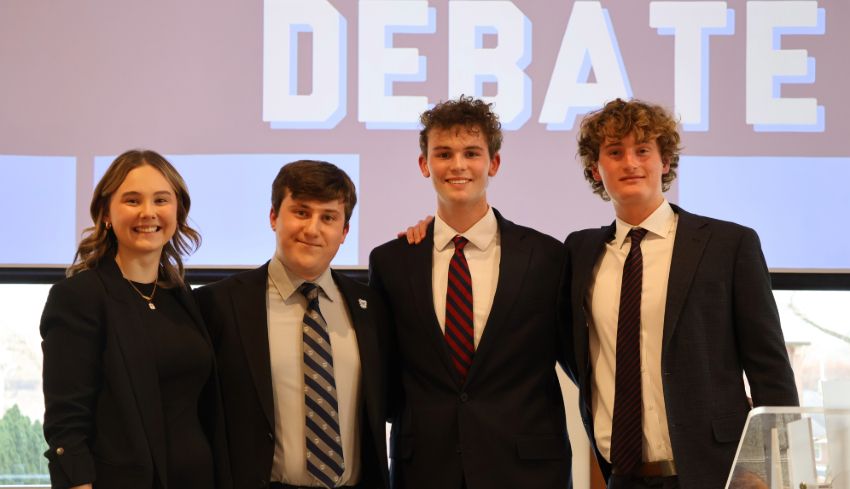
The SGA Election Oversight Commission (EOC) held the annual Student Government Association (SGA) presidential debate on March 25 in Atherton Union’s Reilly Room. Douglas Baldino and Abigail McKenzie are running against Alec Elrod and Kanoa Gahl for the president and vice president roles, respectively, for the 2026-27 school year.
The two presidential tickets gathered in front of Butler community members less than a week after the beginning of their campaigns on March 20. The election will take place on Monday, March 30, and students can vote online or in person from 8 a.m. to 8 p.m.
The debate started with opening statements from each ticket, the presidential candidate speaking first, and the vice presidential candidate second. The candidates were then asked three pre-released questions, two questions from the EOC and five anonymous student questions. Lastly, each ticket was given two minutes for a closing statement from either or both of the candidates.
Opening Statements:
Baldino and McKenzie
After random selection, presidential candidate Doug Baldino, a junior business technology analytics and risk management and insurance double major, began the debate outlining his concerns about the current state of SGA. He noted a lack of structure and introduced the three pillars of the Baldino-McKenzie campaign: effective governance, voice and action and purposeful progress. He emphasized how he and McKenzie are committed to their purpose: everything they do is for the students.
“We know that the most important part about [this] organization is representing you, the students,” Baldino said. “[SGA] shouldn’t be us just sitting around a table, making big decisions for you. [SGA] should be actively attempting to engage [students], getting them to come to us. [Also, our job as] student leaders is to come to you, [figuring] out how we can directly speak with you, and figuring out your wants, needs and desires to make this experience and this campus as best as it could possibly be.”
Abigail McKenzie, vice presidential candidate and sophomore English and strategic communications double major, explained the need for internal change. McKenzie talked about the resolutions she has written in her time in SGA, along with her role as vice president of recruitment programming for Butler Panhellenic, and how those experiences have prepared her for the role of SGA vice president. She reiterated her and Baldino’s focus on being student-centered, providing a welcoming environment for all students.
Elrod and Gahl
Presidential candidate Alec Elrod, a junior history and political science double major, opened with a testimony about his experience transferring to Butler. He reflected on the many people who made him feel welcome, and how he hopes to accurately represent all those voices. A top priority of the Elrod-Gahl campaign is transparent and strong communication between the SGA and the student body, hoping to give students a say in actions before they are taken. Another focus of their campaign is physical and mental health, intending to keep all students healthy and safe.
Elord’s running mate, Kanoa Gahl, a first-year marketing and strategic communication double major, spoke about how Butler has always been a part of his life, as both his parents attended the university. Gahl spoke about how quickly he has developed a sense of pride and love for Butler, and he is passionate about representing the university’s diverse student body.
“I feel that what makes Butler so great is its diversity, in both student background and student perspective,” Gahl said. “I also feel that when we have leaders set in place, we [learn] how to listen, lead and connect that same student body with [its] student government. That is where we can have the most impact, and that’s what me and my partner Alec Elrod, aim to do.”
Pre-released questions:
- What makes your platform unique from the other presidential tickets on the stage or previous student government presidencies?
- In your own words, what are the roles and responsibilities of the vice president? How would you make the role of vice president your own?
- What is an achievable goal that your ticket has that will benefit the student body? How will you work to achieve this goal and communicate your progress to the students?
Baldino and McKenzie
For the first question, Baldino explained that their platform was designed intricately, with months of development and years of experience going into their campaign. He said that metrics will be used to keep SGA accountable, and students will have a say in how their success is measured. Baldino also brought up legacy, stating that Butler has legacies for certain aspects, but not for its student government, something that he hopes to change.
“Butler has a legacy for basketball,” Baldino said. “We have a legacy of being inclusive throughout the years. But what we don’t have is a legacy building on the future of the student experience through student voice and through student government. We’re going to make sure that we build that legacy so it becomes something we are absolutely known for.”
McKenzie addressed the second question by first noting the SGA Constitution’s definition of the vice president’s role, and then elaborating on the internal functions of the vice president. She mentioned her past experiences voting on legislation regarding budgets, aiming to bring an understanding of financial processes into the role. She brought up how she hopes to bring all the branches of SGA together, while empowering student leaders and supporting Baldino.
“The role is a support system for the president and its support for the entire student organization,” McKenzie said. “As your VP, I want to be someone that student leaders can come to and confide in, [recognizing] that I’m here for them, because the only way this organization is going to get better and grow is by having people [who] are listening, hearing and empowering its members.”
For the third question, McKenzie highlighted a goal to build more relationships with outside organizations such as the Diversity Program Council (DPC) and the University Program Council (UPC), to hear their concerns. She also noted a need for strengthened communication between SGA and students, and to address that, she and Baldino hope to develop the public relations board and work with The Butler Collegian to keep students updated on SGA’s actions. Baldino also spoke about his work with SGA’s senate on promoting safety around campus.
Elrod and Gahl
For the first question, Elrod noted that neither he nor Gahl holds a position in SGA, but he sees that as a strength, connecting them to the mentality of the student body. He explained that through not being in SGA, he understands students’ lack of knowledge regarding SGA actions. Elrod stated that he is committed to keeping students involved by providing more resources to leave comments and complaints. He also brought up past involvement in high school student government and other leadership positions at Purdue University that have prepared him to represent a large group of students.
“A lot of people don’t know what’s going on with [the SGA] budget, so we strive to be different and to communicate with [students],” Elrod said. “That will make our approach different … Because we want [students] to be at the core of the decisions that we make.”
In response to the second question, Gahl acknowledged the known financial responsibilities of the vice president, but explained how he and Elrod are campaigning on a goal to include all student organizations. Gahl spoke about planned efforts to reach out to organizations to understand their wants and needs in order to better achieve them. He also mentioned his experience co-owning a company in high school, where he worked with budgeting and community outreach.
For the third question, Elrod highlighted their aforementioned priority of safety. He brought up his and Gahl’s idea to partner with the Interfraternity Council and Butler Panhellenic to distribute safety items such as breathalyzers to promote safe actions on campus. He mentioned providing additional safety education, highlighting availability to students both in and out of Greek life. Elrod said that they also hope to maintain the bushes around I-lot and regularly check the blue light security systems to further ensure safety. Lastly, he complimented Baldino’s commitment to safety in the past, hoping to continue what Baldino started.
Election Oversight Commission questions:
- In situations when students’ voices need to be heard, how will you effectively communicate that information with administrators and follow through on outcomes?
- What are your thoughts and ideas for strengthening student bonds and ensuring a strong community at Butler?
Baldino and McKenzie
For the first question, Baldino referred back to the second pillar of their campaign: voice and action. He remarked that it begins with approaching students to hear their concerns. He mentioned how SGA office hours can be difficult for students to attend, so they hope to implement traveling tables, where members hold office hours in a variety of locations around campus, to better see where issues may exist. McKenzie brought up how she has written resolutions as a senator and established herself as a strong communicator among faculty through her academic affairs role.
To answer the second question, Baldino returned to the idea of an event coordinator position that would have a focus on building relationships with campus organizations, hoping to develop community on campus. McKenzie emphasized how she and Baldino value different perspectives and want to ensure that students’ voices are heard.
“We [can only] make a difference when we’re listening and hearing out everyone,” McKenzie said. “That comes from surrounding yourself with people [who] have different perspectives from you, and that is what our partnership stands for.”
Elrod and Gahl
For the first question, Gahl brought up their campaign’s goal to listen, lead and connect. They hope to do this by putting out QR codes for students to scan to leave requests or concerns. He promised to be a personable and accessible leader whom any student can reach out to to have their voice be heard. Elrod brought up how he and Gahl have already reached out to President Danko and other faculty to establish personal relationships in all areas of campus.
“I feel the best way to form connections is through communication,” Gahl said. “Communication is so vital on a campus like Butler. Our whole goal here is to act as a bridge between the student body and the administration. We feel that we can do that in a very great and productive way.”
To answer the second question, Elrod first acknowledged how people shape a university and one’s experience in college. He said that they want to strengthen the campus community by collaborating with UPC and DPC on events that will allow a larger number of students to gather together, while ensuring constitutionality. Gahl brought up a goal to host dinners with SGA, where SGA members could eat with students on a non-professional basis, to get to know people of all backgrounds.
Student questions:
- How do you plan on increasing accountability within SGA itself? What specific initiatives and/or plans are you planning on enacting in this regard?
- SGA can seem confusing and very ambiguous to students who are not involved with other leadership positions on campus. While SGA has made attempts to address this issue in the past, progress has been slow. How do you plan to make SGA more accessible for the general student population, and what is a realistic timeline for these changes?
- You touched on the importance of unity within the branches of government. Do you have a plan to maintain or increase unity between the branches of government?
- The nature of a presidential race is inherently about what you would do better than the other candidates. To contrast that, what do you admire about the presidential ticket running against you?
- What will you do to incorporate commuter student and international student populations into Butler events and activities?
Baldino and McKenzie
For the first question, Baldino brought up their campaign pillar of effective governance, admiring the current action of reporting to the chief of staff. He said that they hope to expand the reports to all of SGA, not only executive members and to hold all members accountable.
“Accountability is not just telling us what to do or us telling you what to do,” Baldino said. “It’s ensuring that the people within the student government empower each other to get that done.”
For the second question, McKenzie emphasized how an understanding of the SGA Constitution allows members to paraphrase it in a way any student can understand. She said that she and Baldino want to begin holding monthly town hall meetings where students can meet them and receive updates regarding SGA actions.
“It’s an absolute disservice that the student body doesn’t know what we’re doing because we’re doing amazing things all the time,” McKenzie said. “I can name multiple things by being a member of SGA that we’ve done this year that haven’t been heard publicly by the student body because there’s been a lapse of communication. As your student leaders, we want to make sure that communication is fixed, and that starts by reaching out and making those bridges where they’re needed.”
For the third question, Baldino mentioned a plan to build a retreat for all branch leaders in SGA, to ensure that all branches can collaborate and share ideas. He also recognized the Indiana Student Government Coalition and the success they were able to achieve in updating the Indiana Lifeline Law.
“[The lifeline law] was something that Butler had a part of … All of us have been able to build and create [together],” Baldino said. “If we have a greater connection with the rest of them, there is no limit to what we can accomplish as an organization and as a campus.”
For the fourth question, Baldino acknowledged Elrod and Gahl’s passion and confidence, citing their unique lack of SGA experience. He also noted their emphasis on safety as an integral part of making the campus the best it can be.
For the final student question, McKenzie said that the first step is meeting people face to face. Both McKenzie and Baldino emphasized a desire to enter their spaces, meeting students where they are at, hoping to make communication more accessible. With that, they acknowledged the Founder’s College and commuter students as students with isolated spaces that may make it hard to feel connected to campus, and they want to explore more transportation partnerships to accommodate them.
“Sometimes it’s important just to hear about what they need from us as their leaders, and that just means going to spaces that they’re at and being there,” McKenzie said. “Sometimes people just need you to be there for them.”
Elrod and Gahl
For the first question, Elrod said that he hopes to create a system where he and Gahl will sit down with SGA members to hear about all of their current actions. He said that they would have an advisor sit in as an unbiased party to guarantee that rules are being followed.
For the second question, Elrod explained that by not being a member of SGA, he understands the confusion many students face. He hopes to provide monthly updates on social media, breaking down actions SGA takes and outlining who it may affect. Gahl then emphasized the importance of accessibility and how many students are unable to be involved in SGA. In response, he wants to provide online options for those who cannot attend Senate meetings.
“[There are] commuters who may not be on campus and people who may not feel comfortable coming in [or] may not have time to do so,” Gahl said. “If [meetings are] digital, I think [they are] easier. While I do think meeting in person is essential for effective communication, I think it’s also important to have accessible communication.”
For the third question, Elrod mentioned the importance of the separation of powers, acknowledging how each branch functions separately. Noting that, he wants to keep all of the branches involved, through attending Congress sessions or private meetings with the judicial branch, to remain involved in order to work off of each other.
“We’re able to use their ideas, which are often brilliant ideas, to work with them and make [SGA] the best we can for everyone,” Elrod said.
For the fourth question, Gahl expressed admiration for Baldino and McKenzie’s three pillars, along with their personal drive and involvement in SGA.
For the fifth and final question, Elrod praised the question as one close to international and commuter students. He first suggested a scholarship for commuter students, where they would have a chance to share what the Butler community has given them, to highlight perspectives that are not shared often. He also mentioned a hope to further include international students and expand Butler’s global recognition.
“It’s incredible that Butler already has such a great reputation within the state of Indiana, within the Midwest region and throughout the country, but we love to see that it extends beyond national borders,” Elrod said. “We want to hear their points of view, and we want to incorporate [international students] just as much as we incorporate every other student when we’re creating legislation and working along the other branches.”
Closing statements:
Baldino and McKenzie
Baldino gave the Baldino-McKenzie closing statement, first thanking everyone who attended the debate. He then recognized the three pillars of their campaign, emphasizing their goal to expand on past governance while increasing efficiency and communication to ensure that more is accomplished. He stressed how he and McKenzie are passionate about the students and will work to get involved most effectively.
“We are committed to the progress of this campus, but we are far more committed to the purpose, which is you,” Baldino said. “The purpose of all of this is not for me [to have] the title of president or [for] Abby and I being the student government executive leaders. It is about us being able to speak for you, with you and get done the things that we all want out of this Butler experience, so that we can truly transform our college experience for the rest of our lives.”
Elrod and Gahl
Both Elrod and Gahl gave a closing statement for the Elrod-Gahl campaign. Elrod began by reminding attendees that they represent the student body and that every action they take will be with the students in mind.
“The last sentence I want to leave you guys with today is to see me and Kanoa as a direct reflection of you, working for your interests in government,” Elrod said.
Gahl emphasized their slogan to listen, lead and connect, stating that it comes from the heart. He said that they hope to advance past initiatives while focusing on showing every student that they are heard.
“We want everyone, regardless of race, gender identity [or] background perspective, to truly feel like they have a spot in our student government and to truly feel like they have a part in the Butler community,” Gahl said.
SGA will hold election day tabling at the gazebo outside of Starbucks on Monday, March 30 to instruct students on how to submit their votes. Students can vote in person at the gazebo or online through a link that all undergraduate students will receive. Voting will close at 8 p.m.