
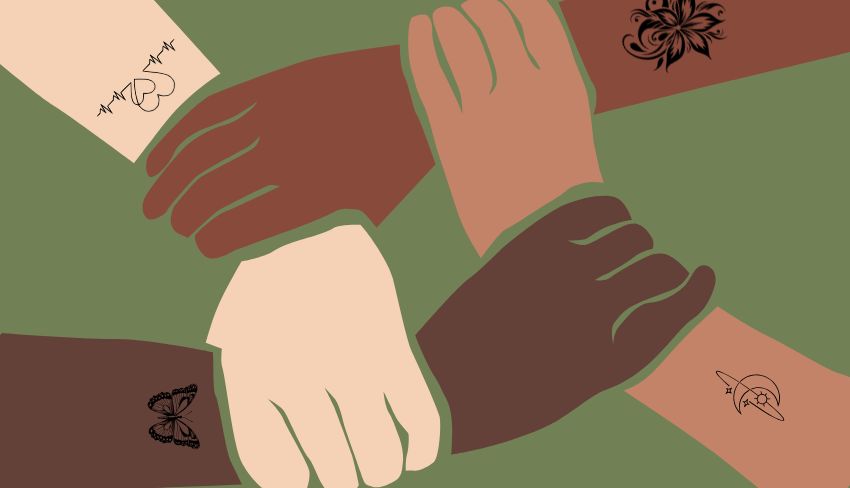
For spring break, my sister gave me my second tattoo: an arrow surrounded by wood rings and a sundial on the outward-facing side of my left arm — a location much more visible than my first. Although I went through a period of trepidation about the placement, I have since settled into a sense of comfort. Now I understand that having a visible tattoo means being connected not only to human history, but also to my lived experience.
The oldest recorded instance of the practice dates back nearly five-and-a-half millennia, discovered on a body frozen in glacial ice. The tattoos of this man are far removed from the practice as we know it today and are believed by scientists to have been performed as a form of joint therapy. Thousands of years later we’ve reached modern day, where tattoos have become a generally accepted and integrated part of Western society.
But this acceptance was not immediate. The cultural attitude towards individuals with tattoos remained stigmatized — reflecting the artform’s more contemporary-historical association with society’s ‘outcasts’ — until the socio-cultural movements of the 1960s, when this began to change. Although diversity was still less valued in society than it is today, diversity made itself known.
From the 1960s to present day, the popularity of tattoos has been ever-increasing. As of 2023, 32% of Americans have a tattoo. As this artistic diversity has gone up, so has cultural diversity. Diversity, Equity and Inclusion initiatives — although under scrutiny from the same government that partners with corporations that suppress individuality — are still popular.
Conformity in the corporate workspace is highly valued, whereas individuality is seen as inefficient. Think of a stereotypical office building interior. Cubicles are neat and orderly, and work is done cleanly and efficiently. Deadlines are assigned and met. Monotony is the killer of the human spirit, and I argue that art — which disrupts monotony — enlivens the soul.
Logan Goettemoeller, a senior creative writing, music industry studies and German triple major, noted the prevalence of artistic expression in employment and the prospect of individuality.
“It’s a lot more common for people [today] to express themselves through fashion, hair, tattoos or more [aspects of] physical appearance,” Goettemoeller said.
The individuality and creativity of humankind are older than the members of our species frozen in time, as artistic expression dates back over 67,000 years. What could be more unquestionably human than unifying yourself with one of our oldest identifiers, and moreover, one that predates culture itself?
While this important historical connection is unlikely to be at the forefront of most people’s decision-making, what is essential is personal justification. That which holds significance to each human being is inherently unique and personalized. Even tattoos with a broad scope, such as those referencing specific works of fiction, are individualized in relation to the concept of sonder. Even a life lesson everyone eventually learns can be especially meaningful to an individual, depending on their lived experiences.
If we wear our individuality on our skin, it is an ever-present reminder that our lives are intricately complex. Whenever I see people with tattoos, I am driven to compliment them, almost regardless of what they depict. By complimenting tattoos, I am not just complimenting something like an outfit that can be changed day to day, but an integral part of someone’s life that marks them as a unique individual with their own story.
Sophomore vocal performance major, Kelsey Thomas, noted the importance of tattoos in humanizing people.
“[A tattoo] tells a story about that person … it shows who they are,” Thomas said. “I like the people I interact with professionally to be people and not just a service to me.”
Corporate America’s focus on employee conformity is a strong motivator for a monotonous, dull life. Artistic expression, that ancient human element, is perhaps the most compelling means of resistance available to us for promoting diversity and self-representation.