
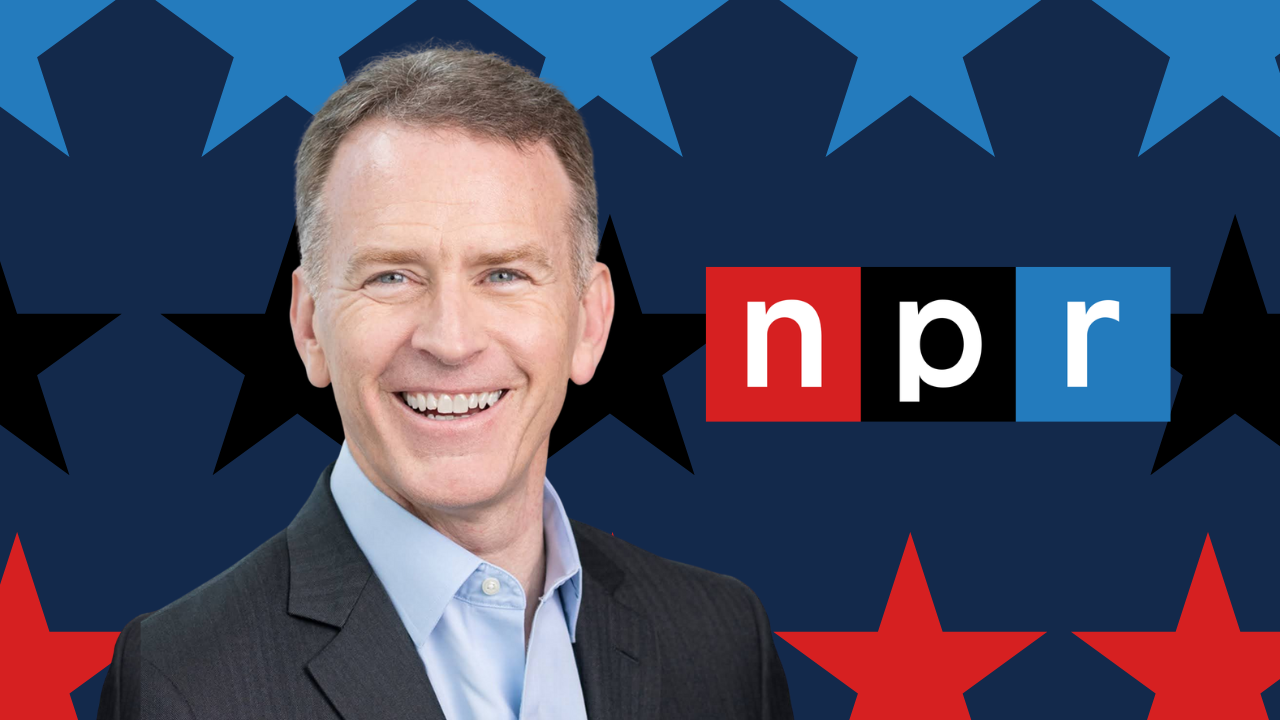
Steve Inskeep returned to his hometown of Indianapolis to speak at an Indiana Economic Club luncheon. Photo courtesy of Indiana Journalism Hall of Fame. Graphic by Ollie Fitzgerald.
ELLA HALL | STAFF REPORTER | erhall@butler.edu
ELLIOT MUEHLHAUSEN | STAFF REPORTER | emuehlhausen@butler.edu
NPR host Steve Inskeep emphasized the importance of community-based journalism and civic dialogue as this month’s speaker for the Economic Club of Indiana’s luncheon on Oct. 8 at the Indiana Roof Ballroom.
Inskeep reflected on challenges that modern journalism faces — in a time where the future of public media is uncertain — amidst deepening political divisions. He encouraged the business leaders attending the event to continue engaging with information, even when they disagree with what is being said.
One thing Inskeep emphasized was the importance of locally-sourced media and a dedication to centering the facts. With social media fueling constant commentary, he reminded listeners that “finding credible information amid such a mass of it” has become more of a challenge.
WFYI was one organization Inskeep highlighted as an example of how local journalism should be sustained.
“They’re in the community, and they are accountable to the community,” Inskeep said. “That is really valuable. I think that public media can be especially valuable in rural areas… Rural public radio and TV stations have been hit really hard because they depended more on the subsidies, but if we can sustain them — if they can stay — they will be part of strengthening or reviving a lot of rural communities and fostering a greater sense of community.”
On July 25, 2025, President Donald Trump signed a bill cutting more than $1 billion of government spending for public broadcasting. Stations like NPR and PBS are now trying to find ways to continue to serve their audiences.
“My attitude toward this moment of change and turmoil really is to embrace it and to do my job as a citizen,” Inskeep said. “We were very fortunate to have federal support for many, many years, and that’s great, but it’s not required to have a subsidy to do your job as an American, and I’m going to do the best that I can.”
The media groups that will feel these cuts most are local, rural broadcast stations. As Inskeep explained, NPR and larger broadcasts have lots of donor support, but rural areas do not receive the same assistance. Local broadcasts are extremely important for rural communities, sometimes being the only form of reliable media available.
Senior sports media major Gaby Whisler was disappointed to hear about these cuts, saying that she thinks they will “hurt journalism overall.”
“For me, as a student, I think the biggest thing [to combat this issue] is talking about [how] this is happening in our country, [and why] it is a problem,” Whisler said. “I think the more that we speak up about it, [the more we] can make an impact.”
In his speech, Inskeep also highlighted relevant elements in his book, “Differ We Must”, detailing Abraham Lincoln’s debates with those who opposed him.
“There is value in engaging with people who are different from yourself,” Inskeep said. “We live in this really big, really complicated world where social media and other kinds of media bring us in contact with all kinds of people who seem incomprehensible to us and prior generations just never met those people.”
Inskeep framed listening as an integral component of reporting, and not necessarily as something that requires agreement, but involves an ability to understand.
“Talking to people a little more [and] listening a little better, is really valuable,” Inskeep said. “They may change your mind. Even if they don’t change your mind, you may learn something that helps you figure out how to deal with them, or if they’re on the other side of you politically, how to beat them. It’s valuable to learn about the other side.”
Bob Schultz, the faculty director for Butler Institute of Sports and Entertainment, agreed with Inskeep’s ideas on nonpartisan journalism.
“I loved [Inskeep’s] philosophy that everyone has a story, everyone has an opinion [and] everyone has a right to an opinion,” Schultz said.
He added that public broadcasting serves an important role in civic education, referring to it as “an open classroom for the nation.”
Reflecting on Inskeep’s message, Schultz was reminded of one of his favorite quotes, from Philip Graham of The Washington Post, that captures the essence of why conversations like this matter: “journalism is the first rough draft of history.”
Inskeep emphasized journalism’s role in the public sector.
“We are members of the public acting in the public interest for our fellow members of the public, and we’ll continue doing it, as long as the public supports us,” Inskeep said.
Individuals can continue supporting public media by reading, listening or donating to local news organizations.