
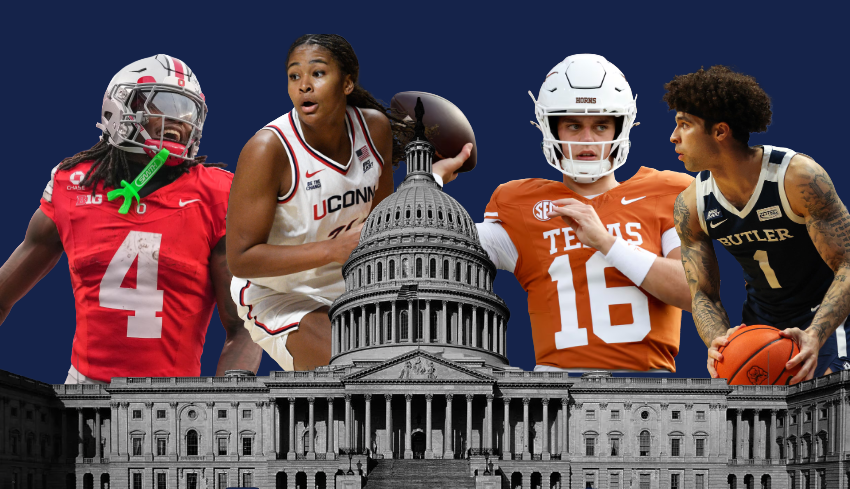
Three weeks ago, the federal government was turned on its head as the Democratic Party swept midterm elections, taking control from Republicans in both chambers of Congress.
With this newfound power, Democrats also find themselves now in control of one of the most pivotal sport-related bills to date — the Protect College Sports Act (PCSA) — a bill aimed to curtail the current “Wild Wild West” that is college sports.
Backed by the NCAA and numerous colleges around the country, this bipartisan legislation holds the potential to significantly change college athletics for the long haul. Having already passed through the Senate back in September with a final vote of 77-22, all the bill has left to do is survive the House and then travel to President Donald Trump’s desk for his signature.
If passed, this bill would give the NCAA a limited antitrust exemption, which would allow them to uniformly create and enforce rules in conjunction with its member institutions. In other words, the NCAA would be made akin to other major sports leagues, acting as an independent body that can make and carry out its own rules without having them be undermined through the interference of a third party — something the NCAA has struggled with in the post-NIL era.
Grant Leiendecker, Butler’s vice president and director of athletics, explained that the university — along with the rest of the Big East conference — backs the legislation.
“We fully support it at Butler,” Leiendecker said. “The Big East is aligned on fully supporting it. Generally, there’s so many things [about the bill] that help put some protections and federal standards around some of the challenges that we’re facing in college athletics right now.”
The legislation would also introduce — or in certain cases, reintroduce — several significant rule changes that hold the potential to shake up the collegiate landscape.
Although the PCSA will not drastically change Butler’s athletic department and its teams, the act will still impact them in more ways than one. Here are two major components of the PCSA that could shape the future of Bulldog athletics.
Transfers, transfers, transfers
The transfer portal has been many student-athletes’ best friend in the post-NIL era, but if the PCSA is passed, that bond may be strained to the breaking point.
A rule alteration proposed in the legislation would have the transfer rule in college athletics reverted to its yesterdecade form, allowing athletes only one free transfer barring an exception — a head coach leaving, an athletic program being discontinued, misconduct-related circumstances or transferring to be a graduate student — before having to sit out a year if they decide to transfer more than the allowed freebie.
Leiendecker, like many athletic departments around the nation, sees this change as one of the main reasons why the bill should pass.
“[It would be] a huge benefit to [Butler] because our programs have always been built around continuity,” Leiendecker said. “In order to build a program, you need to have players in your program for multiple years to build relationships and develop players … Our coaches [place] a great emphasis on the type of players they’re bringing in in their first year, making sure we’re on the same page with what [the student-athletes] want out of [their college and athletic experiences].”
Along with that, reducing the amount of transfers allowed could help with recruiting troubles sparked by student-athletes wanting to capitalize on their likeness.
“The financial component is real, and that’s what’s driving [a lot of the transfer portal],” Leiendecker said. “A lot of [these transfer] cases [are] student-athletes looking to maximize what they’re able to earn through NIL.”
Revenue and NIL spending caps
Last year, the NCAA and its power conferences — the Big Ten, Big 12, SEC and ACC — tried to establish a $21.5 million spending cap for the football teams in all four conferences. The cap was meant to limit the amount of direct spending by schools to its student-athletes, in this case particularly to football.
Out of 68 power conference teams, it was found that 30 of them had gone $8.5 million over the cap, with 15 of them going as far as $18.5 million over.
So, to combat this, another rule change is being proposed in the PCSA that would create a hard spending cap of $50 million — comprising $22.5 million in revenue-sharing funds and $27.5 million in external NIL funding.
When talking about the possible effects of this new rule, Leiendecker believes that it will increase competition and parity between schools with different means of funding.
“[It] won’t affect our budget,” Leiendecker said. “We are striving to grow our resources every single year, and we’ve made great progress with that. What [this rule] does is level the playing field and puts a limit on this runaway spending that’s happening across college athletics. For Butler and the Big East in general, it’s beneficial to us because we don’t have football revenues and we’re competing with programs [who do] in all of our other sports, and if the spending continues to escalate at an unsustainable rate for all of college athletics, that makes it really difficult for us to keep up with.”
Concerns and current state of the PCSA
While seemingly all college athletic departments and their respective conferences are aligned on getting this legislation passed into law, they do so fending off the many concerns brought with it.
Critics of the PCSA say that it is too vague in areas concerning the rights, freedoms and protections of student-athletes, does not address the role colleges and universities play in the destabilization of college athletics and believe it is risky to give an antitrust exemption to the NCAA.
With language that can be interpreted in multiple ways, many against the PCSA are worried that this bill will send the pendulum too far in the other direction and lead to the exploitation of student-athletes for profit, like what was seen before 2021’s landmark NCAA v. Alston decision.
Regarding the PCSA and the concerns around it, Lee Farquhar, a journalism and creative media professor, holding a middle-ground position between both worlds, can see the validity of arguments for either side.
“From a fan side, I would want my players that I cheer for on my team to stay on my team and continue to build loyalty,” Farquhar said. “But from the personal individual rights side, to be honest, I’m conflicted on it because it feels like [the PCSA is] protecting larger institutions and not doing as much protection for the individual.”
Fortunately for opponents of the PCSA, because of the aforementioned midterm elections, it seems increasingly unlikely that this bill will pass through the House. Even though it has bipartisan support, the PCSA was largely given life by Republicans, who have now been pushed out of power.
With that in mind, many say that the only chance for the PCSA to survive is for it to come to a vote now before the new members of Congress can be sworn in come January. But that will be hard to come by during Congress’ current “lame-duck session” — the session that takes place after November general elections but before new congresspeople are sworn into office. This period of time is notorious for how little is accomplished within it, vote-wise.
Benton Ives-Halperin, a former adjunct professor at Butler and the national security editor at Politico, has spent over 20 years covering matters on Capitol Hill. He believes that Democrats will use their control over Congress to bend the PCSA to their liking.
“[Democrats] went from being out of power to sweeping Republicans out of congressional power wholesale,” Ives-Halperin said. “They have a lot of margin of error to play with next year. If I’m Hakeem Jeffries or Chuck Schumer or maybe Chris Van Hollen, depending on how Senate leadership shakes out, I have a lot more power next year. Looking at the lame-duck [session], if I’m a Democratic leader, I think I’m not going to agree to anything with the Republicans because I can really put the screws to them next year.”
The PCSA holds the potential to be the most decisive sport-related bills of all time, with an impact that affects hundreds of thousands of student-athletes around the country. If it makes its way to the Oval Office’s desk soon, only time will tell if its passing was the right move.