
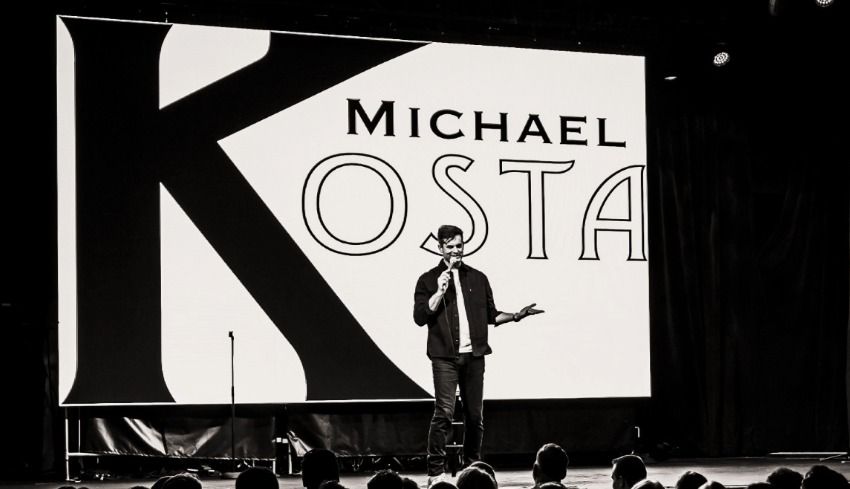
When Michael Kosta’s professional tennis career ended, he started volleying on a different court: the stage. His comedy career has been defined by stand-up sets, appearances on popular late-night shows, specials and a nine-year stint on “The Daily Show“. Kosta is set to visit the Schrott Center for the Arts on Dec. 12 at 8 p.m. Tickets are available for purchase online.
The Butler Collegian chatted with Kosta to discuss life, tennis, politics and his upcoming tour.
THE BUTLER COLLEGIAN: I hear you have a show in Indy on Dec. 12. Can you tell me a little bit about what to expect from the ‘Big Dad Energy’ show?
MICHAEL KOSTA: Well, I’m excited about this show. I’ve never performed on Butler’s campus, but Indianapolis is a great comedy town. I’ve done comedy there many times, and my comedy is my point of view … It is going to be some politics, a lot of my family, a lot of the way I see the world and, most of all, funny.
TBC: You’ve talked about how with tennis you’re all alone out there, and comedy is sort of in a similar vein — you’re by yourself, and you’re batting a ‘ball’ between you and the audience. How do you think tennis has prepared you for being on a stage by yourself?
MK: Yeah, I think it has a lot. You know, it’s immediate, there’s pressure. If you do well, it feels great. If you do poorly, it feels awful. I feel comfortable being alone [in] a space. I feel comfortable [with] people watching me. But I think most of all, probably the biggest thing that’s helped me is [with] tennis, any endeavor, you need to go to work every day. If things go well, you go to work the next day. If things go poorly, you go to work the next day, and you just stay the course. And comedy is very similar. So, so many lessons I learned in tennis paid off in comedy because I just approached it the same way I approach tennis, which was [that] I’m going to try to get better every single day, no matter what.
You blink, and you’re 46 years old, and you’re pretty good at something, and that’s something I hope all your readers realize. Keep going every day, whatever your passion is, and you get pretty good at it.
TBC: If your comedy style was a famous tennis match, what tennis match would it be?
MK: Great question. There’s an epic Roger Federer versus Rafael Nadal Wimbledon final that was played over five sets, many hours, and I would say I’m like that match because you can’t take your eyes off it.
TBC: There’s sometimes a narrative with artists or comedians where you have to come from a painful past that you make into comedy. Do you feel like that’s actually not something we should promote?
MK: That certainly troubled me at the beginning. It’s like, ‘Do I have to be a drug addict? An orphan?’ I think there’s been great strides in that as comics have been going to therapy, and you know, Bill Burr recently spoke about that publicly, that he can actually go deeper and funnier with his comedy now because he’s not filled with anger and pain.
I think any good artist mines their personal life for comedy, and that doesn’t need to be pain. Sometimes it will be pain because we all have that. But there is great humor in the mundane in our day to day, and you don’t need to be broken up with to have a great song — or to write comedy about it. I think it’s good that we’re starting to not promote that. To be an artist, you need to be creative and work hard at it, and have a point of view, and that can happen no matter what your childhood was like.
TBC: You’re very successful. You’ve succeeded twice in two very different industries. Do you ever take the time to process all of that?
MK: You sound like my sister. She’s like, ‘I’m so proud of you. Do you ever just think about what you’ve done?’ Absolutely not! I’ve got a busy day tomorrow.
I remember when ‘The Daily Show’ hired me, I thought, ‘Hey, at least there’ll be something in my obituary.’ I’m not saying that’s healthy thoughts. Now, when I have a family, I can tell you I’m way more focused on that than external accomplishments. I think that gives you a lot of perspective, being a dad and seeing that there’s people that are really young that rely on me for basic human needs. I’m really proud. I really am. I’m proud of where I’ve gotten to in the industry. It’s been really hard … I [didn’t] when I was 25, but I am at an age now where I do appreciate it … Your question helps me appreciate it, but also as you get older, you just start to go, ‘Oh, this is cool. This is cool that I’m doing this.’ So, I am very grateful for where I’m at.
TBC: Was processing that something that maybe just took a little while?
MK: Definitely. Yeah, your 20s and 30s, you’re just trying so hard to make something happen, and thankfully, a few things have happened. And 40s are me trying to enjoy them a little bit.
TBC: You’ve been on ‘The Daily Show’ for about the past nine years. What do you think you’ve taken away from that time?
MK: ‘The Daily Show’ is like going to [a] comedy PhD school. You really learn a lot, and you’re surrounded by award-winning everything: editors, writers, producers. Because I came from stand-up, which was so individual, one of the things I really had to learn was to trust other people. At first, it was hard for me to take a note, to adjust something, to listen to someone else because I thought, ‘Hey, I know how to be funny. I’ve been being funny.’ But, when you lower your guard, you realize those people are really excellent at their job, and they’re only trying to make you look better and make the show funnier. So for me, I’ve really had to learn to trust other people.
I’ve also learned, and I think this is the great secret of ‘The Daily Show’ — which we’re going to publish in a newspaper — when we try to be funny, that is the best way to inform our audience.
If we go out to inform our audience, it feels heavy-handed. It feels like we’re preaching. But if we try to go be funny about that subject, people will walk away laughing, and also they will have learned something, which is kind of the best.
TBC: You’re from Michigan. How do you feel about the blue wave that just happened?
MK: You know, as an American, I’m thankful that it feels like many Americans are paying attention and are frustrated with the current situation. I would advise everybody, though, that democracy is an ongoing form of government where you need to stay engaged, stay paying attention. Just voting once every two or four years isn’t enough. So I’m very thankful and I’m proud that many Americans have done this blue wave. But now, the real work starts.
TBC: A lot of college students are probably going to read this. Do you have any messages to them about politics — or just to young people?
MK: It is not as hard and overwhelming as you think to pay attention to national and global politics. You can listen to a three-minute-a-day podcast. You can watch national news. It’s really important to pay attention and don’t be afraid to read about World War I, World War II [and the] Vietnam War. You’ll see so much of history repeating itself and then you’ll be well armed for the current moment.