
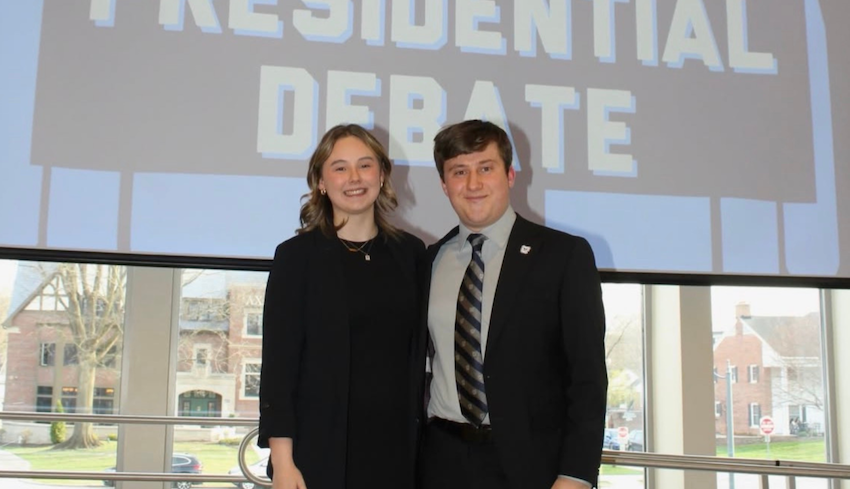
Douglas Baldino, a senior business technology and analytics and risk management and insurance double major, and Abigail McKenzie, a junior English and strategic communications double major, were elected Student Government Association (SGA) president and vice president, respectively, on March 30, 2026. The Butler Collegian sat down with them to discuss goals for the upcoming year.
THE BUTLER COLLEGIAN: How did you both initially get involved in SGA?
DOUGLAS BALDINO: I initially got involved [when] I was sitting with a bunch of friends of mine, and we all got that big blast email [that asked] everybody to apply. I [thought], ‘I’m really interested in this. I really think I should do it [even if it is] kind of out of nowhere.’ I applied, and the vice president-elect at the time, Elena Clark, actually came to me and said, ‘I think you will do better in this other role. You should apply to this one.’ I did, and I ended up getting a job in the executive cabinet under Eloise and Elena last year.
ABIGAIL MCKENZIE: During my freshman year, I was interested in student government — and I was involved in high school, so it felt like a natural progression when I came to college. I remember going to the call-out meeting, asking different questions and just learning more. I was really nervous to run — I ran as a class senator, and I think that was the most contested race that year, [around] eight or nine of us [running] — and I remember thinking, ‘I don’t know if I actually am going to win.’ On the committee of academic affairs, I really saw the potential in SGA — the work that you can do and the connections you can make, from the deans to the professors that you might not have in class to different students — and I was really excited. I got to do so much freshman year since I was on a smaller committee. SGA [became] a passion of mine.
TBC: What made you decide to run for president and vice president, respectively, as well as together?
DB: Both individually and together, I think that has the exact same answer. We had met in our separate roles, but had an overlap over a resolution that Abby was writing, and I remember after collaborating a little bit and just bumping into one another in the office, we realized that we had a lot of similar goals for both the organization and for ourselves. We both really wanted to take things by the reins and make sure that full potential would be realized.
Over the next three months, we would [go back and forth on running or not]. Right before Christmas break, we were like, ‘Over Christmas break, we’re not going to talk to each other, not talk about SGA at all, and we are going to decide on the first day we come back whether or not we’re going to [run].’ We got back, and we still didn’t decide, so then, two weeks later and continuing the same conversations, we finally realized the potential that we both want out of our jobs in SGA, but also out of the organization as a whole, and leaving that lasting impact on Butler means a lot to us. So that’s when we both just had the realization that we want the same thing, and here we are.
AM: This was something more than just titles for us. We really wanted to [run] if we were going to be all-in and if we felt like we were the right people for the job. We went back and forth with that, and we spent a lot of nights with pros and cons lists, especially once we came back from winter break. We have these ideas, we have these goals, we have what’s driving us to do this, and then we were finally like, ‘Let’s just do it.’ Working together on those resolutions, we realized how we think similarly, but also think very differently sometimes — so we wanted to bring those multiple perspectives together.
TBC: The three pillars of your campaign were effective governance, voice and action and purposeful progress. Can you explain more about what these three mean, and how you are working to put them into action?
DB: When we were first determining what our pillars were going to be when we were running, we realized that we didn’t just want it to be three separate things that people could look at and be like, ‘Oh, they want to do this, this, this,’ because we wanted to build a vision and a story with our campaign. I look at our three pillars as a progression from start to finish, starting with that first one of effective governance.
It is really just about utilizing the full potential of SGA, making sure that everybody on board is fully equipped and prepared for the job, but also that our brainstorming is as good as it could possibly be, and that all the inefficiencies that at some point in the past had previously existed could be at least mitigated to the best of our ability. Also ensuring that everybody was working really hard and collaborating [is] something that we’ve done a lot of this year already. A lot of internal teaching, especially for our executive cabinet members, is, ‘These are the people you should go and talk to when you’re thinking about stuff like this. These are the people you should go and talk to for this other thing,’ and I think working together inside of the executive cabinet — and then now that senate and judicial are coming into formation more — being able to work with them more to collaborate and really fine-tune that inside of the government. Making the government more effective was the first step in what we want to do.
AM: Our voice and action [pillar] was more about reaching out to students and having students feel more comfortable coming to us. We’re really interested in doing traveling tables, and as our exec cabinet starts to hire and they feel more comfortable in their roles, in the next few weeks we’re going to start looking at different locations to start doing that. We really enjoyed tabling for Grubhub [on the] first day [of] classes and having students come up to us and engaging with them on the sidewalk and talking to them. We’re looking for different ways to do that, and we have ideas for our directors on where they can start tabling very soon.
We also really wanted to work on our transparency, which I think blends and bleeds into our three overall pillars with our connection with the Collegian, sitting down for interviews and better connecting our staff and the rest of our organization. Then also the big one, ‘How can we poll students and how can we gather that feedback? How can we bring them into our space?’ We’re still working on that because that [will most likely] be an all-year kind of thing. A lot of people are still realizing where our office is, and our ultimate goal at the end of the year is [for] students to feel comfortable enough to just come in and talk about their day or talk about what class they’re having. It doesn’t always have to be SGA-related, but we want to be friends with the rest of the student body, so them feeling comfortable to come into the office can [lead to us] also asking for feedback.
DB: That leads perfectly into that last pillar of purposeful progress. The point of that pillar is looking at SGA’s legacy [and] looking at the reason why we’re doing things. Like Abby started out with, this isn’t for us. It wasn’t a matter of the title, and it shouldn’t be for anyone in the organization. I hate to be that cliche, but, ‘by the students for the students.’ It should be that moment where students can really come together and say, ‘We know what the struggles are. We reached out. We’ve talked to so many people.’ We ourselves are students living in a similar experience. We know what we can do in order to improve the day-to-day lives of students. We actually want to be able to do it, and we want to do it for the right reasons.
Also looking at those [who will be here] next year, those five years from now — building a legacy of what SGA is and what it’s capable of is really important, which ties purposeful progress as a pillar. Once SGA is working as effectively as possible, students have a greater interaction with us and we have a greater interaction with them, then we can lead into the overall organization working significantly harder and just [being]better for everybody involved. I think that’s going to be beneficial to the students, but even just admin and other groups of people around campus being greater and better informed on what it is we’re doing, how we can help and being able to have those collaborations that are going to allow so much change to be possible.
AM: We’ve started on that by trying to promote ourselves as a campus partner. Doug and I, and the other branch leaders, have started to set up meetings across campus with different administrators and faculty to establish those year-long connections, so we can start working towards those long-term goals alongside them. During our executive retreat, it brought all of our directors at the beginning of the year to start planning and actually talking about those summer goals that they started on, and how we can actually start implementing them. One big thing that I think was one of the coolest parts of our retreat was having the provost come, the dean of students come and other campus partners, like the dean of students’ office came. It was great to connect them with our executive cabinet as they’re starting to build initiatives. I think that goes to show what our ultimate goal is this year.
TBC: You previously mentioned some initiatives to strengthen SGA, such as establishing an event coordinator position, holding monthly town hall meetings, and strengthening relationships with the Indiana Student Government Coalition. Can you explain what progress has been made on this so far, and what you plan to do to further these goals?
DB: I’ll start with the Indiana Student Government Coalition (ISGC) is a phenomenal group of four executive members that have their own elections and the rest of it is actually made up of all the different presidents from all the different Indiana student governments. They are able to come together and make what we do here at Butler more of a state or potentially even regional or national impact. [Butler SGA’s] involvement with the Indiana Lifeline Law makes us question how much more we could do with the ISGC. Over the summer, I started establishing a relationship and started attending their regular meetings. It is definitely a slow-moving wheel, but I think at the end of the day, it’s one of those organizations that — when fully utilized — is going to be so beneficial for not just all the Butler students, but all the students here in Indiana. We are really excited to continue partnering with them.
Then obviously, again, just creating a role within our executive cabinet through our administrative specialist, where they’re going to actually be able to work directly with [The Butler Collegian] to connect the speaker of the senate, and the chief justice, but also [share if] there’s a new initiative. [We want to] make those connections so that the students are better informed, but also so that the actual student leaders and their projects are better known across campus.
AM: We are starting to work on town halls, but we are waiting for the senate to be fully sworn in.
DB: We are definitely going to establish [those] and even though Senate sessions are already available to anyone — any student can come in whenever, admin as well — I think creating a town hall where it’s all of the branches coming together and presenting the big things that they’ve been working on each and every quarter is something that we’re really excited to spearhead.
TBC: You also previously referenced building on transportation partnerships and becoming more involved with the Gateway Project. Can you further elaborate on the progress with these goals and what you intend to do to accomplish them?
AM: We are really excited for the Midtown Art Project and the Butler Gateway Project. As we’ve settled into our roles, we are starting to delegate some of these tasks to our cabinet directors, making those connections, and reaching out to those different people to start on how we can partner with them long-term.
DB: To specifically point out transportation, I know that’s definitely something that’s always been one of those hot topics around campus, and that is definitely something we’re focusing on. I am excited; as the year progresses, I know we’re going to continue the Pacers Bike Share program and the bird scooter partnership. There are also so many other routes we could take, and continue ideating on how we want to make certain decisions. There should be more news on that at some point soon.
AM: Right now, our directors are connecting about [new] bus stop possibilities and working on that. It’s a work in progress — so no promises — but there are always things going on, and a lot of the things that we are working on are long-term.
TBC: Doug, in the presidential debate, you said that SGA should actively be engaging students. What work have you both done, or are planning to do, to achieve this?
DB: Before joining SGA, I honestly didn’t even really know what it was about. I didn’t know what SGA was able to accomplish, what they had ever done in the past. After joining, I realized a lot of the things I do on a day-to-day basis exist because of student government. So when I talk about engaging students, it’s not just a matter of knowing what SGA did for you. What I am hopefully going to be able to do and accomplish this year is give students an opportunity to feel like they are the voice that steers our organization. We can come up with ideas all day and night to improve Butler, but at the end of the day, even with however many of us in student government as a whole, I think there are thousands of other students who can be that voice that leads to action. Making sure that is exactly how it works out is the dream. More tabling and better promoting our office hours is a lot of relying on students to come to us. We want to do a better job of going to the students. I know me personally, I’ve already started meeting more on the higher level at the young alumni boards — the recent graduates — and talking about what their biggest grievances have been after graduation — like what Butler did not prepare [people] for — so that I can work to hopefully help change that.
I know more on the senate side, constituencies are going to make more of an effort to host their own tabling and their own office hour-type events around campus. Promoting, in a sense, where students can come grab an Alani and come tell us something that they are worrying about, something they are struggling with or just something that they want to highlight. SGA will try to support it and mention it at senate, being able to speak directly with the students so that the student’s voice leads to our action. That is really what I think this organization has been missing, and what we’re going to hopefully do.
TBC: Abigail, you highlighted building stronger bonds with the Diversity Program Council (DPC) and University Program Council (UPC), as well as a focus on developing the public relations board. How are you working to achieve this goal?
AM: Last year, there was a resolution passed through the senate to add a required member of the diversity, equity and student belonging board that is a member of the DPC. So we will have someone specifically from the DPC working with our director to figure out how to better that relationship and how we can better support and develop programming with them. As well, our PR board — we’re changing the name — we want to be the director of communications and marketing or director of PR and marketing. We want it to encompass more of what the role is actually doing for our organization, and up our marketing techniques and strategies that we’re doing.
We’ve noticed in the past that sometimes we don’t always share all the events that we have going on. We don’t highlight everything that everyone in our organization is doing, and sometimes that internal communication has faltered in the past. We definitely want to work on building our internal communication so that external communication can be better done. We have been working with our [new PR director] to better strategize for what we’re looking for this year. It is really cool to see that board and how her vision is coming to life too. We sit down with her at the end of every cabinet meeting [to walk through] the things that [we are] doing. I think that there will be a lot more engagement, a lot more of us sharing who our senators are, where to find our senators, what initiatives and programs we’re doing and having more of that [available] to the students. Sharing more obviously what we are doing instead of feeling like [students] have to come to the office to do that. We are also working on updating our website so that it’s better for students and easier to access everything.
TBC: One of the things you discussed in regard to effective governance is accountability. What specific goals do you have and how do you plan to achieve them?
AM: We have our chief of staff, Adrienne Creech, and she has refreshed what the chief of staff reporting looks like for our directors. The directors are required to submit a form to her every week that has to do with what initiatives they’re working on, meetings that they’re holding every week, if they have missed a meeting or a requirement of their position for any reason and also just like health checks as well. Like, ‘How are you feeling? How can we support you?’ Also, [giving] the opportunity to highlight other members of our organization if they feel like someone’s not going to shout themselves out; they can do that for their peers. That was one big thing within the executive branch that we really wanted to do: more of a supportive, acknowledging environment so that people can feel comfortable going to Adrienne if anyone has anything going on.
DB: I think what we really wanted to focus on was finding a way to increase the accountability, not just within our branch, but also in all of SGA. Obviously, for us, the best move was to start in our branch, and then move outward. I think with Adrienne, kind of revamping the chief of staff reporting, and then working to make it not just about doing the things [staff are not] supposed to do, but having it based around what initiatives you are doing, are you enjoying them and then how are they going to benefit the student body — but then also things like ‘How are you doing?’
A good, healthy staff is a hardworking staff. Making sure that everybody’s able to be themselves, be happy, and feel supported is so important to making sure that they’re doing that work for others around campus. In terms of expanding it across the organization, I actually just had a meeting with the other branch leaders — speaker of the senate Lainey Elliott and chief justice Noelle Davis — about expanding that specific chief of staff reporting and tweaking it to fit the other branches so that those resources are there across the board to maintain accountability.
Being more transparent with the students is immediately going to have to hold us to a higher standard of accountability because we are going to say that we are doing things, and if nothing is happening, the students will notice that. So increasing that transparency outwardly, and also improving our internal systems, is going to create an overall greater sense of accountability.
AM: Our [campaign] platform was so that we can be held accountable if we were elected, and so it is [about] hearing questions that we have to respond to. It is holding us accountable, and then on top of that, we really want students to feel like we want them to be productive and efficient, but we also recognize that comes with feeling supported in their mental health as a person and as a student goes hand in hand with this responsibility. So making sure [students] get that full, well-rounded support. Additionally, for accountability, I am working with the other branch leaders on better expense tracking for our organization. So [we have] better transparency if students are interested in what we’re purchasing; we have explanations for them.
TBC: Outside of your campaign goals, what goals or initiatives are you hoping to achieve and work on?
DB: Without revealing too much — because we don’t want to make promises we can’t keep — I do want to highlight that we have already been made aware of, or have already started pushing for different initiatives that Butler has been holding off on because they have been waiting for student input or waiting for somebody to really be passionate about it. [There are] backlog projects that we definitely want to take into our hands and do ourselves. Conversations have been started, whether it be something on the facilities side or even something on the university life side, where it is something that is going to be more of a direct, immediate impact to the students. I think either way, we have kind of already started having those conversations and sorting through the biggest needs and concerns of the students, while also looking again towards that legacy factor of what initiatives we can start. We may never see the end of them, but we [want to] know when we come back at alumni night or homecoming in five years, we’ll see that, ‘Wow, I’m so glad that I started this,’ or that we were able to start and maybe even finish something from previous years.
AM: I think in the short term, our directors have done a wonderful job of thinking and including ideas on their own that I’m really excited about. Cameron, our mental health and well-being director, is getting awesome feedback from students in the library that they wish it would be a better environment for] focusing. She is working on the library space and getting Bricks [installed], for students to tap their phones on. That’s a really cool initiative that I’m really excited to see finished up.
Also this week, Dawgs Night Out [was organized by] our finance and facilities director — he’s worked so hard on this event — we could not be prouder. He did this in less than like two and a half weeks’ turnaround because we got feedback that there were some concerns about alcohol safety throughout our campus, so he has been working tirelessly to connect with Indianapolis resources, campus resources and places so students can come and they can learn more about campus safety.
DB: There [will] also be activities for students to meet the BUPD officers, as well as the bomb-sniffing dog. Officer Grimes is actually bringing goggles that simulate vision when impaired, and will be playing Mario Kart with them on. My application [for SGA] was all about the campus safety concerns that I had at the time, and I know that last year I worked really hard to mitigate some of those and he is going to continue [that work] this year.
TBC: How do you intend to measure achievement in reaching goals?
DB: We actually put metrics for measuring achievement — so when we say, ‘Create a greater relationship with the Collegian,’ we actually listed one to four metrics on what it actually means when we say that, like how we’re going to know we have succeeded. In everything that we campaigned on, we have those metrics of success already written out. In terms of all the other initiatives that are now coming up and being started, I think the best way [to measure achievement] is student input. Something really important is being able to see that impact. I think if there was only one-word definition of [the impression] I want this administration to leave, it is just leaving an impact. Impact day-to-day, month-to-month, year-to-year. What is it that we can do to truly impact a student’s life, but also just the enjoyment of college? At the end of the day, we are all college students, and we are all just trying to figure out [our lives] and make memories and friends.
TBC: Is there anything else you would like students to know?
DB: The most important thing to us is that if a student notices that they have a concern, or just an idea — or ‘I wish this was something that was here at Butler because I know [someone] has this at another college,’ we would love to hear about it. Send us an email. Come to our office. The door is always open. We would love to hear from everybody, anything and everything.
AM: Everyone is so excited for this year. Our directors, the justices, the newly elected senators — they’re all so excited.