
Overtime, or “OT,” is an opinion column series where The Collegian takes national sports headlines or polarizing topics and gives them a Butler-centric angle.
Motorsports are the highest form of technological and human physical advances. The engineering to develop these beasts of vehicles, as well as the strategy and strength of those driving them, has only exponentially grown and been perfected year after year.
But there has always been something missing: women in motorsports. Whether it is in the garage working on the car, racing and competing or being a part of the media, there are few women in these roles.
Junior elementary education major Elizabeth Kipp offered insight into people’s attitudes toward the realities of women’s roles.
“I think it’s hard for people to think [about women in motorsports],” Kipp said. “Yes, it is a male-dominated sport, but then there are also women who work behind the scenes. They are in the teams, in the garage, they’re helping out with the cars, fixing them. But it would be nice to see more females in motorsports overall.”
Formula One (F1) is the pinnacle of technology due to its wonderfully engineered cars — it has become one of the most well-known racing genres. Yet, there are currently no female racers on the grid. In fact, there had not been consistent female drivers since the 1990’s until Susie Wolff raced in 2014.
The International Motor Sports Association (IMSA) famously holds a record number of nine women drivers in pit road, with many programs purposely helping women get into these roles, like the Porsche Mobil 1 Female Driver Program. Its goal is to make racing more accessible to these successful female racers, providing financial support to the several expenses required to race — and it shows.
The Heart of Racing currently has two women driving in their Aston Martin Vantage AMR GT4 Evo in the IMSA Michelin Pilot Challenge. Hannah Grisham and Hannah Greenemeier secured their spots on the team during an Aston Martin Vantage racing shootout.
Greenemeier elaborated on her experience of being a female racer.
“Its not that we are different, obviously we are females in a male-dominated sport,” Greenemeier said. “But people underestimate us, and I know that there [are] plenty of females out there [who] can drive just as good as a guy or even better. Being able to prove to this generation and generations to come that times are changing and bringing more females into the sport.”
Grisham and Greenemeier are two of the few women who have the privilege of racing. Representation matters; little girls around the world look for these women in racing and see themselves, but it is hard to do that without women in seats.
Grisham commented on her experience growing up in racing and how it has changed now.
“As a kid there were [not many women in racing], just the occasional one here and there,” Grisham said. “I think we are seeing more and more [people] get into the sport, but there is more we still need to do.”
Women are beginning to enter all forms of racing, whether it is a seat in the car itself or working in the pits; they are taking up space. Unfortunately, it has stalled in progress this season.
The fastest racing on earth, IndyCar, currently has zero female racers lined up in the pit lane. However, in past years, there have been a few women drivers who were consistently competing in the sport. Despite all the work to get those women racers a spot, there will be zero female drivers or teams competing at the Indianapolis 500 this coming season.
Motorsports is one of the few sports that allows for both men and women to compete against and with each other, but women still lack positions of power, jobs within teams and seats in the car. Statistically, women and girls make up about 10% of participants in motorsports across all platforms.
Despite the lack of female drivers, women are still watching and creating communities within F1 and other racing. Women are still taking up space in motorsports, showing the world that they are and will be a part of racing.
Julia Veres, a senior strategic communications and sports media major, commented on her experience with being a woman in the open and encouraging motorsports community.
“I found a lot of other women who like [racing], and that was something that I think I wasn’t necessarily expecting because it’s very male-dominated,” Veres said. “I found a lot of women who are really into it, [and they are] some of my best friends.”
Veres explained how her friends favor different genres of racing and teach each other what they know about their sport. This supportive and informative behavior cultivates an accepting community, helping more and more women get involved. Unfortunately, this has not yet completely reached the higher levels of racing.
The progress that women have made has been extremely successful, even if their opportunities are far and few between. One of the most widely regarded and successful team strategists in F1 is Hannah Schmitz, principal strategy engineer for Oracle Red Bull Racing.
Schmitz has worked for the team for over 16 years. During her time, she not only improved the team but also helped them achieve four F1 World Championships and three Constructors’ World Championships.
Schmitz paved the way for so many women and girls to get serious and important roles within racing. Without Schmitz, Max Verstappen would not have any of his titles. Yet, he gets most of the recognition.
After Wolff retired, she pursued her passions to benefit other women in racing by creating Dare To Be Different. This program helped get women more involved in the sport, and eventually these efforts led to a female formula driving division.
The funding to become a racer is atrocious and only gets bigger. Sponsorships, scholarships and familial positions are the grassroots for drivers, but not all people have access to those opportunities, especially young girls getting into racing.
“Finances are the biggest barrier for anyone getting into motorsport,” Greenemeier said. “I am super fortunate that I have the opportunity to be in this world. But another barrier [is] being respected and gaining respect from the fellow male drivers, I think that was one of the biggest things, at least in carting. I was fast, but I got pushed around a lot until I figured out I could push back, then I got the respect, and they wouldn’t push me anymore. But it took a little bit. But I, like most females, tend to be nicer. But once you gain the respect, you have it.”
Female drivers, unlike their male counterparts, have to work to gain respect; it’s not given to them. Greenemeier, and so many other women in different motorsport positions, fought to be there and made space for themselves because no one else was going to.
Women lack recognition and appreciation in the sport. Dare To Be Different and other programs alike give so many women the acknowledgment, celebration and communal validation that they do not typically get.
If anything, girls and women get the opposite. They get ridiculed for enjoying racing or being a part of it.
Junior international business major Madelyn Gaylord described conversations she has with men when she reveals her joy for racing.
“When I tell people that I watch motorsport, they [say] ‘Well, you’re a girl, why would you watch it?’” Gaylord said. “Or like, ‘You only watch it because the drivers are hot.’”
This is a common experience for female race enthusiasts. Despite the inability to see the drivers themselves during the race, it is still a common accusation. There is an egotistical view that women can only enjoy something because of men, but it is really despite the men that women enjoy racing or participating in it themselves.
Grisham explains her experience as a female driver making her presence known, and how it’s changed her views.
“There [are] so many things about this sport, obviously the elephant in the room, being a female in a very male-dominated industry,” Grisham said. “That had brought a different viewpoint than most males have had. As a female, you have to prove yourself a little bit more than a male might have to, and you [also] get underestimated a bit more than our male counterparts.”
This male-centered perspective is why women empowerment programs or driving series are necessary, because women are capable and talented enough to work and race with men, but some men are too fragile to let them in.
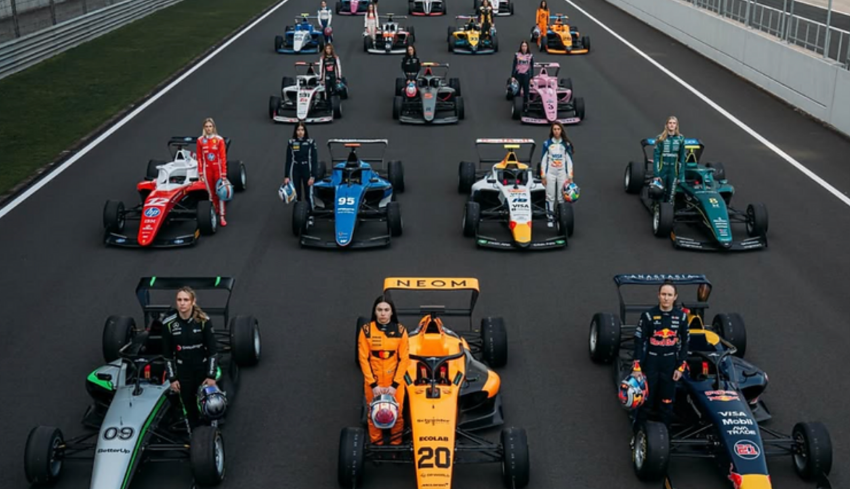
F1 Academy, an all-female driving series, is a great example of women working together to better this sport. The Academy features six teams and fifty-four female racers, with their upcoming race weekend occurring on May 22-24 in Montreal, Canada. This program provides seats that these talented racers would not have gotten otherwise, due to the sexist and classist nature of racing.
Kayla Wright, a sophomore journalism and sports media double major, discussed the unfortunate reality of media for women in motorsports.
“People don’t care in a way,” Wright said. “The media doesn’t push [women in racing] very much. No one really pays attention to [F1 Academy]. I have seen things from it, but it’s rarely ever posted [or] talked about.”
Though it does not get much media attention and is not discussed, women and young girls are watching, they are talking about it and they will not stop. Women are relentless and passionate, and eventually, everyone’s attitudes will change about women in motorsport because women will make it happen.
Greenemeier and Grisham express their role in helping to uplift the little girls with big dreams.
“We have made a lot of headway in the last few years,” Greenemeier said. “It’s great to see so many more little girls at the track. I love it when we see little girls come up to our car and be so excited. We love putting them in the car, and letting them see that it’s possible, that if they can dream it and they see it, they can go out there and they can do it. They just gotta put their mind to it.”
There needs to be a shift in how people treat this sport; it is a sport for everyone. All ages, all races and all genders. The best way to do that is to come together, hold each other up, encourage one another and the sport will only grow as it already has.
Women deserve to be a part of racing; they are strong, intelligent, passionate, talented and just as good as their male counterparts — if not better.