
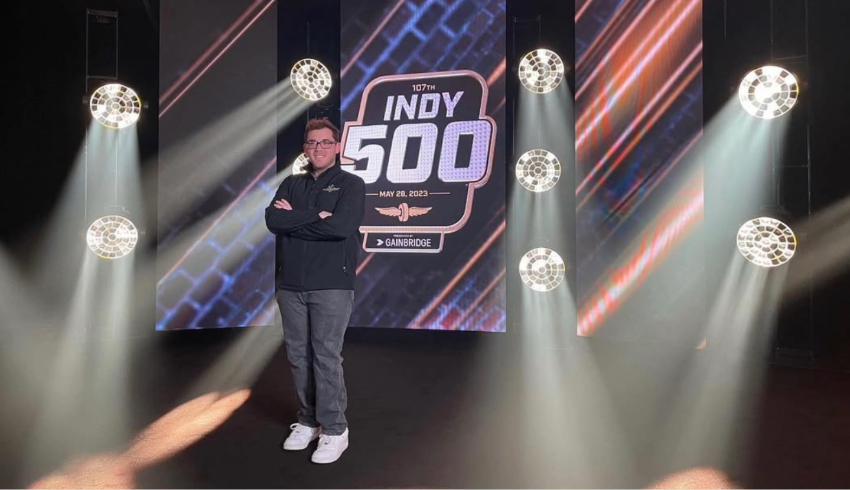
Members of the Butler community are achieving extraordinary things, both on and off campus. From first-years to alumni to administrators and back, each Bulldog has a story to tell. Read on to discover the next of our Bulldogs of Butler through a Q&A style interview.
The Indianapolis 500 is a massive draw for the city, attracting millions of viewers in person and on television every year. Zach Horrall has both past and ongoing ties to Butler — he graduated in 2019 with a bachelor’s degree in journalism, and is currently attending the university’s sports management program. Horrall also serves as an interim professor in graphic design. He has gone from a passionate fan of IndyCar racing to the director of marketing for the Indianapolis Motor Speedway.
The Butler Collegian spoke with Horrall to discuss how his time at the university has helped him turn his passion for the Indy 500 into a career.
THE BUTLER COLLEGIAN: How did you become interested in digital marketing?
ZACH HORRALL: I grew up in southern Indiana. I’m from Vincennes, and I grew up coming to the racetrack. I grew up [as] a big race fan, and always wanted to be involved in racing — at the end of the day, [I wanted to] be a part of the Indianapolis Motor Speedway. I came to Butler knowing that Indianapolis was a huge racing city, and if I wanted to work in racing, I needed to put myself in that community.
I thought for a long time that I wanted to be a motorsports journalist, but those specific beats are hard to come by these days. I saw the writing on the wall that [it] was probably going to be easier to just let myself be part of the industry, whatever that may be. I was working at IndyStar part-time, covering auto racing for them, and I got to know a lot of people at the track. That turned into a PR internship, which turned into a writing position … Once you prove you can do one thing, people want you to do another thing.
TBC: You went from writing for The Butler Collegian to The Indianapolis Star. How did your time with these organizations shape where you are today?
ZH: It was hugely impactful, [especially] having that mock newsroom set up. IndyStar hires a bunch of college kids to work the sports desk, take phone calls and cover high school sports … probably seven to 10 college kids a year. I became one of those kids and stayed on for a few years. The more I got immersed with that, the more I started covering high school sports. They had a change in their motorsports reporter, [and] the guy they hired was phenomenal but he didn’t have the background [in] racing that I had. I was able to step up and be a second voice for him. There’s so much racing that happens in the city, [so] when he wasn’t able to cover multiple things, I would step in and be that second reporter from a motorsports perspective.
TBC: What has your experience working for Indianapolis Motor Speedway been like?
ZH: It’s really awesome, and it’s really chaotic and crazy. No two days are the same, and especially right now, we’re just full speed ahead towards the Indy 500. What I grew up admiring about this place is that it means so much to the motorsports community, but it also means so much to the Indianapolis community. I just love that it’s the foundation for both communities in a sense.
Motorsports in the United States certainly would not be what it is today without the Indianapolis Motor Speedway, and I think one could argue the city of Indianapolis probably also would not be what it is today without the [racetrack], so there’s a lot of weight that it pulls. It means a lot to a lot of people, including myself, and I love being able to be a part of that.
It’s really powerful to me to be a part of that and help it mean something to the community. It’s the largest single day sporting event on the planet, and no other sporting event is going to [have] as many people [in one single place] as the Indy 500. The track literally turns into the second largest city in the state of Indiana on race day, and it means that much to people that they have to be here. It’s fun being able to be a fan and get people ready to celebrate a moment that means so much.
TBC: Is there anyone from Butler that had a major impact on your career path?
ZH: I was already at Butler when [professor] Lee [Farquhar] joined … He was really instrumental in getting the sports media program up and going and helping me get more of a non-writing perspective. [Professor] Nancy Whitmore was my advisor, and she was just a really great advocate for journalism students. [She was] so great at supporting students’ interests and what they wanted to do.
The other one that I would say played a big role was Michael Kaltenmark. He’s my boss now here at the track, but at the time he was the handler for Blue II, and he worked in marketing for the university. He also taught a sports marketing class, and I was able to work my way into that class even though I wasn’t a [strategic communication] major. It helped me broaden my perspective into the sports world. He had a lot of great guest speakers that would immerse us even further into the community. That was the class that really made me open my eyes and say, ‘Okay, I don’t, I don’t think being a motorsports journalist is for me. But working in racing, [there is definitely] something there.’
[Kaltenmark is] now our vice president of marketing … I talk to him every day. He’s hugely important in my professional career, and having met him at Butler and [grown] through his class, I definitely owe a lot to him.
TBC: Do you have any advice for students hoping to follow a similar path?
ZH: When you’re thinking about a career, you have to do what you love, and you have to follow what you’re passionate about. I think that is what’s made me good at my job. I care so deeply about the Indianapolis Motor Speedway, and I care so deeply about racing, and I care about social media and content and telling a story. Those things matter a lot to me. If you took me and gave me my exact position at the Pacers, I would probably be really bad at my job, because I don’t follow basketball and I don’t particularly care about it. I have no skin in the game, but [motorsports] matter to me.
That inherently builds a foundation of success. I’m already invested, I already have a personal stake in this, and therefore I want to be successful. You’ve got to follow your passion. That can be a really specific passion [like IndyCar racing], or that can be a wide passion [like photography]. There are so many different ways that passion can be described, and I think as long as you follow your passion, you’re going to be successful.